

Your great-grandfather left the Netherlands on a ship. Somewhere, a record names that ship. Dutch passenger lists can show you the vessel, the port, the date and the people who sailed beside him. This guide shows you how to find that voyage.
Why the ship record matters
A passenger list does more than prove a date. It often names the town your family came from. It lists age, job and travelling companions. Sometimes it names the relative waiting at the other end.
For many families, this list is the first document that links a new-world surname to a Dutch town. From that town, you can search the Dutch records in our step-by-step guide to tracing Dutch ancestry.
Gather four facts before you search
You do not need a full file. You need a few clues. Write down these four facts first:
- Name: the full name, plus every spelling you know. Add the maiden name of any wife.
- Birth year: a guess within five years is enough.
- Departure year: the year the family left, or the year they first appear abroad.
- Destination: the country and, if you know it, the town.
Partial facts still help. A destination alone tells you which archives to search first.
Step 1: Find the Dutch departure trace
Start in the Netherlands, not on the ship. Dutch town clerks often recorded who left. From about 1850, each municipality kept a population register, the bevolkingsregister. Clerks noted when a household moved away. They often noted where it went.
A line such as vertrokken naar Amerika gives you a departure year. Search for it on WieWasWie and on Open Archives. Open Archives pulls indexes from many Dutch archives into one search box.
Try the surname first. Then try the first name and the town. If the register names a destination, copy it down exactly. You will need it in step 2.
Step 2: Find the arrival record
Now cross the ocean. The right archive depends on where your family landed.
United States
US ports kept passenger arrival lists from 1820. The US National Archives explains these records on its passenger arrival page. Two New York gateways cover most Dutch arrivals.
- Castle Garden at the tip of Manhattan received arrivals from 1855 to 1890.
- Ellis Island opened in 1892 and closed in 1954. You can search it on the Ellis Island database, which the Statue of Liberty-Ellis Island Foundation runs.
Other ports matter too. Many Dutch families landed in Baltimore, Boston, Philadelphia or New Orleans. If New York fails, try those next.
Canada
After the Second World War, thousands of Dutch families sailed to Halifax. Pier 21 in Halifax received immigrants from 1928 to 1971. The Pier 21 website tells the story of those arrivals. Our Dutch-Canadian roots guide covers the post-war emigrant families in more depth.
Australia and New Zealand
Many Dutch families also chose Australia and New Zealand after 1945. The National Archives of Australia holds migration and arrival records. Search its name index first. Our Dutch-Australian heritage guide shows you how to plan the trip home.
The Cape and the East
Ancestors who sailed for the Cape or the East under the VOC left a different trail. Read our VOC trail guide and our Cape Dutch roots guide for those records.
Step 3: Name the ship and the port
When you find the voyage, note three things: the ship, the departure port and the date. Many Dutch emigrants left from Rotterdam. Others left from Amsterdam, Antwerp, Le Havre, Bremen or Hamburg. Do not assume Rotterdam.
The Holland America Line began in Rotterdam in 1873. It carried huge numbers of emigrants across the Atlantic. Its ships included the Volendam and the Veendam. The Stadsarchief Rotterdam, the city archive, holds Holland America Line records. Ask its staff what passenger material they hold for your years.
Once you know the ship, you can read about the voyage itself. Ask yourself what the crossing felt like. How long did it last? Who shared the cabin? That detail turns a name on a list into a story.
🇳🇱 Enjoying this? Netherlands lovers get stories like this every week. Subscribe free →
Spelling traps that hide your family
Most failed searches come down to spelling. Watch for these five traps.
- The Ellis Island myth. Inspectors did not change names at Ellis Island. Shipping clerks wrote the lists at the departure port, from Dutch papers. Most changes came later, when a family chose an easier spelling.
- Father’s names. Many families used a father’s name as a surname until 1811. That year, a new law fixed surnames for good. Read about it in our Napoleon naming law guide.
- Letter swaps. Try ij and y, Janssen and Jansen, Cornelis and Cornelius.
- Prefixes. Clerks filed Van der Meer under V, M or even D. Search under every letter.
- Wives’ names. Dutch records use a woman’s maiden name. A ship’s clerk may have written her husband’s name instead.
Ages and towns can be wrong too. Treat each list as a clue, not a verdict.
Three waves, three kinds of record
The 1840s and 1850s: groups and congregations
Entire congregations left together in the late 1840s. Many settled in places like Holland, Michigan and Pella, Iowa. Because groups travelled together, one family’s entry also shows their neighbours. Start with our guides to Holland, Michigan roots and Iowa Dutch ancestry. Then use our church and cemetery records guide to follow the family after landing.
The 1880s to the 1920s: work and the big liners
Later, families left in search of work. They sailed on large steamships and passed through Ellis Island. Our Dutch-American homecoming guide follows that route in both directions.
After 1945: planned emigration
After the war, many Dutch families chose a new start abroad. They headed for Canada, Australia, New Zealand and the United States. Families from Indonesia often arrived in the Netherlands first and moved on later. Our Dutch-Indonesian roots guide covers those records.
Visit the port your ancestors left
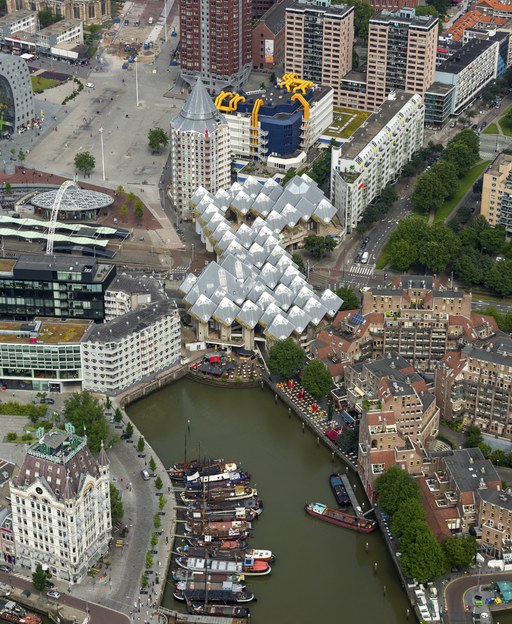
Rotterdam was the main gateway for Dutch emigrants. You can still walk the quays they used. Three stops make a good half-day.
- The old Holland America Line head office stands on the Wilhelmina Pier. It houses the Hotel New York.
- The SS Rotterdam, a 1959 Holland America liner, has its own website with visitor details.
- The Stadsarchief Rotterdam holds the city’s records. Check its website for research rooms and online indexes before you go.
Plan the rest of your trip with our guide to visiting your ancestral town. The Nationaal Archief in The Hague also holds national records worth a visit.
A simple research plan
- Write down names, spellings, birth year, departure year and destination.
- Search the Dutch population registers for a departure note.
- Search the arrival lists for the country you found.
- Note the ship, port and date. Check the ship’s other voyages.
- Test other spellings and other ports.
- Record every source. Save a copy of each page.
Frequently asked questions
Where can I search Dutch emigrant records online?
Open Archives and the Ellis Island database both let you run searches online. Each site sets its own access rules, so check them before you start.
Did all Dutch emigrants leave from Rotterdam?
No. Rotterdam was the busiest Dutch port, but many families left from Amsterdam, Antwerp, Le Havre, Bremen or Hamburg. Search under each port if the first one fails.
Why can’t I find my ancestor on a passenger list?
Spelling is the usual cause. Your ancestor may also have landed at a different port, or sailed in a different year. Try every spelling and every likely port.
Did Ellis Island change my family’s name?
No. Shipping clerks wrote the lists at the departure port. Families usually changed their own spelling after they settled.
What if my ancestor sailed before 1820?
US federal arrival lists start in 1820. Before that, you rely on Dutch records, church books and local histories. Our guide to New Netherland roots covers the earliest settlers.
Your ancestor once stood on a quay in Rotterdam. They carried what they could and trusted a ship to do the rest. A passenger list puts their name back on that quay. Your opa left Holland. Now it’s time to go back.
You Might Also Enjoy
- Dutch-American Church and Cemetery Records: A Practical Guide
- The Dutch-American Homecoming: From New York to Old Holland
- How to Plan a Dutch Heritage Trip to Your Ancestral Town
Join Netherlands Lovers
Every week, discover the Netherlands beyond the tourist trail — hidden villages, local recipes, cycling routes, and travel insights you won’t find in any guidebook.
Subscribe free — enter your email:
Already subscribed? Explore our archives for more hidden Dutch gems.
Free forever · One email per week · Unsubscribe anytime
Plan Your Netherlands Trip
Ready to visit the port your family left? Start with our Start Here page. It shows you how to plan a trip around your roots.
Tours & experiences you might love


Powered by Viator. Some links are affiliate links — we may earn a small commission at no extra cost to you.