

The VOC trail is the best way to follow a Dutch ancestor who sailed east. The Dutch East India Company, the VOC, sent nearly a million people to sea between 1602 and 1795. Fewer than four in ten came home. If your family name sits in a ship’s pay book, a handful of Dutch towns can show you where the story began.
This guide links the places, archives and museums that matter. You can walk the whole route in five days. You can also pick one stop and build a day around it.
What the VOC Was and Why Your Family May Be in Its Records
The States General granted the VOC its charter in 1602. The company ran six local branches, called chambers. They sat in Amsterdam, Zeeland, Delft, Rotterdam, Hoorn and Enkhuizen. Each chamber built ships, hired crews and kept its own books.
Not every sailor was Dutch. Many crew members came from German lands, Scandinavia and beyond. Soldiers, carpenters, surgeons and cooks all signed on. The company wrote down their names, ranks and home towns. Those pay records now give family historians a rare gift: a named ancestor with a place of origin.
Your ancestor may not have sailed at all. Clerks, shipwrights, ropemakers and merchants fed the company too. Their records sit in the same towns. Start with our step-by-step guide to tracing Dutch ancestry if you have not yet found a first name and date.
Stop 1: Hoorn, Where the Trail Begins
Hoorn sits on the old Zuiderzee coast in North Holland. It ran its own VOC chamber. The harbour still looks the part. Tall brick gables line the water, and historic sailing barges tie up below them.
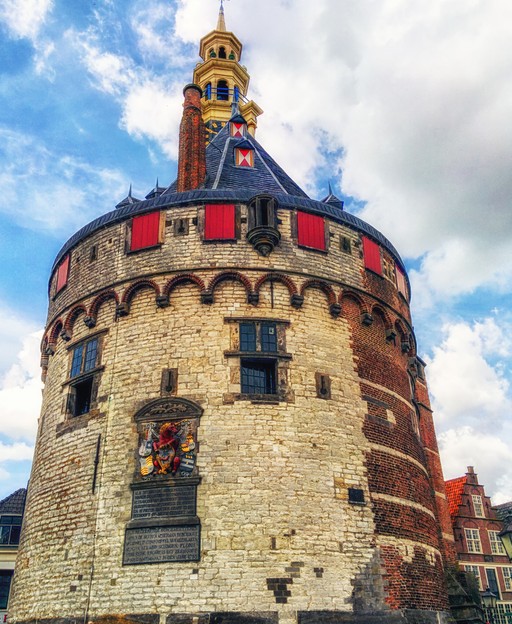
Look for the Hoofdtoren, the round harbour tower. Builders finished it in 1532 to guard the harbour. Walk on to the Roode Steen, the old market square. Jan Pieterszoon Coen, a Hoorn man who became a senior VOC official in Asia, has a statue there. Willem Schouten, another Hoorn sailor, gave Cape Horn its name in 1616. He named it after his home town.
The Westfries Museum holds a large VOC collection. Its main building has been under renovation, so check the museum website for the current location and opening times. Our guide to tracing your North Holland heritage lists the regional archives near Hoorn.
Stop 2: Enkhuizen and the Spice Warehouse
Enkhuizen lies a short train ride from Hoorn. It ran the smallest of the six chambers, but its harbour is just as photogenic. The Drommedaris tower, built in 1540, guards the entrance.
The Peperhuis here is a former VOC warehouse. A merchant built it in 1625. The company later used it to store spices, tea and textiles. It now forms part of the Zuiderzee Museum. Walk through it and picture the crates your ancestor may have loaded.
Enkhuizen is also a good place to slow down. Cafés line the harbour, and the old town rewards an unhurried walk.
🇳🇱 Enjoying this? Netherlands lovers get stories like this every week. Subscribe free →
Stop 3: Amsterdam, the Company’s Largest Chamber
Amsterdam’s chamber was the biggest of the six. The Scheepvaartmuseum, the National Maritime Museum, stands in the old naval storehouse on Kattenburg. Builders finished that storehouse in 1656. A full-size replica of the VOC ship Amsterdam floats outside. The real ship ran aground off the English coast in 1749, on her first voyage.
Go inside to see charts, ship models and objects from the voyages. Then walk to the Oost-Indisch Huis near Oude Hoogstraat. The company ran its Amsterdam business from this complex. Today the University of Amsterdam uses part of it.
The Amsterdam City Archives on Vijzelstraat hold notarial deeds, wills and baptism records. Many VOC families left traces there. Book a reading-room slot before you travel.
Stop 4: Zeeland, Middelburg and Vlissingen
Zeeland ran the second-largest chamber. Its office stood in Middelburg, and its ships often sailed from nearby Vlissingen. The province is quiet today. Your ancestors would have known it as a bustling gateway.
The Zeeuws Archief in Middelburg holds company papers and local church records. Its online index, Zeeuwen Gezocht, lets you search names from home. Many visitors spend a full day here. Our 7-day Dutch heritage itinerary shows how to fit Zeeland into a longer trip.
Stop 5: The Hague, Home of the VOC Archive
The National Archives in The Hague keep the main VOC archive. UNESCO added the VOC archives to its Memory of the World Register in 2003. Staff here also run the VOC Opvarenden index. It lists people who sailed on company ships between 1699 and 1794. You can search it for free on the National Archives website. Check the site for the current address of the database.
Search by surname first, then try spelling variants. Clerks spelled names as they heard them. A Van der Berg may appear as Vanderberg or Van den Berg.
How to Search the Records Before You Go
- Collect names and dates. Use family papers, ship lists and any later civil records.
- Check surname history. Dutch families only took fixed surnames in 1811. Read our guide to the Napoleonic naming law before you rule anyone out.
- Search the VOC Opvarenden index. Note the ship, rank and home town.
- Find the home town archive. Request baptism, marriage and burial records.
- Email the archive. Ask which records you can see in person.
Where the Voyage Ended: Descendants Around the World
Company ships carried people to the Cape, Batavia, Ceylon and beyond. Their descendants now live on four continents. The Cape settlement began in 1652. Read our guides to Cape Dutch roots and to tracing your Boer roots if your family came through South Africa.
Families from the Dutch East Indies also built new lives in the Netherlands. Our article on Dutch-Indonesian heritage covers that story. In Sri Lanka, the Dutch Burgher community still keeps its heritage alive.
A Five-Day VOC Trail Plan
- Day 1: Amsterdam. Visit the Scheepvaartmuseum and the Oost-Indisch Huis.
- Day 2: Amsterdam City Archives in the morning. Travel to Hoorn in the afternoon.
- Day 3: Hoorn and Enkhuizen. See the harbours, the Peperhuis and the Drommedaris.
- Day 4: Travel to Middelburg. Spend the day at the Zeeuws Archief.
- Day 5: The Hague. Search the National Archives, then relax by the sea at Scheveningen.
Read our advice on how to plan a heritage trip to your ancestral town for tips on booking archives and finding local guides.
Frequently Asked Questions
What does VOC stand for?
VOC stands for Vereenigde Oostindische Compagnie, or Dutch East India Company. The Dutch government chartered it in 1602. It traded in Asia for almost two centuries.
Can I search VOC crew records online?
Yes. The National Archives run a free VOC Opvarenden index. It covers voyages from 1699 to 1794. Search by name, then check the original pay ledgers for detail.
Which Dutch towns had a VOC chamber?
Six towns did: Amsterdam, Middelburg (Zeeland), Delft, Rotterdam, Hoorn and Enkhuizen. Amsterdam was the largest.
How much of the trail can I walk in one day?
You can see Hoorn and Enkhuizen in one day. A direct train links them. Amsterdam and The Hague each deserve a day of their own.
Do I need to read Dutch to use the archives?
No, but it helps. Many archive sites offer English pages. Staff often reply to emails in English. Old handwriting is harder than the language.
You Might Also Enjoy
- 7-Day Dutch Heritage Itinerary: Trace Your Roots Across the Netherlands
- Dutch-Australian Heritage Trip: How to Plan Your Homecoming
- The Dutch-American Homecoming: From New York to Old Holland
Join Netherlands Lovers
Every week, discover the Netherlands beyond the tourist trail — hidden villages, local recipes, cycling routes, and travel insights you won’t find in any guidebook.
Subscribe free — enter your email:
Already subscribed? Explore our archives for more hidden Dutch gems.
Love more? Join 64,000 Ireland lovers → · Join 43,000 Scotland lovers → · Join 30,000 Italy lovers →
Free forever · One email per week · Unsubscribe anytime
Plan Your Netherlands Trip
Ready to build your own route? Visit our Start Here page for planning tips, travel guides and heritage resources.
Tours & experiences you might love


Powered by Viator. Some links are affiliate links — we may earn a small commission at no extra cost to you.