

You have a Dutch surname. Your grandparents spoke Dutch at home. Or perhaps you simply feel an inexplicable pull towards the Netherlands — its flat horizons, its amber-lit canal houses, its centuries-deep sense of place. Whatever drew you here, this seven-day Dutch heritage journey will take you beyond the tourist trail and into the very heart of where your ancestors lived, loved, worked, and left their mark on the world.
This itinerary is built for the Dutch diaspora traveller: someone who wants to stand in an archive and hold a baptism record from 1742, walk the streets their great-grandmother walked, and eat stamppot in a café that has been open since the Golden Age. It weaves together ancestry research, historic towns, and the quiet pleasures of Dutch life into a journey that will stay with you long after you come home.
Before You Go: Essential Preparation
A heritage trip rewards those who prepare. Before you board your flight, spend a few evenings with our complete guide to tracing your Dutch ancestry — it will help you identify which provinces, towns, and archives matter most for your specific family story. Even if you only know one great-grandparent’s name and birthplace, that is enough to build this itinerary around.
Write down (or photograph) any family documents you have at home: old letters, church records, emigration papers. Bring copies. Dutch archivists are extraordinarily helpful, but they work most efficiently when you arrive with a name, a town, and a rough date range. Make a booking with the relevant regional archive (more on that below) before you leave home — waiting lists can be a week or more at busy institutions.
Day 1: Amsterdam — The Gateway and the Golden Age
You land at Schiphol, and the Netherlands immediately greets you with its characteristic efficiency: trains from the airport to Amsterdam Centraal run every ten minutes and take fifteen. Drop your bags at your hotel, then walk straight to the Stadsarchief Amsterdam (Amsterdam City Archive), a magnificent building on Vijzelstraat that holds the world’s largest municipal archive. Entry is free.
If your ancestors passed through Amsterdam — and a remarkable number of Dutch emigrants did, since ships departed from here for the Cape Colony, Batavia, New Amsterdam (now New York), and beyond — you can search digitised records on their computers or request physical documents from the reading room. The archive holds doopregisters (baptism records), marriage registers, and VOC (Dutch East India Company) employment records stretching back to the early 1600s.
In the afternoon, walk the Golden Age canal houses of the Grachtengordel. These are not mere tourist scenery. They are the physical record of Dutch commercial ambition — merchant families who traded across four continents and built their wealth in brick, stone, and stepped gables along the Herengracht. Look up at the hoisting beams jutting from the rooftops. Goods once swung up to those attic warehouses. Somebody’s ancestor loaded those ropes.
End the day with bitterballen and a glass of Dutch lager at a bruin café (traditional brown pub) — the Hoppe on Spui has been open since 1670. This is living history you can taste.
Day 2: Leiden — Birthplace of Ambition
Catch a forty-minute train south to Leiden, one of the most quietly extraordinary towns in Europe. Rembrandt van Rijn was born here in 1606. The Pilgrim Fathers sheltered here before sailing for America. Europe’s first tulip bulb flowered here in 1594. And the Regionaal Archief Leiden holds records for much of South Holland’s historic heartland.
Begin at the archive on Boisotkade. If your family came from the areas around Leiden, Leiderdorp, Zoeterwoude, or the surrounding polder villages, this is where you will find them. The staff are accustomed to assisting diaspora visitors and often speak excellent English. Give yourself two hours here — it rarely takes less.
Walk from the archive to the old city centre. Leiden’s canal network is smaller and less visited than Amsterdam’s, which makes it feel all the more authentic. The Pieterskerk, a vast Gothic church in the heart of the city, contains memorials to Leiden’s merchant families — some of the carved grave slabs date to the 1300s. The Pilgrim Fathers worshipped here before their Atlantic crossing.
Lunch at one of the canal-side restaurants on the Rapenburg, then visit the Rijksmuseum van Oudheden (National Museum of Antiquities) — not for the Egyptian temple inside (though that is genuinely spectacular) but for its collection of Roman artefacts from the Netherlands, which remind you that this land has been inhabited, contested, and loved for two millennia.
🇳🇱 Enjoying this? Netherlands lovers get stories like this every week. Subscribe free →
Day 3: Delft and The Hague — Court, Craft, and Quiet Graves
The train between Leiden, Delft, and The Hague runs every few minutes and costs almost nothing. Today you visit two cities that shaped the Netherlands — one royal, one artistic, both historically dense.
Start in Delft. The old town is a near-perfect preservation of seventeenth-century Dutch urban life: grachten (canals) lined with brick facades, a central market square dominated by two churches, and workshops where artisans still hand-paint the blue-and-white pottery that made Delft famous across the world. Johannes Vermeer was baptised in the Nieuwe Kerk on the Markt in 1632 and buried in the Oude Kerk nearby. William the Silent — the father of the Dutch nation — is entombed beneath a magnificent marble monument in the Nieuwe Kerk.
If your family had roots in Delft or the surrounding area, the Stadsarchief Delft is open to researchers on weekday mornings. Delft’s role as a centre of trade, pottery, and military organisation means its archives include records of craftsmen, soldiers, and merchants from across the Dutch Republic.
In the afternoon, take the five-minute train to The Hague. Visit the Binnenhof — the medieval parliament complex that has been the seat of Dutch government for seven centuries — and then walk to the Mauritshuis, a small and perfectly formed museum housing Vermeer’s Girl with a Pearl Earring and Rembrandt’s The Anatomy Lesson of Dr Nicolaes Tulp. Both paintings capture something essential about the Dutch Golden Age: its scientific curiosity, its wealth, its fascination with light.
If your family came from South Holland more broadly, the Haags Gemeentearchief (The Hague Municipal Archive) and the Nationaal Archief — the Dutch national archive, also in The Hague — are essential stops. The Nationaal Archief holds VOC records, military records, and notarial archives that cover the entire Dutch Republic. Book ahead.
Day 4: Utrecht — The Hidden Heart of the Netherlands
Utrecht sits at the geographic centre of the Netherlands, and it feels it. Unlike Amsterdam, which has always looked outward towards the sea, Utrecht looked inward — to the Church, to scholarship, to the slow commerce of the Rhine. Its medieval city centre, with canal-level wharves unique in the world, is one of the most underrated urban environments in Europe.
The Het Utrechts Archief is housed in a former church on Alexander Numankade and covers Utrecht province from the Middle Ages onwards. If your ancestors were farmers in the Utrechtse Heuvelrug (the gentle ridge of hills east of the city), craftsmen in Utrecht itself, or clergy in any of the province’s many monasteries and churches, their records likely live here. The archive has an exceptional online catalogue — search ahead of your visit at hetutrechtsarchief.nl.
After your archival session, walk to the Domtoren — the tower that once belonged to Utrecht’s medieval cathedral (the nave collapsed in a storm in 1674 and was never rebuilt, so the tower now stands alone). Climb it for a view across the flat Dutch landscape that stretches to the horizon in every direction: a landscape your ancestors navigated by church tower, windmill, and the glint of water.
End the day at one of the canal-level kelderrestaurants — restaurants built into the brick arches below street level, right at the water’s edge. Order erwtensoep (thick pea soup) if the weather is cool, or uitsmijter (eggs on bread with ham) if you want something lighter. Both are as Dutch as it gets.
Day 5: Kinderdijk and Dordrecht — Water, Power, and the Oldest City
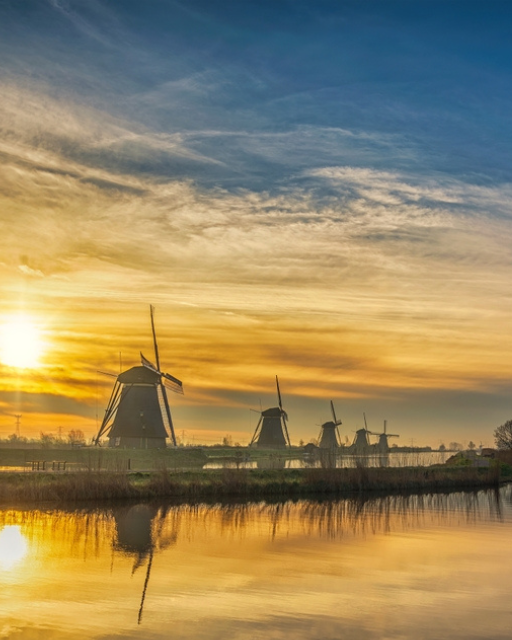
No heritage trip through the Netherlands is complete without a reckoning with water. The Dutch did not simply live beside water — they fought it, managed it, and ultimately remade their entire landscape through extraordinary feats of collective engineering. The nineteen windmills at Kinderdijk, a UNESCO World Heritage Site south-east of Rotterdam, are the most visible symbol of that achievement.
Take the waterbus from Rotterdam Erasmusbrug (the most scenic approach) or a bus from Ridderkerk. Walk the dyke paths between the mills. These were not decorative structures — they were industrial machinery, running continuously to pump water from the polders below sea level into the rivers above. Families of millers lived inside them, keeping them turning through night and storm. The miller’s houses are original; some contain the furniture and tools of families who worked these mills for generations.
In the afternoon, travel to Dordrecht — the oldest city in Holland, chartered in 1220. It was here that the Dutch states first declared independence from Spain in 1572. Its historic harbour is lined with seventeenth-century warehouses, and its archive, the Regionaal Archief Dordrecht, holds records that predate the Dutch Republic itself. If your family came from South Holland’s river towns — Dordrecht, Gorinchem, Sliedrecht — this is where their stories are kept.
Day 6: Your Ancestral Province — A Day for Deep Roots
By now you have a feel for how the Netherlands works: its compact geography (you can cross the country by train in under three hours), its extraordinary archive infrastructure, and its deep habit of recording everything. Today is the day you dedicate entirely to your own family’s specific geography.
We have detailed heritage guides for every Dutch province. If your roots lie in North Holland, head to Haarlem and the North Holland archive. If your family came from Drenthe, the Drenthe heritage guide will point you to the Drents Archief in Assen and the prehistoric landscapes your ancestors farmed. For Friesland — with its own language, its own traditions, and its extraordinary genealogical records — our Friesland roots guide covers the Tresoar archive in Leeuwarden, one of the best regional archives in Europe.
Whatever province you choose, follow this structure for your day:
- Morning: Two hours in the regional archive, working with a specific research goal (find a marriage record, identify a birth village, trace a migration).
- Mid-morning: Walk to the ancestral town or village, if it is reachable. Stand in the marketplace. Find the old church. Look for family names on gravestones.
- Afternoon: Visit the provincial museum for context — Dutch provincial museums are frequently excellent and rarely crowded.
- Evening: Write up everything you found. Take photographs of records. Send copies home to family members. This is the day they will thank you for.
Day 7: Amsterdam Again — The Rijksmuseum and a Final Goodbye
You return to Amsterdam for your final day with different eyes. A week ago, the city was beautiful but unfamiliar. Now you understand the history encoded in its architecture, the commercial ambition that built its canals, and the global reach of the culture that produced it.
Spend your morning in the Rijksmuseum. The great rooms of Golden Age painting — Rembrandt’s Night Watch, Vermeer’s The Milkmaid, the landscapes and seascapes and domestic interiors of the seventeenth century — are not simply art. They are documentary evidence of how Dutch people lived, dressed, worked, and saw themselves during the most extraordinary century in their nation’s history. After a week of archival research, the faces in these paintings may feel uncannily familiar.
If you have time before your flight, visit the Amsterdam Museum (currently in temporary locations while its main building is restored) for a clear-eyed account of Amsterdam’s history, including its role in the slave trade — a chapter of Dutch heritage that is increasingly and honestly addressed in Dutch cultural life.
Buy a jar of stroopwafels at the Albert Cuyp market. Buy a small piece of Delftware. Buy nothing if you prefer — you are taking home something more valuable: the knowledge of where you come from, and a living connection to the Netherlands that no souvenir shop can supply.
Practical Planning: The Essential Details
Getting Around
The Netherlands has the densest railway network in Europe. An OV-chipkaart (contactless public transport card) covers trains, trams, buses, and metro across the country. Load it with credit at any station machine. Intercity trains between major cities run at least every fifteen minutes; local trains to smaller towns run hourly. For Kinderdijk, the waterbus is worth the small extra cost for the scenic approach.
Booking Archives in Advance
Most Dutch regional archives require advance booking for reading room access, especially if you want to order physical documents from storage. Email in English — Dutch archivists routinely respond in English — at least two weeks before your visit. Include the surnames you are researching, the approximate date range, and the geographic area. They will often prepare relevant materials before you arrive.
Where to Stay
Amsterdam for Days 1, 2 (easy day-trip to Leiden), and 7. Utrecht for Days 4 and 5 (central location, day-trip distance from Kinderdijk and Dordrecht). A hotel in your ancestral province for Day 6, if it differs. The Dutch hotel market is competitive at the middle price point — book three to four months ahead for summer travel.
Dutch Heritage Websites to Bookmark
- Alle Groningers (allgroningers.nl) — free database for Groningen province
- Genlias / WieWasWie (wiewaswie.nl) — national civil registration database, free
- Militieregisters — nineteenth-century conscription records, searchable online
- CBG Centre for Family History (cbg.nl) — national genealogy centre, based in The Hague
- FamilySearch Netherlands — extensive free digitised records
Frequently Asked Questions
Do I need to speak Dutch to research in Dutch archives?
No. Dutch archivists at every level — municipal, regional, and national — are accustomed to assisting international diaspora visitors. Most speak fluent English. The older documents will be in Dutch (or earlier, in Latin), but archivist staff can help you interpret key passages, and many record types follow standard formats that are easy to navigate once you understand the structure. Online tutorials for reading Dutch genealogical records are widely available in English.
What is the best time of year for a Dutch heritage trip?
April and May offer tulip season alongside good weather and longer days. September is excellent — summer crowds have thinned, accommodation prices drop, and the light turns golden in the afternoons. July and August are peak tourist season; book everything well ahead and expect company at the major sites. Winter is quieter and the museums are uncrowded, though the weather is grey and cold and some smaller sites reduce their hours.
Can I visit all the places in this itinerary without a car?
Yes, entirely. The Netherlands is the easiest country in Europe to navigate by public transport. The only exception is reaching very small villages in rural provinces (Drenthe, Zeeland, parts of Friesland), where a bicycle or taxi may be more practical than waiting for an infrequent rural bus. Hiring a bicycle for a day in your ancestral province is, frankly, the most Dutch thing you can do — and it will give you a completely different relationship with the flat landscape your ancestors navigated for centuries.
What if I cannot identify my ancestral town before I go?
Do not let uncertainty stop you travelling. The CBG Centre for Family History in The Hague offers research consultations and can help you identify a starting point even if your family knowledge is limited to a surname and a rough date of emigration. Many Dutch surnames carry strong regional associations — a Van der Berg from seventeenth-century records is likely from a different province than a Van der Berg from the nineteenth — and the CBG’s professional genealogists can often narrow a search to two or three possible provinces in a single session. Read our step-by-step Dutch ancestry guide before you go for a full briefing on the process.
Is it possible to extend this itinerary to include Belgium?
Absolutely, and it is worth considering if your family came from the southern provinces of the historic Dutch Republic — what is now Belgium. Antwerp, Ghent, and Brussels are all within easy train reach from the Netherlands, and Belgian provincial archives hold records for families who lived under Dutch rule before Belgian independence in 1830. The city of Maastricht, at the southern tip of the Netherlands, is a particularly rich starting point for families with Limburg roots — it changed hands between the Dutch Republic, France, and various other powers repeatedly between the 1500s and the 1800s, and its archives reflect that complex history.
You Might Also Enjoy
- How to Trace Your Dutch Ancestry – Step-by-Step Guide (2026)
- Discover Your Utrecht Roots: Heritage, Diaspora, and Family History
- Discover Your Dutch-Canadian Roots: How to Trace Your Post-War Emigrant Ancestors
Join Netherlands Lovers
Every week, discover the Netherlands beyond the tourist trail — hidden villages, local recipes, cycling routes, and travel insights you won’t find in any guidebook.
Subscribe free — enter your email:
Already subscribed? Explore our archives for more hidden Dutch gems.
Love more? Join 64,000 Ireland lovers → · Join 43,000 Scotland lovers → · Join 30,000 Italy lovers →
Free forever · One email per week · Unsubscribe anytime
Tours & experiences you might love


Powered by Viator. Some links are affiliate links — we may earn a small commission at no extra cost to you.