
North Brabant kept its faith when the rest of the Netherlands did not. When the Protestant Dutch Republic took control in the late 1500s, this southern province stayed Catholic. It held onto its Flemish accent, its festive spirit, and its own way of life. If your family came from North Brabant, they came from the border country — a place that always sat between two worlds.
This guide will help you discover your North Brabant roots. You will learn where your ancestors lived, which archives hold their records, and how to connect with this underrated Dutch province on a personal level. Whether your family left in the 17th century with the VOC or in the 1950s for a new life in Australia, their story starts here.
The Province with Two Souls
North Brabant sits in the south of the Netherlands. It borders Belgium and shares the Maas river valley with the provinces to the north. For centuries, the land belonged to the Duchy of Brabant — a territory that stretched across what is now both southern Netherlands and northern Belgium.
When the Dutch Republic formed in 1579, North Brabant found itself caught between two worlds. The north was Protestant. North Brabant was Catholic. The new republic tolerated the province but treated it as a dependency, not a full member. For two hundred years, Catholics here could not hold public office or practise their faith openly.
That history shaped everything. North Brabant families built their lives around the local parish. The church was not just a place of worship — it was school, social network, and record keeper. Your ancestors carried that community spirit wherever they went.
The culture here is distinct from the Protestant north. North Brabant celebrates Carnaval with genuine enthusiasm. The food is richer, the pace is slower, and the people are warmer. Locals call it Burgundian — a word they use to describe good food, good company, and a relaxed outlook on life.
Where North Brabant Families Settled Around the World
North Brabant sent emigrants to every corner of the globe. The province’s Catholic identity often shaped where families chose to go.
South Africa
The Cape Colony drew Dutch settlers from all provinces. Many North Brabant families left during the 17th and 18th centuries as VOC employees or free burghers. Catholic families sometimes joined Reformed Church communities to fit in. Surnames like Van Den Berg, Vermeulen, and Martens appear in Afrikaner family trees today. If your Boer or Afrikaner heritage points to the Netherlands, read our guide to tracing your Boer roots in the Netherlands.
North America
Dutch Catholics emigrated in large numbers during the 19th century. Many settled in Michigan, Minnesota, Wisconsin, and Iowa. The Catholic Dutch communities in Detroit and Chicago are less famous than the Calvinist Dutch of Holland, Michigan — but they are no less real. If your family came from Tilburg or the Peel region, they may have joined a tight-knit Dutch Catholic parish in the American midwest.
Belgium
The border between North Brabant and Belgium is not ancient. For much of its history, the region was one duchy. Many families lived on both sides and moved freely. If your ancestors came from Breda or Bergen op Zoom, they likely had family across the border in Antwerp province too. Cross-border family research is very common in this part of Europe.
Indonesia and the VOC
North Brabant merchants and administrators sailed with the Dutch East India Company. Some settled permanently in Batavia — now Jakarta — and started families that became part of the Indo-Dutch community. Their descendants are now scattered across the Netherlands, Australia, and the United States. Read our full guide to the VOC Trail and following your Dutch ancestors to Asia.
Australia
Post-war Dutch migration brought many North Brabant families to New South Wales and Victoria. The 1950s saw a peak in emigration. Families from Tilburg and Eindhoven moved to Melbourne and Sydney for industrial work. Many stayed, and their grandchildren call Australia home today.
🇳🇱 Enjoying this? Netherlands lovers get stories like this every week. Subscribe free →
Key Surnames of North Brabant
North Brabant surnames often reflect the province’s Catholic faith and Flemish roots. Here are some of the most common names and what they mean.
- Van Den Berg — “from the hill.” One of the most widespread Dutch surnames. It appears across North Brabant and into Belgium.
- De Bruijn — “the brown one.” Common in Brabant and Zeeland. Often anglicised to De Bruyn or Brown.
- Vermeulen — “from the mill.” A Flemish-influenced surname found widely across the southern Netherlands.
- Peters / Pieters — the Catholic tradition of honouring saints made Peter a very popular first name. Many families took it as their surname.
- Van De Ven — “from the fen.” The Peel area of North Brabant was marshland. This surname marks families from the wetlands of eastern Brabant.
- Martens / Maarten — from the saint’s name Martin. A strong Catholic naming tradition across the province.
- Smulders — connected to forge work and smouldering. Common in the Eindhoven and Helmond areas.
If your surname appears in this list, you may well have Brabant blood. Learn how to trace your Dutch ancestry step by step using the key Dutch genealogy databases.
Your Ancestral Towns — North Brabant’s Heritage Heartland
‘s-Hertogenbosch (Den Bosch)
Den Bosch is the provincial capital and one of the oldest cities in the Netherlands. The Sint-Jan Cathedral dominates the skyline. It took two centuries to build and stands as one of the finest Gothic buildings in northern Europe. If your ancestors lived in Den Bosch, the cathedral registers may hold their baptisms and marriages back to the 1500s. Our guide covers everything to see and do in Den Bosch.
Breda
Breda was a stronghold of William of Orange and changed hands several times during the Dutch Revolt. The Great Church holds centuries of parish records. Breda attracted Flemish refugees and merchants during the 16th century. That is why so many Breda families have surnames that cross the Belgian border. Visit our Breda travel guide when you plan your heritage visit.
Tilburg
Tilburg grew as a textile town in the 18th and 19th centuries. Thousands of workers moved here from rural North Brabant to work in the wool mills. If your ancestors came from Tilburg in the 1800s, they were part of a working-class Catholic migration. Many Tilburg families later emigrated to industrial cities in the USA, Belgium, and Australia.
The Rural Peel and Meierij
The Peel is an ancient marshland that stretches across eastern North Brabant. Families here worked as peat cutters, farmers, and weavers for centuries. The villages of Gemert, Deurne, Helmond, and Veghel all have deep Catholic roots. Peel families often emigrated together — you may find a whole village community transplanted to a single town in Minnesota or Wisconsin.
Tracing Your North Brabant Ancestry — Archives and Records
BHIC — Brabants Historisch Informatie Centrum
The BHIC website (bhic.nl) is your first port of call. It holds civil records, church registers, notarial records, and population registers — most of them free to search and view online. The interface is in Dutch, but the site is straightforward to navigate with a browser translation tool.
Noord-Brabants Archief
The provincial archive in Den Bosch holds original documents for the province. Book a research visit in advance on their website. Bring your family data — names, approximate birth dates, and any village names you already know. Staff speak English and welcome diaspora visitors researching their roots.
WieWasWie.nl
The national Dutch genealogy portal holds civil registration records from 1811 for all provinces, including North Brabant. Births, marriages, and deaths are searchable by name. It is free to use and a good starting point if you know names and rough dates.
Catholic Church Records (Pre-1811)
Before the French introduced civil registration in 1811, churches kept their own records. In North Brabant, these are predominantly Catholic parish registers. The BHIC has digitised many of them. Some go back to the early 1600s. If your family was Catholic and from the rural south, these registers may be your most important source.
Our full guide explains how to plan a Dutch heritage trip to your ancestral town — including how to prepare for an archive visit and what to bring with you.
The Van Gogh Connection
Vincent van Gogh was born in Zundert, North Brabant, in 1853. His father was a Protestant pastor in this predominantly Catholic region — an outsider in his own province. That sense of not quite belonging shaped Vincent from his earliest years.
Van Gogh painted North Brabant obsessively during his early years. The Potato Eaters (1885) shows a family in Nuenen eating their evening meal in a dark, crowded room. They are tired from the fields. It is an honest painting — Van Gogh wanted to show who these people really were.
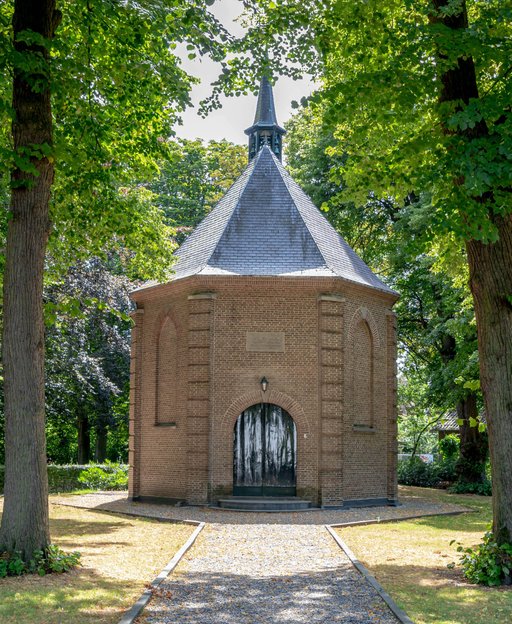
The image at the top of this article is the Van Gogh Kerkje — the small church in Nuenen where his father preached. Van Gogh painted it several times. It still stands today, surrounded by old trees. If your family came from the North Brabant countryside, they may have known this very landscape. A visit to Nuenen adds a powerful emotional layer to any heritage trip.
Practical Tips for Your Heritage Visit
North Brabant is easy to reach from Amsterdam. Den Bosch takes about one hour by direct train. From Den Bosch, you can reach Breda, Tilburg, and Eindhoven quickly by rail.
Start at the Noord-Brabants Archief. Book a research appointment in advance on their website. Bring your family data and any names you already know. Spend your first afternoon in the archive and your first morning walking the old town and the Sint-Jan Cathedral.
On day two, hire a bicycle. North Brabant has excellent cycle paths through the Peel landscape. Ride to Nuenen and see the Van Gogh church yourself. The countryside your ancestors worked still looks much the same.
For a full itinerary with specific archive addresses and suggested routes, read our guide to tracing your family in North Brabant. And if you want to cover several Dutch provinces in one trip, our 5-day Dutch heritage itinerary maps out a route across the whole country.
FAQ — Discovering Your North Brabant Roots
Where do I find genealogy records for North Brabant?
Start with the BHIC website (bhic.nl). It holds the majority of digitised records for North Brabant, including civil registration from 1811 and many Catholic church registers from before that date. The national WieWasWie.nl portal is also useful for civil records from 1811 onwards.
My family name appears in both Netherlands and Belgium. Why?
North Brabant borders the Belgian province of Flemish Brabant. Both areas formed part of the same Duchy of Brabant. Many families lived on both sides of what is now an international border. Cross-border family research is normal in this region. The BHIC holds records from the Dutch side; the Felixarchief in Antwerp covers the Belgian side.
How do I find Catholic church records from North Brabant before 1811?
The BHIC has digitised many Catholic parish registers. Search by parish name. If you know your ancestral village, look up the relevant parish. Record completeness varies — some parishes have registers from the early 1600s, others not until the 1700s. FamilySearch also holds many North Brabant Catholic records for free.
Is North Brabant very different from the rest of the Netherlands?
Yes, noticeably so. North Brabant is predominantly Catholic and has a distinct Burgundian character — festive, warm, and food-loving. The dialect carries Flemish influences. Locals celebrate Carnaval with great enthusiasm, unlike the Protestant north. If your family came from here, they likely carried a warmth and community spirit that set them apart from their northern Dutch neighbours.
You Might Also Enjoy
- Tracing Your Family in North Brabant: A Heritage Travel Plan — practical archive guide with itinerary
- The VOC Trail: Following Your Dutch Ancestors to the East — for families with Indonesian connections
- 5-Day Dutch Heritage Itinerary: Trace Your Roots Across the Netherlands — a full roots journey across multiple provinces
Plan Your Netherlands Trip
Ready to start planning? Our Start Here guide gives you all the practical information you need — from the best time to visit to how to get around the country by train and bicycle.
Join Netherlands Lovers
Every week, discover the Netherlands beyond the tourist trail — hidden villages, local recipes, cycling routes, and travel insights you won’t find in any guidebook.
Subscribe free — enter your email:
Already subscribed? Explore our archives for more hidden Dutch gems.
Love more? Join 64,000 Ireland lovers → · Join 43,000 Scotland lovers → · Join 30,000 Italy lovers →
Free forever · One email per week · Unsubscribe anytime
Tours & experiences you might love


Powered by Viator. Some links are affiliate links — we may earn a small commission at no extra cost to you.