

Tracing your family in South Holland means standing where Dutch history happened. This is the province that shaped the Dutch nation — and sent more emigrants abroad than almost anywhere else in the country. Rotterdam’s harbour launched thousands of ships carrying families to South Africa, America, and Australia. Leiden sheltered the Pilgrim Fathers before they crossed the Atlantic. Dordrecht, the oldest city in the Netherlands, holds church records stretching back centuries. If you have Dutch roots, there is a very good chance they lead here.
South Holland is not just the most populous province in the Netherlands. It is the emotional heart of the Dutch diaspora story. The surnames Van Leeuwen, De Jong, Van Dijk, Visser, and De Graaf that appear in Afrikaner family trees, Dutch-American communities, and Indonesian-Dutch households often trace back to the flat polders, canal towns, and port districts of this province. This guide will show you exactly where to look — and what to expect when you get there.
Why South Holland Matters for Dutch Diaspora
South Holland produced some of the largest waves of Dutch emigration in history. In the seventeenth century, the Dutch East India Company (VOC) recruited heavily from Rotterdam and the surrounding region. Sailors, merchants, and administrators left this port city for Batavia, the Cape of Good Hope, and trading posts across Asia. Many of those who settled at the Cape became the ancestors of today’s Afrikaner community.
In the nineteenth century, the great departures continued. Economic hardship in the 1840s and 1850s pushed thousands of South Holland families onto ships from Rotterdam bound for Michigan, Iowa, and the American Midwest. The names they carried — Van den Berg, Bakker, Mulder, Smits — became common in Dutch-American communities that still thrive today.
If your family came from the Boer tradition in South Africa, read our guide to tracing your Boer roots in the Netherlands. For Dutch-Americans with ancestry in the western provinces, the Dutch-American Homecoming guide gives a broader picture of where to start.
Start at the Archives: Where South Holland Records Are Kept
Before you travel, you need to know where the records are. South Holland’s historical documents are spread across several archives, each covering different towns, time periods, and record types.
Stadsarchief Rotterdam
The Rotterdam City Archives hold civil registration records from 1811 onwards for Rotterdam and surrounding municipalities. They also hold church records, notarial deeds, and VOC employment records from earlier centuries. The archive building is in the city centre and welcomes visitors. You do not need an appointment for the reading room.
Nationaal Archief (The Hague)
The National Archive in The Hague holds records of national importance. This is the place to search if your ancestor worked for the Dutch government, served in the military, sailed with the VOC, or emigrated officially. The archive has a free reading room and many collections are digitised at nationaalarchief.nl.
Haags Gemeentearchief
The Hague’s own municipal archive holds records for the city itself, including church records from the Reformed, Catholic, and other denominations. The Hague was a centre of administration and attracted families from across the Netherlands, so you may find ancestors here even if your family was not originally from the city.
WieWasWie.nl — The Online Starting Point
Before visiting any archive in person, search WieWasWie.nl. This free portal indexes civil registration records (births, marriages, deaths) from across the Netherlands, including South Holland, from 1811 to around 1950. Many searches can be completed from home before you even book your flight.
🇳🇱 Enjoying this? Netherlands lovers get stories like this every week. Subscribe free →
The Pilgrim Connection: Leiden and Delfshaven
South Holland holds one of the most remarkable stories in the history of Dutch emigration. Between 1609 and 1620, a group of English Separatists — the community that history calls the Pilgrim Fathers — lived in Leiden. They had come to the Netherlands seeking religious freedom and found it in this university city. For eleven years they worshipped, worked, and raised their children here.
In 1620, they decided to leave for the New World. They gathered at Delfshaven, a harbour district in Rotterdam, and boarded a ship called the Speedwell. The ship eventually failed and they transferred to the Mayflower in Southampton, but it was from Delfshaven that their journey truly began. A small plaque at the Pelgrimvaderskerk (Pilgrim Fathers Church) in Delfshaven marks the spot where they prayed before departure.
This story matters to Dutch heritage visitors for a specific reason. Many Dutch families sent children to English schools or intermarried with English Protestant communities in the Netherlands during the seventeenth century. If your family has both Dutch and early American heritage, there is a chance the Leiden and Delfshaven connection is part of your story.
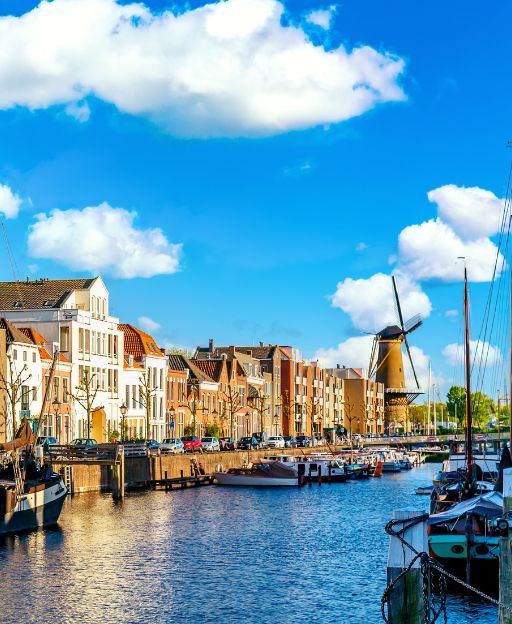
Delfshaven is a quiet, cobbled neighbourhood today — one of the few parts of Rotterdam that survived the 1940 bombing. Walking its canal streets feels like stepping back three centuries. The church is still there, and a small museum nearby tells the Pilgrim story in detail.
Rotterdam: The Port Your Ancestors Left From
For most South Holland emigrants, the journey started at Rotterdam’s port. In the age of steam — roughly 1870 to 1940 — Rotterdam was one of Europe’s great departure points for emigrants heading to the Americas, South Africa, and Australia.
The Holland America Line, founded in Rotterdam in 1873, carried hundreds of thousands of passengers across the Atlantic. If your ancestor left the Netherlands between 1873 and 1940, there is a reasonable chance they sailed on a Holland America ship from Rotterdam. The company’s original terminal building — the Hotel New York — still stands on the Wilhelminapier and has been converted into a restaurant and hotel. It is a deeply moving place to visit if your family passed through this port.
The Stadsarchief Rotterdam holds passenger records, port records, and emigration documents from this era. Their staff are experienced in helping diaspora visitors trace specific ancestors. Book a research consultation in advance through their website.
For a deeper understanding of the VOC records that can connect South Holland families to colonial-era emigration, see our guide to following the VOC trail. Many of the sailors and administrators who left for Asia in the seventeenth and eighteenth centuries came from this province.
Dordrecht: The Oldest Dutch City and Its Records
Dordrecht sits at the junction of three rivers about 20 kilometres south of Rotterdam. It received its city charter in 1220 — which makes it the oldest city in the Netherlands. For many families with deep South Holland roots, Dordrecht is where the earliest records begin.
The Regionaal Archief Dordrecht holds records for the city and surrounding area, including church registers going back to the sixteenth century in some cases. Dordrecht was also an important centre for the Dutch Reformed Church and holds baptism records from Reformed congregations that are some of the oldest surviving ecclesiastical documents in the province.
The surnames connected to Dordrecht tend to be older in form — Van Dordrecht itself, or occupational names like Timmerman (carpenter) and Visser (fisherman) that reflect the town’s medieval river economy. If your family has South Holland roots and the trail goes cold before 1811, Dordrecht’s pre-civil-registration church records are often the next step.
To understand the surnames your ancestors carried, read our guide to Dutch surnames of South Holland, which covers the most common family names and their regional origins in detail.
A Three-Day Heritage Itinerary for South Holland
If you are travelling to South Holland specifically to trace your family, three days gives you enough time to cover the main archives and significant heritage sites without rushing.
Day One: Rotterdam and Delfshaven
Arrive in Rotterdam and check into accommodation near the city centre. In the morning, visit Delfshaven. Walk the canal, step inside the Pelgrimvaderskerk, and spend time at the small Pilgrim heritage display. In the afternoon, visit Hotel New York on the Wilhelminapier. Have lunch there and absorb the history of the building — this is where your ancestors may have eaten their last Dutch meal before departing. In the late afternoon, visit the Stadsarchief Rotterdam to get your bearings. Pick up their research guide for genealogy visitors and make a note of what records you want to consult the following day.
Day Two: The Rotterdam City Archives
Spend the morning in the Stadsarchief Rotterdam reading room. Bring printed copies of what you have found on WieWasWie.nl as a starting point. Staff can direct you to specific registers, emigration records, or church collections. In the afternoon, travel to Dordrecht (20 minutes by train). Walk along the historic waterfront and visit the Regionaal Archief Dordrecht if you need to consult pre-1811 church records. Dordrecht’s medieval town centre is atmospheric and easy to explore on foot.
Day Three: Leiden and The Hague
Take the train to Leiden in the morning. This city requires a full morning to do justice to — the Pilgrim Fathers Museum on Beschuitsteeg is small but excellent, and the Leiden Municipal Archive on Boisotkade holds records for one of the most historically significant cities in the province. In the afternoon, travel to The Hague (20 minutes by train) and visit the Nationaal Archief. If your ancestor served in the Dutch military or worked in a government capacity, this is where those records live. The archive is close to the city centre and easy to reach.
Practical Tips for Your Heritage Visit
South Holland’s archives are professional and well-organised. Most have English-speaking staff. Here is what to know before you go.
- Book archive visits in advance. The Stadsarchief Rotterdam and Nationaal Archief both have reading rooms you can visit without appointments, but research consultations with staff need to be booked ahead.
- Bring ID. Most Dutch archives require a valid passport or ID card to register as a researcher.
- Know the key dates. Civil registration began in 1811 across the Netherlands. Church records before that date vary enormously in survival and accessibility depending on the municipality.
- Use WieWasWie.nl before you travel. A morning with this database at home can save you hours in the archive.
- Take photographs, not notes. Most archives allow photography of records for personal research use. A smartphone is your most useful research tool.
- Plan for travel between cities. South Holland is compact. Rotterdam, Delft, Leiden, The Hague, and Dordrecht are all within 45 minutes of each other by train.
For a broader overview of heritage travel planning across the Netherlands, our guide to planning a Dutch heritage trip covers every step from first research to finding the church where your ancestor was baptised. If you want to combine your South Holland visit with research in other provinces, see our 5-day Dutch heritage itinerary, which covers multiple provinces in one journey.
We have also published dedicated guides for neighbouring provinces: Tracing Your Family in North Holland covers Amsterdam and the northern coast. Tracing Your Family in Zeeland covers the delta province to the south, where many Afrikaner families have their deepest roots.
Frequently Asked Questions
Where are the birth, marriage, and death records for South Holland kept?
Civil registration records (from 1811 onwards) are held at the municipal archives of each gemeente in South Holland. The largest collections for Rotterdam are at the Stadsarchief Rotterdam. Many records are also searchable online via WieWasWie.nl. Pre-1811 church records vary by town and are often held at the same municipal archives or at the Nationaal Archief in The Hague.
How do I find an ancestor who emigrated through Rotterdam?
Start with the Stadsarchief Rotterdam, which holds emigration records and passenger lists. The Holland America Line records (for departures between 1873 and the mid-twentieth century) are particularly well preserved. Many are searchable via the Ellis Island Foundation database for arrivals in New York. The Nationaal Archief in The Hague also holds emigration records for earlier periods.
Can I visit the archives without speaking Dutch?
Yes. The Stadsarchief Rotterdam, Nationaal Archief, and Haags Gemeentearchief all have English-speaking staff. Most finding aids and online databases offer English interfaces. You will find that Dutch archivists are well used to helping diaspora visitors from the United States, South Africa, Australia, and Canada.
What is the connection between South Holland and Afrikaner heritage?
Many of the Dutch settlers who founded the Cape Colony in the seventeenth century came from South Holland. VOC employees were recruited heavily from Rotterdam and surrounding towns. Later waves of emigration in the eighteenth and nineteenth centuries also brought South Holland families to the Cape. Common Afrikaner surnames like De Villiers, Du Toit, and Van der Merwe have roots in various Dutch provinces, but Rotterdam and South Holland feature prominently in the VOC records. The Nationaal Archief holds the VOC employment registers that can help identify an ancestor’s Dutch hometown.
How do I find the church where my South Holland ancestor was baptised?
Identify the ancestor’s gemeente (municipality) from their civil registration record. Then contact the municipal archive for that gemeente — they will hold, or be able to direct you to, the church registers for that town. For the major cities, Rotterdam’s Stadsarchief and the Haags Gemeentearchief hold a wide range of Reformed, Catholic, and Mennonite church registers. The website Alle Dopen (alledopen.nl) indexes baptism records from several provinces, including South Holland, and is free to search.
You Might Also Enjoy
- Dutch Surnames of South Holland: Origins and Meanings — Discover what the most common South Holland family names reveal about your ancestors’ lives.
- The Dutch-American Homecoming: From New York to Old Holland — A guide for Dutch-Americans returning to the province where their journey began.
- The VOC Trail: Following Your Dutch Ancestors to the East — How to trace ancestors who sailed with the Dutch East India Company from Rotterdam.
Love the Netherlands? So Do We.
Join Netherlands Lovers
Every week, discover the Netherlands beyond the tourist trail — hidden villages, local recipes, cycling routes, and travel insights you won’t find in any guidebook.
Subscribe free — enter your email:
Already subscribed? Explore our archives for more hidden Dutch gems.
Love more? Join 64,000 Ireland lovers → · Join 43,000 Scotland lovers → · Join 30,000 Italy lovers →
Free forever · One email per week · Unsubscribe anytime
Plan Your Netherlands Trip — Ready to trace your roots in person? Start with our start here page for everything you need to plan a meaningful visit to the Netherlands.
Tours & experiences you might love


Powered by Viator. Some links are affiliate links — we may earn a small commission at no extra cost to you.