
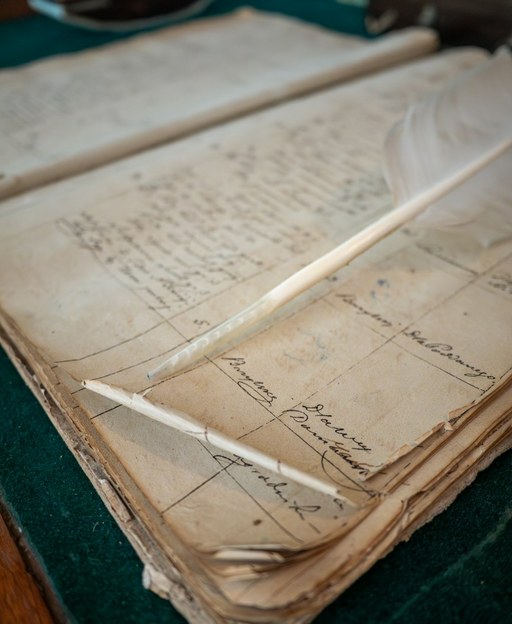
You found your ancestor’s record. You open the scan. It looks like a row of loops and hooks. Do not give up. Old Dutch handwriting looks hard at first, but you can learn to read it. This guide shows you how.
Why old Dutch records look so hard
Three things make old records tricky. First, the language is Dutch. Second, clerks wrote by hand, and every clerk wrote differently. Third, spelling changed over time.
Dutch spelling rules first appeared in 1804. Before that, a clerk spelled a name the way it sounded. Your ancestor may appear under three spellings in one decade. That is normal.
Some records add a fourth problem. Catholic church books often use Latin. Records from the French period, around 1811 to 1813, can use French. You will meet all three languages in a long search.
The good news is that most records follow a fixed pattern. Clerks used the same phrases again and again. Learn the pattern, and you can read far more than you expect.
Start with the easiest records
Pick your first record with care. Some records are far easier to read than others.
- Civil registers from 1811: these use a set layout. Later ones often use printed forms. Only the names, dates and places are handwritten.
- Population registers: these use columns. Each column has a heading, so you know what to expect.
- Church books before 1811: these are harder. The layout changes from parish to parish. Save them for later.
- Notary records: these are the hardest. They use long legal sentences. Try them last.
Our step-by-step guide to tracing Dutch ancestry explains where to find each record type. Start with a civil record for a person you already know. You will learn the letters faster when you know the answer.
Learn the key Dutch words
You do not need to speak Dutch. You need about thirty words. Copy this list and keep it beside you.
- geboren means born
- overleden means died
- gehuwd or getrouwd means married
- zoon van means son of
- dochter van means daughter of
- echtgenoot means husband
- echtgenote means wife
- weduwe means widow
- weduwnaar means widower
- getuigen means witnesses
- oud means aged
- beroep means occupation
- landbouwer means farmer
- arbeider means labourer
- schipper means skipper
- timmerman means carpenter
- koopman means merchant
The months look familiar: januari, februari, maart, april, mei, juni, juli, augustus, september, october, november, december. Older books sometimes write September to December as 7ber, 8ber, 9ber and 10ber. The numbers come from the old Latin count of months.
🇳🇱 Enjoying this? Netherlands lovers get stories like this every week. Subscribe free →
Understand Dutch name patterns
Names add their own puzzle. Before 1811, many families had no fixed surname. A child took a name from the father’s first name. Jan’s son Pieter became Pieter Jansz. The z stands for zoon, or son. A daughter became Maria Jansdr. The dr stands for dochter, or daughter.
Watch for these short forms too:
- wed. or wed. van means widow of
- alias means also known as
- v. or van often shows a place of origin
Napoleon’s rule changed all this. Our article on the 1811 surname law explains why your family may have two names in one record.
How to read a hard letter
Do not read a word at a glance. Read it one letter at a time. Follow these steps.
- Scan the whole page first. Look for words you know, such as geboren and the month names.
- Build an alphabet. Find a word you can read. Study how the clerk wrote each letter in it. Then look for the same shapes elsewhere.
- Compare with one name. Find a name you already know on the page. Use it as your key.
- Transcribe letter by letter. Write a question mark for any letter you cannot read. Never guess.
- Fill the gaps last. Use the fixed phrases to work out the missing words.
Some letters cause trouble in almost every record:
- The letters u, n, m and w blur into a row of strokes.
- The Dutch ij often looks like a y with two dots.
- Capital letters such as S, L and H can carry big loops.
- A double s can look like a tall, f-shaped letter followed by a short s.
Use your screen. Zoom in. Raise the contrast. Switch between colour and grey tones. A faded line often becomes clear when you change the contrast.
Free tools that help
You do not have to work alone. These tools save hours.
- Open Archives lets you search names across many Dutch archives. Many entries already include a typed version of the record.
- WieWasWie offers indexes of births, marriages and deaths. Check the typed entry against the scan.
- Delpher holds old Dutch newspapers and books. Its printed text helps you learn old spelling.
- The Nationaal Archief in The Hague explains how to use Dutch archives. Its site also comes in English.
- VeleHanden is a volunteer project. Volunteers type up old records. Joining one is a fun way to practise.
- Transkribus is software that tries to read handwriting for you. Treat its output as a first draft. Always check it by eye.
Dutch genealogy societies often run courses on old handwriting, called oud schrift. Many archives also run reading groups. Check their websites for current dates.
Records that need extra care
Some families need special skills. Each of these paths has its own habits.
- Church books: Reformed books use Dutch. Catholic books often use Latin. See our guide to Dutch-American church and cemetery records for how churches kept their books.
- Mennonite records: these often use their own forms. Our Mennonite roots guide lists where to look.
- Jewish records: these may include Hebrew and Portuguese. Read our Dutch Jewish ancestry guide before you start.
- VOC and colonial papers: clerks used long forms and many short marks. Our VOC trail guide and our Dutch-Indonesian roots guide point to the right archives.
- Ship lists: clerks wrote these fast. Our guide to Dutch emigrant ships and passenger lists shows what to expect.
A simple practise plan
- Pick one civil record for a person you know well.
- Read the typed index entry on Open Archives first.
- Open the scan. Find each word from the index on the page.
- Copy the clerk’s letters onto paper. Do this for ten minutes.
- Repeat with a second record from the same clerk.
- Move back in time, one generation at a time.
Stay with one clerk for a while. Each clerk has habits. Once you know the habits, the whole book opens up.
Frequently asked questions
Do I need to speak Dutch to read these records?
No. A short word list and the fixed phrases take you a long way. Free online translators help with the rest.
Why does my ancestor’s name have three spellings?
Clerks wrote what they heard. Spelling rules came late. Search every spelling you can think of.
Can software read old Dutch handwriting for me?
Some tools can try. They make mistakes on faded or messy pages. Always check the result against the scan.
Which Dutch records are easiest to read?
Civil registers from 1811 onward are the best start. Many use printed forms with a clear layout.
Where can I learn old Dutch script?
Start with volunteer projects, genealogy societies and archive reading rooms. Many offer courses, tips and practise pages.
Behind every loop and hook sits a person. A clerk wrote your great-grandmother’s name by candlelight or lamp light. Now you can read it. Your opa left Holland. Now it’s time to go back. When you read the record, plan the visit with our guide to your ancestral town trip.
You Might Also Enjoy
- You Found Your Dutch Ancestral Town: What to Do Next
- Dutch Emigrant Ships and Passenger Lists: Find Your Ancestor’s Voyage
- Why Your Dutch Ancestors Chose Their Surname in 1811
Join Netherlands Lovers
Every week, discover the Netherlands beyond the tourist trail — small villages, local recipes, cycling routes, and travel insights you won’t find in any guidebook.
Subscribe free — enter your email:
Already subscribed? Explore our archives for more Dutch trip ideas.
Free forever · One email per week · Unsubscribe anytime
Plan Your Netherlands Trip
Ready to see the archive where your family’s story sits? Start with our Start Here page. It shows you how to plan a trip around your roots.
Tours & experiences you might love


Powered by Viator. Some links are affiliate links — we may earn a small commission at no extra cost to you.