

Most visitors to the Netherlands go to Amsterdam. That is understandable. But the city that actually governs the country — and hosts some of the world’s most powerful legal institutions — lies 50 kilometres to the south. Most travellers never reach it.
The Hague is the seat of Dutch government, the home of the royal family, and the base of the International Court of Justice. It is also a calm and walkable city that rewards a full day of exploration. If you want to understand how the Netherlands actually works, this is where to come. Read our guide to exploring the Netherlands before you plan your visit.
Not the Capital — But the Most Important City
Amsterdam is the constitutional capital of the Netherlands. The King’s coronation takes place there. But the Dutch government, parliament, supreme court, and royal household all operate from The Hague. This arrangement began in the 16th century and has never changed.
The split shapes everything about the city. The Hague is formal, purposeful, and unhurried in a way that Amsterdam rarely manages. Its streets are wider. Its parks are larger. Its restaurants serve diplomats, civil servants, and long-term residents rather than tourists passing through.
Walk ten minutes from the central station and you reach the historic core — a compact cluster of medieval courtyards, Gothic towers, and 17th-century merchant buildings that survived both the wars and the urban planners.
The Binnenhof — Eight Centuries of Power in One Courtyard
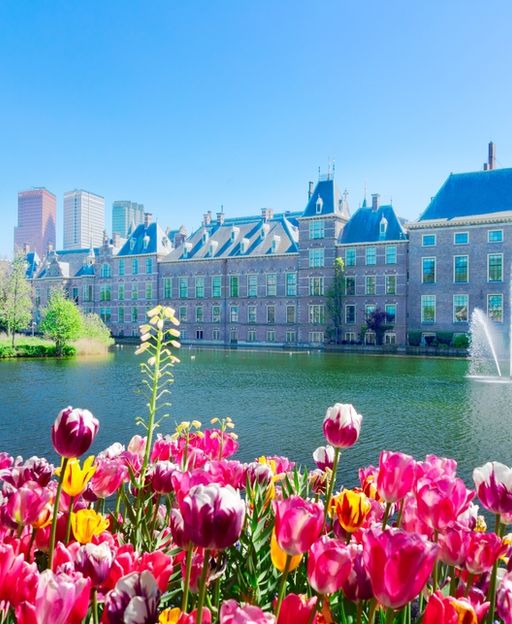
At the centre of the city stands the Binnenhof, a medieval castle complex that has housed Dutch politics for over 800 years. Walk through its arched gatehouse and you enter a cobbled inner courtyard surrounded by towers, Gothic stonework, and a long reflecting pool called the Hofvijver.
At the courtyard’s heart stands the Ridderzaal — the Hall of Knights. Builders completed it in 1280. Every year on Prinsjesdag, the third Tuesday of September, the Dutch monarch reads the annual throne speech from inside this hall. The tradition has continued, almost without interruption, for centuries.
The Binnenhof is free to enter and open to the public. Few places in Europe combine this depth of political history with such easy access. No barriers, no long queues, no entrance fee.
The Peace Palace — Where Nations Come to Be Judged
Enjoying this? Get stories like this every week from Love Netherlands — Subscribe free →
A ten-minute walk from the Binnenhof brings you to the Peace Palace. Builders completed it in 1913. American industrialist Andrew Carnegie provided much of the funding. Today it is home to the International Court of Justice — the principal judicial organ of the United Nations.
Nations, not individuals, bring their disputes here. When two countries go to war and eventually agree to negotiate, the arguments often end up in this building. Recent cases have involved Ukraine, Myanmar, and South Africa. The court’s decisions carry binding force under international law.
The building itself is extraordinary — red brick and neo-Gothic, with formal gardens and a tower that is visible from much of the surrounding neighbourhood. Guided tours run in summer. Even standing outside the gates, knowing what happens within, changes how you see the whole city.
Royal Palaces You Can Walk Past for Free
The Dutch royal family has deep roots in The Hague. Huis ten Bosch — a 17th-century palace on the city’s wooded eastern edge — is the working residence of King Willem-Alexander and Queen Máxima. The palace is closed to visitors. But the surrounding woodland is public, and cycling past the gates on a quiet morning makes the city feel very different from the tourist trail.
In the city centre, Paleis Noordeinde serves as the king’s official working palace. The changing of the guard takes place here several times a year. Watch it from the street — there is no ticket, no barrier, and no crowd management. Stand on the pavement and centuries of royal protocol unfold in front of you.
Art, Beaches, and the Best Indonesian Food in Europe
The Hague has a cultural life that surprises most first-time visitors. The Mauritshuis museum holds one of Europe’s finest Golden Age collections — including Vermeer’s Girl with a Pearl Earring. The collection is small enough to see properly in two hours without exhaustion.
The city is also home to the Netherlands’ best Indonesian restaurants. The Hague became the preferred destination for families returning from the Dutch East Indies after independence in 1945. Their culinary traditions stayed. The Statenkwartier neighbourhood is the place to begin.
When the sun appears, locals take the tram to Scheveningen, the city’s coastal district. The beach is wide, the North Sea reliably dramatic, and the boulevard busy with people eating herring and watching kite surfers. It is the Dutch seaside at its most everyday.
Frequently Asked Questions About Visiting The Hague
Is The Hague worth visiting as a day trip from Amsterdam?
Yes. The train runs every 15 minutes from Amsterdam Centraal and takes about 50 minutes. The Binnenhof, Peace Palace, and Mauritshuis are all within walking distance of The Hague Centraal station. A full day gives you time to see the main sights without rushing.
What is The Hague best known for internationally?
The Hague hosts the International Court of Justice, the International Criminal Court, Europol, and over 150 other international organisations. Only New York and Geneva host more. Many diplomats and legal scholars call it the world’s legal capital.
Why is Amsterdam the capital if the government sits in The Hague?
The Dutch government moved to The Hague in the 16th century under William of Orange. Amsterdam was named constitutional capital later — but the government never relocated there. The arrangement has remained unchanged ever since, and most Dutch people barely think about it.
What is the best time of year to visit The Hague?
April to June is ideal. The tulip fields outside the city are in bloom, daylight hours are long, and the city is active without summer crowds. September is also rewarding — Prinsjesdag brings ceremonial pageantry to the Binnenhof in the third week of the month.
The Hague does not perform for tourists. It governs a country, hosts the world’s courts, and gets on with the business of being a city — calmly, without fuss, in a way that feels deeply Dutch. That restraint, for many visitors, turns out to be exactly the point.
Love Netherlands — Free Every Week
Canal towns, hidden villages, Dutch stories. A free letter about the Netherlands — written slowly, delivered weekly.
Love more? Join 64,000 Ireland lovers → · Join 43,000 Scotland lovers → · Join 30,000 Italy lovers →
Free forever · One email per week · Unsubscribe anytime
Tours & experiences you might love


Powered by Viator. Some links are affiliate links — we may earn a small commission at no extra cost to you.