

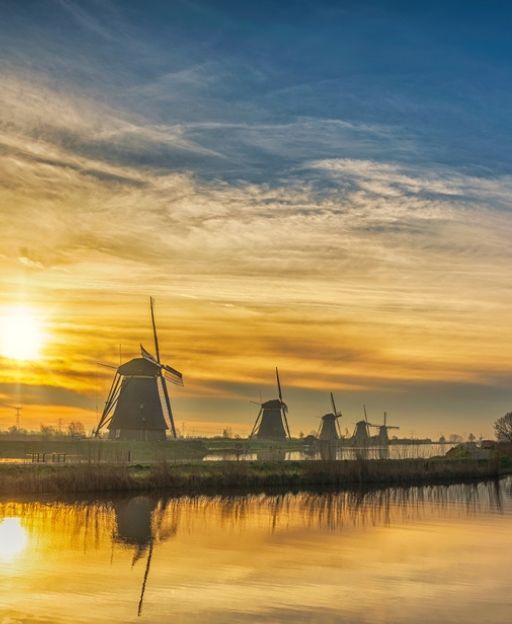
Most visitors arrive at Kinderdijk expecting a postcard. They find something stranger. These 19 windmills did not stand here to look beautiful. They stood here because, without them, the land beneath your feet would not exist.
A Land That Needed Saving
The Netherlands sits in a bowl. Much of the country lies below sea level — some areas more than seven metres down. Rivers Rhine and Maas drain into this bowl. Water pushes in from the coast. Without constant drainage, it all goes under.
The Dutch had one answer: pump it out. For centuries, the only pump powerful enough to do the job ran on wind.
The Alblasserwaard polder — the flat region around Kinderdijk — was sinking. Drainage canals helped, but the water kept returning. Engineers built 19 pumping windmills along two parallel waterways in the early 18th century. It was the largest windmill complex the Dutch had ever assembled in one place.
How 19 Mills Could Save a Region
Each mill drove a rotating screw or paddle wheel. This lifted water from the low-lying polder into the higher drainage canal. From there, it flowed out to the river.
The mills did not stand in a row by accident. They worked as a chain, passing water along in stages. One mill alone could not shift enough water. Together, they could drain an entire region.
If you want to understand how this battle shaped Dutch history, the Delta Works story shows what the Dutch built when they ran out of windmills.
The Families Who Lived Inside the Mills
Each windmill held a family. Millers, their wives, and their children lived in the base of the mill, in rooms barely wide enough to pass through. The miller worked whenever the wind blew — day or night, midwinter or midsummer.
These families formed a tight community. They married each other, baptised children in each other’s homes, and buried relatives on the same narrow strip of land. Many of their descendants still visit Kinderdijk today.
Their lives followed the wind, not the clock. When a storm rose in the night, the miller rose too. When the water crept higher, the sails turned faster. These mills were not just buildings — they were lifelines.
Enjoying this? Get stories like this every week from Love Netherlands — Subscribe free →
What Kinderdijk Looks Like Today
UNESCO declared Kinderdijk a World Heritage Site in 1997 — not for its beauty, but for what the mills represent. A civilisation that refused to accept the landscape it was given and built its own instead.
Electric pumping stations do the drainage work now. But the mills still turn. On certain weekdays in summer, all 19 operate together. It is one of the most quietly extraordinary sights in the country.
One mill opens as a museum. You walk into the base, climb through the tiny living quarters, and reach the working mechanism at the top. The rooms are so small that you understand immediately what it meant to live here. New to the Netherlands? The Start Here page has everything you need to plan a first visit.
When to Visit and What to Expect
Kinderdijk sits 15 kilometres from Rotterdam. A Waterbus ferry runs from Rotterdam Erasmusbrug in about 20 minutes. It costs around €4 each way and gives you the best possible arrival — by water, towards windmills, across a flat horizon.
Arrive before 9am in summer. By 10am, the paths fill with visitors and the light flattens. Early morning mist rises off the canals. Long shadows fall across the water. This is when Kinderdijk earns its reputation.
Hire a bicycle and cycle the full 4-kilometre circuit. Most visitors walk only part of the route and miss the far end, where the canal opens out and the crowds thin. Those last two windmills are the quietest — and often the most memorable. If Zaanse Schans is also on your list, that guide explains what makes the two sites feel completely different.
What is the best time of year to visit Kinderdijk?
April to October offers the best conditions. May and June bring clear skies and fewer crowds than July and August. Late April also brings tulip fields in full bloom nearby, making spring the most rewarding season for a day trip.
How do you get to Kinderdijk from Rotterdam?
Take the Waterbus ferry from Rotterdam Erasmusbrug — it runs regularly and takes about 20 minutes. The fare is around €4 each way. This is the most scenic and practical route, and you arrive directly at the windmills.
Can you go inside the windmills at Kinderdijk?
One windmill is open as a museum. You step through the miller’s living quarters, climb to the working mechanism, and see exactly how the mill lifted water uphill. Entry is included in the standard Kinderdijk visitor ticket.
Stand at Kinderdijk before the coaches arrive. The water reflects the sails. The mills creak and turn. You feel it — the quiet confidence of a place that fought the sea for three hundred years, and won.
Love Netherlands — Free Every Week
Canal towns, hidden villages, Dutch stories. A free letter about the Netherlands — written slowly, delivered weekly.
Love more? Join 64,000 Ireland lovers → · Join 43,000 Scotland lovers → · Join 30,000 Italy lovers →
Free forever · One email per week · Unsubscribe anytime
Frequently Asked Questions
What did the Kinderdijk windmills actually do?
These 19 windmills pumped water from the low-lying polder into higher drainage canals, preventing the region from flooding. The Netherlands sits partly below sea level, so without constant drainage, the land would have disappeared underwater.
How did the windmills work together to drain an entire region?
Each mill drove a rotating screw or paddle wheel to lift water, and they were positioned in a chain to pass water along in stages. One mill alone couldn't shift enough water, but the 19 working together could handle the region's drainage.
Who lived in the Kinderdijk windmills?
Miller families lived in small rooms at the base of each mill and formed a tight community that married each other and raised children across generations. The miller worked whenever the wind blew, day or night and in all seasons.
Why were 19 windmills needed instead of just building one larger mill?
The sinking polder required more water-moving capacity than any single mill could provide—the water kept returning no matter what. Built in the early 18th century, these 19 mills working as a chain could finally shift enough water to save the entire region.
Tours & experiences you might love


Powered by Viator. Some links are affiliate links — we may earn a small commission at no extra cost to you.