

During the Second World War, the Dutch resistance used a single word to unmask German spies: “Scheveningen.”
No German agent could pronounce it correctly. The soft G, the rolling syllables, the impossible rhythm — Dutch tongues learned it in childhood. Spies failed the test every time. Resistance members used it at checkpoints across occupied Netherlands to identify infiltrators.
Today, that same word belongs to one of Europe’s most underrated seaside destinations. Scheveningen sits just 5 kilometres from The Hague’s city centre — and most visitors to the Netherlands never find it.
The Fishing Village That Became a Resort
Scheveningen started as a simple North Sea fishing village. Local boats caught herring and cod. Fishwives sold the catch on the harbour. Life ran to tidal rhythms.
By the early 19th century, wealthier residents of The Hague had discovered what the fisherfolk always knew: the air here is different. Saltier. Cleaner. The late afternoon light is extraordinary.
Elegant hotels followed. Then a grand promenade. Then the structure that still defines the skyline — the Kurhaus.
The Kurhaus: Where Kings and Rock Stars Both Slept
Builders completed the Kurhaus hotel in 1885. It looks wildly out of place on a Dutch beach — a domed, Baroque palace of cream and terracotta, more suited to Vienna than the North Sea coast.
That contrast is exactly the point.
The ballroom inside has hosted Queen Wilhelmina, Winston Churchill, and the Rolling Stones — not in the same week, though some evenings came close. Walk in off the boulevard today. Order coffee in the grand café. The staff expect curious visitors. You won’t be the first person to wander in just to stare at the ceiling.
The Pier and Its Turbulent History
Scheveningen’s pier is famous. It is also famous for nearly disappearing several times.
The first pier opened in 1901, stretching out over the North Sea on iron stilts. Fire destroyed it in 1943. The German army then demolished most of Scheveningen’s seafront to build the Atlantic Wall — a line of concrete fortifications running from Norway to France.
After liberation, the Dutch rebuilt. A new pier rose in the 1960s. Then that pier closed, fell into neglect, and nearly came down entirely in the 2000s.
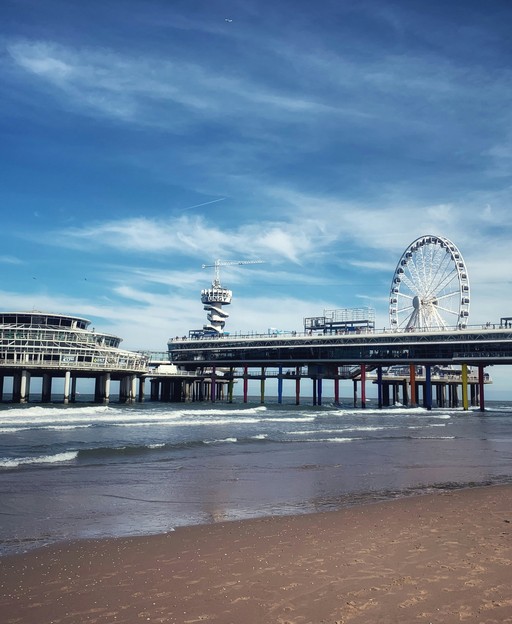
Today it stands again, stretching nearly 400 metres into the sea. At the end, a bungee jump tower and a Ferris wheel offer views stretching to the horizon on clear days. Walk out there on a grey autumn afternoon. Watch the swells roll in from the Atlantic. You’ll understand why the Dutch have always called themselves “people of the water.”
Enjoying this? Get stories like this every week from Love Netherlands — Subscribe free →
The Beach, the Boulevard, and What to Do There
Scheveningen’s beach runs 11 kilometres along the North Sea coast. The boulevard follows the full length, lined with restaurants, beach clubs, kite shops, and fish stalls.
What to Eat on the Waterfront
The harbour end of the boulevard has the best fish stalls. Order a portion of kibbeling — battered cod pieces eaten hot from a paper cone with garlic sauce. It costs a few euros. It tastes better in the sea breeze than in any restaurant.
Fresh haring (herring) appears everywhere in summer. The Dutch eat it the traditional way: raw fish, raw onion, pickles. Hold it by the tail and eat it whole if you want to fit in.
Beach clubs (called strandbars) range from simple wooden huts to full restaurant terraces with sun loungers. In summer, these fill fast. Arrive before midday on weekends.
Scheveningen in Winter
Most tourists arrive in July and August. The Dutch know a different Scheveningen.
Between October and March, the beach belongs to kite surfers. The wind picks up, the crowds thin, and the light turns the sea silver. The boulevard stays open. The Kurhaus stays warm. A walk along the waterfront on a stormy November day costs nothing and feels like one of the most Dutch things you can do.
Between September and November, look out for the sand sculpture festival. Artists carve enormous figures from compressed sand — entire historic scenes, wildlife, fantasy landscapes. The work takes weeks. Rain destroys it. That impermanence is part of the point.
Getting to Scheveningen
From Amsterdam, take the Intercity train to Den Haag Centraal. The journey takes about 50 minutes. From the station, tram lines 1 and 9 run directly to Scheveningen Haven and the boulevard in about 20 minutes.
No car needed. The tram is cheap, frequent, and drops you within walking distance of everything.
If you plan to explore more of the Dutch coast, the island of Texel offers a wilder, quieter North Sea experience — best reached from Den Helder by ferry. For more Dutch destinations worth your time, our start here page is a good place to begin. If you enjoy Dutch city day trips, Haarlem makes a natural companion to a Hague visit — just 35 minutes by train from Den Haag Centraal.
Frequently Asked Questions
When is the best time to visit Scheveningen?
June to August brings warm weather, open beach clubs, and the full summer resort experience. May and September are quieter but still pleasant. Winter visits offer dramatic North Sea scenery and a nearly empty boulevard that local residents prefer.
How do you get from Amsterdam to Scheveningen?
Take the Intercity train from Amsterdam Centraal to Den Haag Centraal (about 50 minutes), then tram 1 or 9 to the Scheveningen boulevard (20 minutes further). The full return journey costs under €20 per person.
What should you eat in Scheveningen?
Order kibbeling (battered cod) from a harbour fish stall — eaten hot from a paper cone with garlic sauce. Fresh haring with raw onion is the other essential Dutch beach food. Both cost a few euros and are entirely traditional.
Is Scheveningen worth a day trip from Amsterdam?
Yes. The full journey from Amsterdam Centraal takes about 70 minutes each way. A day gives you enough time to walk the boulevard, visit the Kurhaus, eat lunch on the waterfront, and see the pier. Start before midday in summer to beat the beach club queues.
Scheveningen offers nothing postcard-perfect. No painted wooden houses, no tulip fields. What it gives instead is harder to define — the feeling of a real Dutch city that has lived beside the sea for four centuries and built its whole identity around it.
Come on a grey morning before the season starts. Buy a kibbeling from the harbour. Watch the kite surfers fight the wind. You’ll find yourself planning to come back before you’ve even left.
Love Netherlands — Free Every Week
Canal towns, hidden villages, Dutch stories. A free letter about the Netherlands — written slowly, delivered weekly.
Love more? Join 64,000 Ireland lovers → · Join 43,000 Scotland lovers → · Join 30,000 Italy lovers →
Free forever · One email per week · Unsubscribe anytime
Tours & experiences you might love


Powered by Viator. Some links are affiliate links — we may earn a small commission at no extra cost to you.