

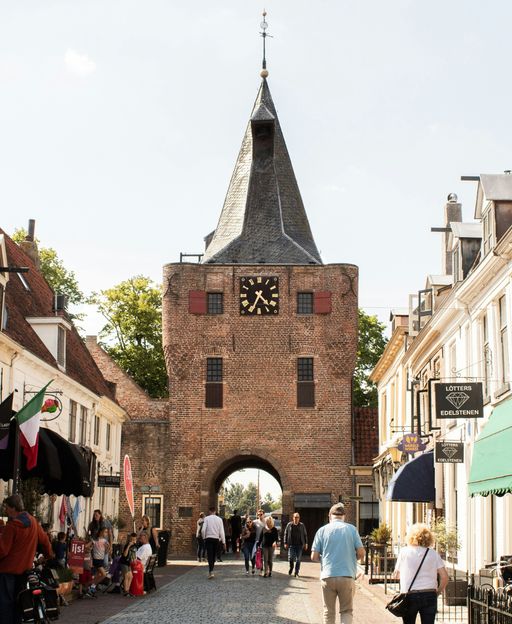
Stand at the Vischpoort on a quiet morning and you feel it immediately. The medieval gate rises above you, its brick unchanged since the 14th century. Behind it, the main street runs straight as a ruler — exactly as the town planners drew it in 1392.
Elburg doesn’t pretend to be old. It simply is.
Most visitors to the Netherlands never hear of it. That tends to change once they go.
A Town Built to a Plan — and Never Changed
In 1392, Count Arent van Egmont decided to move his entire town. The old village sat in a dangerous position — too exposed to flooding from the Zuiderzee. He picked a new site, hired a planner, and laid out a strict grid.
Two main streets cross at right angles. Smaller alleys run parallel between them. Every plot shares the same width. The town walls form a neat rectangle with the harbour on one side.
That grid still stands today. Walk any street in Elburg and you follow a path laid down over 600 years ago.
The Plan That Defied Six Centuries
Wars, floods, and centuries of change barely touched the layout. When you turn a corner in Elburg, you take the same turn that every market trader, fisherman, and schoolchild has taken since the 1400s.
You can see the whole grid from the top of the town walls. From up there, it looks like someone drew it yesterday with a ruler.
The Vischpoort: A Gate That Served Two Purposes
The Vischpoort — the Fish Gate — stands at the harbour end of the main street. Fishing boats once unloaded their catch below it before trading began inside the walls.
The gate doubled as a lighthouse. Sailors crossing the Zuiderzee used its tower to navigate towards Elburg after dark. Builders later added a clock. It still chimes on the hour today.
Walk through its arch and you step where those fishermen walked every morning for four centuries.
What Elburg Feels Like to Walk Around
From street level, Elburg is small and unhurried. The centre takes about 20 minutes to cross end to end. Cafés sit inside houses with low doorways. Bookshops occupy buildings that started as warehouses.
You can walk along the top of the town walls. The view shows the whole grid below — canals, streets, and rooftops in perfect order, just as they have always been.
This isn’t a museum town. People live and work here. The butcher has been on the main street for decades. Cyclists cut through the alleys without a second glance at the medieval surroundings.
That normalness is exactly what makes Elburg special. History here isn’t behind glass. It’s just the street outside.
Enjoying this? Get stories like this every week from Love Netherlands — Subscribe free →
Elburg and Naarden: Two Fortress Towns, Very Different Souls
Elburg is often compared to Naarden, the star-shaped fortress town in North Holland. Both survive as rare examples of planned medieval Dutch towns. But they feel completely different.
Naarden has dramatic star-shaped military ramparts and a formal, well-documented atmosphere. Elburg feels more like a living town that happens to be ancient. It’s quieter, far less visited, and rewards slow exploration over structured sightseeing.
If hidden Dutch towns appeal to you, our Start Here guide points you towards more of the Netherlands that most visitors never find.
How to Get to Elburg
Elburg sits on the eastern shore of the Veluwe Randmeren lakes, about 90 minutes from Amsterdam by car. Take the A28 towards Zwolle and follow signs for Elburg on the N309.
By public transport, trains run to Harderwijk — about 25 minutes from Elburg by bus or bicycle. The flat cycling paths through the Veluwe region make the bike approach popular in summer.
Park outside the town walls — the centre is pedestrian only. Most visitors spend two to three hours in Elburg before cycling out into the surrounding countryside.
What Is the Best Time to Visit Elburg?
Spring and summer (April to September) offer the best conditions for walking the walls and enjoying the harbour. Winter mornings bring a quiet that summer crowds never allow — the town looks particularly striking under frost.
How Long Should I Spend in Elburg?
Two to three hours covers the medieval centre, the Vischpoort, and a walk along the town walls. Pair it with a cycle ride along the Randmeren lakes for a comfortable half-day trip from Amsterdam or Utrecht.
Is Elburg Worth Visiting for First-Time Netherlands Travellers?
Yes — especially if you have already seen Amsterdam or Utrecht. Elburg offers something genuinely different: a complete medieval grid that later development never touched, and almost no tourist crowds.
Where Is Elburg in the Netherlands?
Elburg is in the province of Gelderland in the eastern Netherlands. It sits on the shore of the Veluwe Randmeren lakes, roughly 90 minutes by car from Amsterdam.
Some places survive because they got lucky. Elburg survived because it stayed exactly what it always was. The gate is still standing. The streets still follow the 1392 plan. You don’t need to imagine what it looked like centuries ago — you can just look at it.
Love Netherlands — Free Every Week
Canal towns, hidden villages, Dutch stories. A free letter about the Netherlands — written slowly, delivered weekly.
Love more? Join 64,000 Ireland lovers → · Join 43,000 Scotland lovers → · Join 30,000 Italy lovers →
Free forever · One email per week · Unsubscribe anytime
Frequently Asked Questions
Where is Elburg and why was it moved there in 1392?
Elburg was relocated to escape flooding from the Zuiderzee, when Count Arent van Egmont hired a planner to create a new town based on a precise grid layout with two main streets crossing at right angles.
How much of Elburg's original 1392 layout still exists?
The entire grid remains intact — every street follows the paths laid out over 600 years ago, with the medieval walls, harbor, and geometric street pattern surviving unchanged through wars and floods.
What is the Vischpoort and why does it still matter?
The Fish Gate at the harbor entrance served double duty as both a trading point for fishermen and a lighthouse for sailors navigating the Zuiderzee at night; it still stands with its original clock tower.
What can you actually see and do when you walk around Elburg?
You can walk the same medieval grid streets laid out centuries ago, climb the town walls to see the entire geometric pattern from above, and pass through the Vischpoort where fishermen have walked for four centuries.
Tours & experiences you might love


Powered by Viator. Some links are affiliate links — we may earn a small commission at no extra cost to you.