

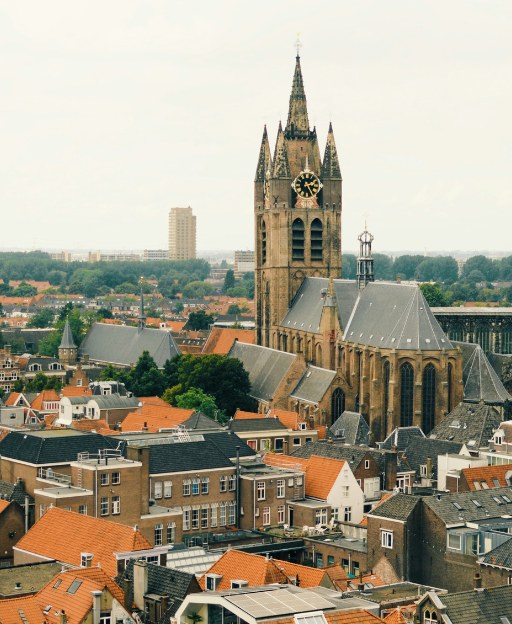
Johannes Vermeer painted this city 400 years ago. He captured its light, its canals, and its church towers rising above orange rooftops. Walk Delft’s streets today and you understand exactly what he saw.
The Painter Who Stayed
Vermeer was born in Delft in 1632. He died here in 1675. He rarely travelled in between. That choice — to remain in one small city his whole life — shaped everything he painted.
His light is Delft’s light. It enters rooms sideways through tall windows, reflects off canal water, and falls across simple objects with extraordinary precision. No other Dutch painter captured it in quite the same way.
His most famous cityscape, “View of Delft,” shows the city from across the Schie river. Vermeer painted it around 1660. The church towers still rise in the same way today. Most of the waterfront is unchanged. You can still stand on roughly the spot where he worked.
Delft’s Oude Kerk (Old Church) leans gently. The soft polder ground beneath it has shifted over centuries. Vermeer is buried inside, in an unmarked grave, surrounded by the city that made him.
A City That Time Passed Gently
Delft sits between The Hague and Rotterdam, around 15 minutes from each by train. Despite this, the historic centre feels entirely unhurried. Streets are narrow. Canals are tree-lined. Brick houses lean at angles that delight every photographer.
The Markt — Delft’s vast central square — anchors the city. The Nieuwe Kerk (New Church) stands at one end. Builders completed it in 1496. William of Orange, founder of the Dutch Republic, rests beneath its floor.
Across the square, the Renaissance city hall faces the church. Both buildings are still in use today. The Prinsenhof, a former palace on the edge of the old quarter, is where an assassin shot William of Orange in 1584. Two bullet holes remain visible in the wall. The Dutch mark history with precision, not drama.
The canal ring around the old centre is one of the most photographed in the Netherlands. The Koornmarkt and Voldersgracht are the prettiest stretches — quiet water, leaning houses, houseboats moored between stone bridges. In the evening, after the day-trippers leave, Delft is remarkably peaceful.
The Blue That Changed European Taste
In the early 1600s, Dutch East India Company ships brought Chinese porcelain home from Asia. The blue-and-white style captivated buyers across Europe. Dutch potters saw the opportunity and started imitating it.
Delft became the centre of this movement. Craftsmen here developed tin-glazed earthenware in the same blue-and-white palette. Delftware spread across Europe within decades. Kings and nobles collected it. The style defined Dutch decorative art for over a century.
One factory from that era survives: De Porceleyne Fles, now called Royal Delft. Craftsmen here have produced pottery continuously since 1653. Visitors can tour the workshop, watch painters at work, and see three centuries of pieces on display.
A single hand-painted plate takes hours to finish. Authentic Royal Delft pieces carry a crown-and-snake mark on the base. Much of the cheaper “Delft Blue” sold in tourist shops is mass-produced abroad — not made in the Netherlands at all.
Enjoying this? Get stories like this every week from Love Netherlands — Subscribe free →
What to See in Delft
Start at the Markt. Walk the square slowly — the church on one side, the city hall on the other, and the scale of the whole thing sinking in. Then head south along Choorstraat towards the canal ring.
The Vermeer Centrum Delft tells the full story of his technique and life. It holds no original paintings — his surviving works are in museums across the world, including one that surprises visitors in The Hague — but it reconstructs his methods with genuine insight. The camera obscura theory alone is worth an hour of your time.
Royal Delft is a short walk south on Rotterdamseweg. Book ahead if you want a tile-painting workshop — they sell out faster than you expect.
From Delft, Leiden is under 20 minutes by train — another preserved canal city with its own painter and its own unhurried pace. New to the Netherlands? Our start-here guide has everything you need before you go.
What is the best time to visit Delft?
Spring (April to June) is ideal. Tulip fields bloom nearby, and Delft is quieter than in summer. Autumn is beautiful too, with coloured leaves reflected in the canals. Avoid August weekends if crowds bother you.
How far is Delft from Amsterdam?
Delft is about 60 kilometres from Amsterdam — roughly one hour by direct train. Many travellers combine it with a stop in The Hague or Leiden on the same day.
Is Delft worth visiting for a full day?
Yes, easily. The Oude Kerk, Prinsenhof Museum, Royal Delft factory, and a canal walk fill a comfortable full day. Most visitors find they want more time than they planned for.
Where can I buy authentic Delft Blue pottery?
Royal Delft (De Porceleyne Fles) on Rotterdamseweg is the only original factory still operating. Their shop sells authenticated, hand-painted pieces with a trademarked mark on the base. Cheaper “Delft Blue” at tourist stalls is usually made outside the Netherlands.
Delft rewards slow travel. It is a city for walking, for stopping at bridges, for sitting in a canal-side café until the light shifts. Vermeer understood this completely. Four hundred years later, the city still does too.
Love Netherlands — Free Every Week
Canal towns, hidden villages, Dutch stories. A free letter about the Netherlands — written slowly, delivered weekly.
Love more? Join 64,000 Ireland lovers → · Join 43,000 Scotland lovers → · Join 30,000 Italy lovers →
Free forever · One email per week · Unsubscribe anytime
Frequently Asked Questions
How do I get to Delft?
Delft is located between The Hague and Rotterdam, roughly 15 minutes from each by train.
Where did Vermeer paint "View of Delft"?
Vermeer painted it from across the Schie River around 1660, and you can still stand roughly on that same spot today—the waterfront has changed very little.
Does Delft still look like Vermeer painted it?
The city has changed surprisingly little in 400 years. Church towers still rise above orange rooftops, canals are tree-lined, and the light falls across the city much as Vermeer captured it.
Where is Vermeer buried?
Vermeer is buried in an unmarked grave inside the Oude Kerk (Old Church) at the center of Delft. The church itself leans gently from centuries of ground settlement.
Tours & experiences you might love


Powered by Viator. Some links are affiliate links — we may earn a small commission at no extra cost to you.