
Every winter, the same question runs through the Netherlands. Are the canals freezing? Could this be the year?
Since 4 February 1997, the answer has always been no. But Dutch people keep asking anyway — because nothing in this country quite matches the madness, the beauty, and the frozen glory of the Elfstedentocht.
What Is the Elfstedentocht?
The Elfstedentocht is a 200-kilometre ice skating race through eleven cities in the Dutch province of Friesland. Participants start and end in Leeuwarden, the Frisian capital. The route winds through Sneek, IJlst, Sloten, Stavoren, Hindeloopen, Workum, Bolsward, Harlingen, Franeker, and Dokkum.
The name means simply: Eleven Cities Tour.
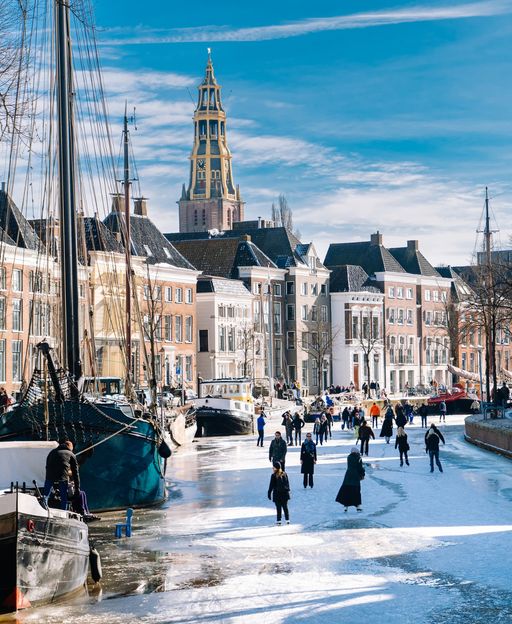
Up to 16,000 people skate the full route. Hundreds of thousands line the banks to watch. Millions follow on television. For one day, the Netherlands stops being a busy modern country and becomes something older — a nation on blades, crossing frozen water together.
The 15-Centimetre Rule
The race cannot happen unless the ice reaches at least 15 centimetres thick across the entire 200-kilometre route. That sounds simple. It is not.
Frisian winters have grown milder over the decades. The canals freeze less reliably than they once did. The Elfstedentocht Association — which has organised the race since 1909 — will not announce unless every single stretch of water meets the standard.
That decision rests with one phone call. When the Association chairman confirms the race is on, Dutch television breaks into live coverage. Government ministers clear their schedules. And across the Netherlands, 16,000 registered skaters reach for their blades.
The Night Before the Race
Most participants skate through the night and into the following day.
The race starts in the early hours — around four or five in the morning — to give skaters as much daylight as possible. The temperature always sits below freezing. Snow is common. The canals creak and groan underfoot on the darker stretches.
Locals line the banks with flasks of hot chocolate and bowls of erwtensoep — Dutch split-pea soup, thick and warming. Volunteers hand it out at every stop. The smell of cold air and hot soup is, for those who were there in 1997, completely inseparable from the memory of the day.
Enjoying this? Get stories like this every week from Love Netherlands — Subscribe free →
A Stamp at Every City
Every participant carries a checkpoint card. At each of the eleven cities, they collect an official stamp. Without stamps from all eleven checkpoints, the finish does not count.
Skaters who complete the full route receive a small cross — the Elfstedenkruis — and their name is listed in the official record for ever. The 1997 list holds around 12,000 names. Every one of those people counts it among the proudest moments of their life.
The 1997 winner was Henk Angenent, a market gardener from the western Netherlands. He crossed the line in six hours and forty-nine minutes. The last finishers arrived well after midnight.
The Frisian Soul of the Race
The Elfstedentocht is not really a Dutch event. It is a Frisian one.
Friesland has its own language, its own calendar, and its own way of measuring what matters. You can read more about that in our piece on the Dutch province where locals don’t feel Dutch. The Elfstedentocht is the purest expression of everything Friesland holds dear: endurance, winter, community, and the belief that cold weather is something to lean into, not hide from.
Frisian children grow up hearing stories of the race from grandparents. Some families have three generations who completed it. In Frisian households, the question “Were you there in ’97?” carries a weight that outsiders rarely understand.
Will It Ever Happen Again?
Climate change has made the frozen-canal winters far rarer. Weather enthusiasts now track a set of conditions known informally as the Elfstedentocht index — the precise combination of sustained frost and calm wind needed to freeze 200 kilometres of Frisian water.
The Dutch response is not grief. It is voorpret — the particular joy of anticipation before something wonderful happens. Every cold snap brings fresh optimism. Every forecast of minus five triggers a wave of social media posts, half hopeful and half joking.
The Dutch ate tulip bulbs to survive one winter. They built an entire nation from water they reclaimed from the sea. That story of Dutch winter endurance runs deep in this culture — and the Elfstedentocht is simply its most joyful expression.
Frequently Asked Questions
What is the Elfstedentocht?
The Elfstedentocht is a 200-kilometre ice skating race and tour through eleven cities in Friesland, the Netherlands. It has been organised by the Elfstedentocht Association since 1909 and only takes place when all canals along the route freeze to at least 15 centimetres thick.
When did the last Elfstedentocht take place?
The most recent Elfstedentocht ran on 4 February 1997. Henk Angenent won the race. Around 12,000 people completed the full route and received their official Elfstedenkruis, the commemorative cross given to finishers.
Can tourists participate in the Elfstedentocht?
Participation requires advance registration with the Elfstedentocht Association. International visitors can register, but places are limited and fill quickly. Spectators are welcome along the entire route, particularly in the eleven cities where the atmosphere is extraordinary.
How do I find out if the Elfstedentocht is happening?
The Association announces the race with very short notice — often just 24 to 48 hours ahead. Dutch news outlets and the official Elfstedentocht website carry the announcement immediately. It is one of the most-followed news events in the entire country.
New to the Netherlands? Our Start Here guide is the best place to begin exploring everything this country has to offer.
Those 12,000 skaters from 1997 are in their forties and fifties now. Every winter, they still glance at the forecast. The Netherlands has not forgotten what it feels like when the water turns to glass — and a whole country, for one impossible day, finds its oldest self again.
Love Netherlands — Free Every Week
Canal towns, hidden villages, Dutch stories. A free letter about the Netherlands — written slowly, delivered weekly.
Love more? Join 64,000 Ireland lovers → · Join 43,000 Scotland lovers → · Join 30,000 Italy lovers →
Free forever · One email per week · Unsubscribe anytime
Tours & experiences you might love


Powered by Viator. Some links are affiliate links — we may earn a small commission at no extra cost to you.