

Many Dutch families own a framed crest. It hangs in a hall or sits on a mug from a souvenir shop. The label often reads “Van der Berg family crest”. Is it real? Usually not. A true Dutch family crest, or familiewapen, belongs to one family line. It does not belong to everyone who shares a surname. This guide shows you how to tell the difference and where to find real evidence.
🇳🇱 Tracing your Dutch roots? Get one heritage story a week. Subscribe free →
What a Dutch coat of arms really is
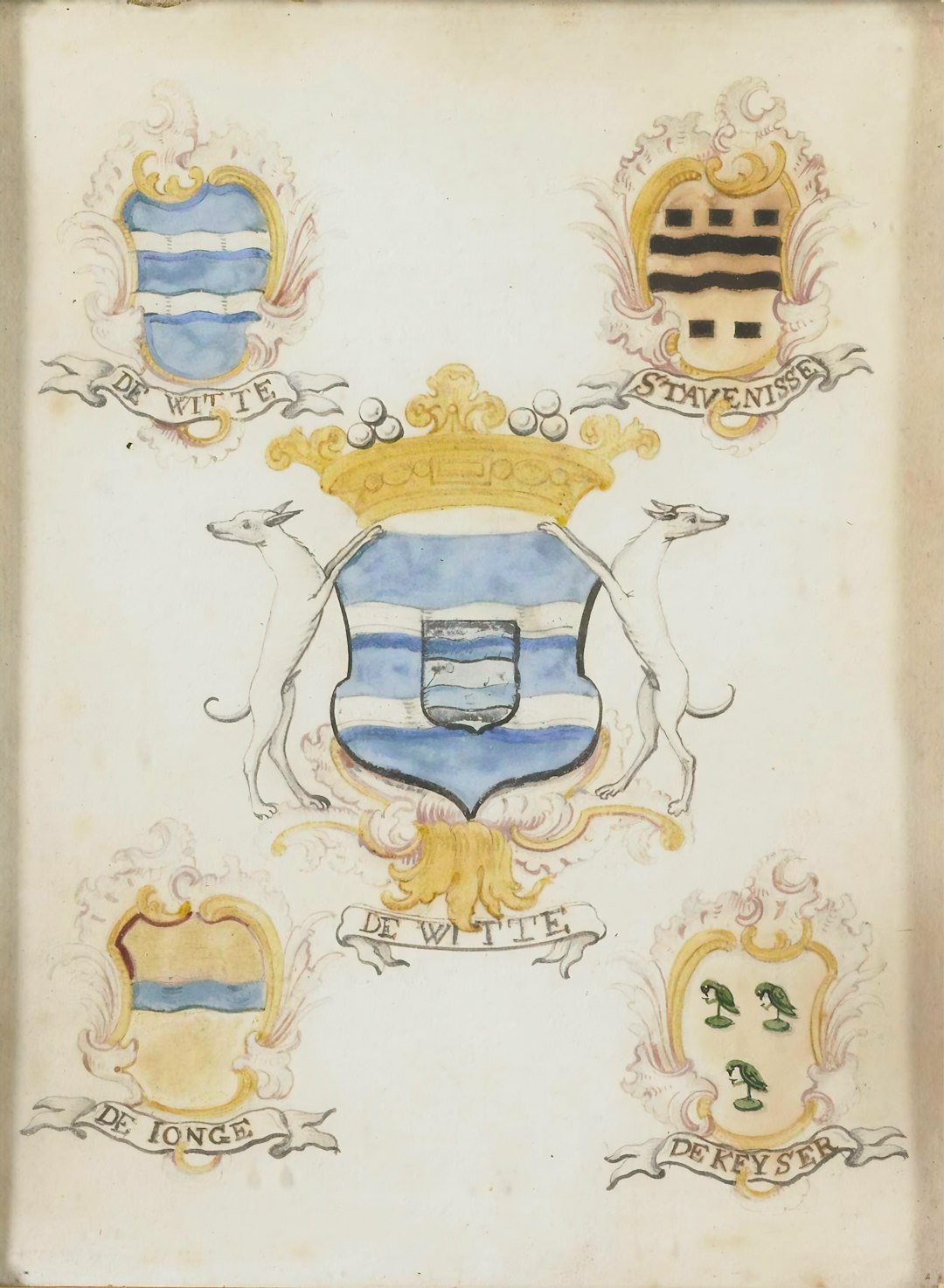
A coat of arms is a design on a shield. It marks a person, a family or a place. In Dutch, it is a wapen. Dutch families used arms from the Middle Ages onwards. Nobles used them. So did merchants, town officials and many ordinary burghers. Historians often call these burgerwapens, or civic arms.
A few Dutch words help when you read old books and archive notes:
- Wapen: the whole coat of arms.
- Schild: the shield.
- Helmteken: the crest that sits on top of the helmet.
- Wapenspreuk: the motto.
English speakers say “crest” for the whole design. Heraldry experts use the word only for the part above the helmet. You will see both uses in shops and archives.
Does every Dutch family have arms?
No. Most Dutch families have never had arms. Arms belong to a family line, not to a surname. Many people named De Vries or Jansen share a name but no common ancestor. So they share no arms either.
Many families used arms long before they had fixed surnames. Civil registration from 1811 then fixed surnames for most Dutch families. A name on a birth record is a good start. It is not proof of noble blood or of a shield.
Your first job is to prove your own line. Build the tree, name each ancestor, and note the town and date. Our guide to what to do once you find your ancestral town shows how to turn a name into a place.
🇳🇱 Enjoying this? Netherlands lovers get stories like this every week. Subscribe free →
Who may use a Dutch coat of arms?
Noble arms belong to the noble family. The Hoge Raad van Adel in The Hague advises on nobility and heraldry. Private families have long adopted arms of their own. In general, you should not copy arms that already belong to another family. Ask the council which rules apply to you before you commission a design.
How to spot a fake Dutch family crest
Some sellers offer “your family crest” for any surname. They ask for your name and nothing else. Watch for these warning signs:
- The seller needs only your surname.
- The same design appears for many unrelated families.
- There is no source, no archive reference and no date.
- The text claims that everyone with the name descends from a knight.
- The label never names a place or a family line.
A real record names a person, a place and a date. If a crest has none of these, treat it as decoration. A print can still look lovely on your wall. Just do not call it your family history.
Where to find real evidence
Real arms leave traces. Look in these places:
- Seals (zegels): many old documents carry a wax seal that shows arms.
- Gravestones (grafzerken): old church floors often hold carved stones with shields.
- Hatchments (rouwborden): some churches hold painted mourning boards with a family’s arms. Our church and cemetery records guide explains how to find the right church.
- Gable stones (gevelstenen): these carved plaques on house fronts show a sign, a trade or a name. They sometimes show a family emblem. Treat them as a clue, not proof.
- Reference books: Nederland’s Adelsboek covers noble families. Nederland’s Patriciaat covers non-noble families of standing. Both list arms where known.
- Rietstap’s Armorial général: a 19th-century reference that lists arms from many countries.
The Nationaal Archief and the CBG Centrum voor Familiegeschiedenis hold collections that can help. Both sit in The Hague. Check each website for visiting rules before you travel. Ask the staff how to search for heraldry.
Five steps to research your own arms
- Prove your line. Work back from records that name each ancestor, one generation at a time.
- Read the original documents. Old Dutch script is hard at first. Our beginner’s guide to Dutch handwriting will save you hours.
- Visit the church and the grave. Look for shields on stones and boards.
- Search the reference books. Look under your ancestor’s name, town and job.
- Ask an expert. If you find a likely link, write to the council or the family history centre with your sources.
Your ancestor may have sailed abroad. If so, our guide to Dutch emigrant ships and passenger lists can fill the gap between the old town and the new one. Families of the Jewish faith kept records in different places. See our guide to Dutch Jewish ancestry for those routes.
Arms you can see on any trip
Dutch cities and provinces carry arms too. Amsterdam’s shield shows three white St Andrew’s crosses on a black vertical band. The national arms show a crowned lion. It holds a sword and a bundle of arrows. The motto reads Je maintiendrai, which means “I will maintain”.
Did you know? The bundle holds seven arrows, one for each province of the old Dutch Republic.
Look up as you walk through any old Dutch town. You will spot shields on town halls, bridges, church walls and gates. Each one tells you who held power there.
Plan a heritage day in The Hague
The Hague works well as a base for this kind of research. The Hoge Raad van Adel, the Nationaal Archief and the CBG Centrum voor Familiegeschiedenis all sit in this city. Book ahead where you can. Bring a list of ancestors with towns and dates. Our heritage trip planning guide shows how to build the rest of your itinerary.
Take time to walk by the Hofvijver pond too. The old buildings around the Binnenhof give you a feel for how power and family names shaped this country.
Frequently asked questions
Can I buy my Dutch family crest online?
You can buy prints. Check whether the arms belong to your own line first. A print based only on your surname proves nothing about your ancestors.
What is the difference between a crest and a coat of arms?
The coat of arms is the whole design, with its shield. The crest, or helmteken, is only the figure above the helmet. People often use “crest” for both.
Do all Dutch surnames have a coat of arms?
No. Most Dutch families never had arms. A surname alone does not give you any right to a design.
Can I design my own Dutch coat of arms?
Private families have long adopted arms of their own. Do not copy another family’s design. Ask the Hoge Raad van Adel which rules apply to you.
Where can I look up noble Dutch families?
Start with Nederland’s Adelsboek and the Hoge Raad van Adel. The CBG Centrum voor Familiegeschiedenis can also help you find family files and books.
Your next step
Your opa left Holland. Now it’s time to go back. Join thousands rediscovering their Dutch roots, and start with the records. Prove the line first. The shield, if there is one, comes after.
You Might Also Enjoy
- You Found Your Dutch Ancestral Town: What to Do Next
- Reading Old Dutch Handwriting: A Beginner’s Guide to Dutch Records
- Dutch-American Church and Cemetery Records: A Practical Guide
Join Netherlands Lovers
Every week, discover the Netherlands beyond the tourist trail — small villages, local recipes, cycling routes, and travel insights you won’t find in any guidebook.
Subscribe free — enter your email:
Already subscribed? Explore our archives for more Dutch trip ideas.
Free forever · One email per week · Unsubscribe anytime
Plan Your Netherlands Trip
Ready to turn research into a journey? Start with our Start Here page and build your Dutch itinerary step by step.
Tours & experiences you might love


Powered by Viator. Some links are affiliate links — we may earn a small commission at no extra cost to you.