Trace your family story across Canada’s thriving Dutch communities, then plan your journey home to the Netherlands.
🇳🇱 Ask In Love With Netherlands
Love Netherlands
Dear Netherlands,
If you walk through Haarlem early on a weekday morning, you can still feel the rhythm of a 17th-century town that never quite left. Coffee at a canal-side café, a short cycle to the old centre, a pause at a bookshop that’s been in the same family for three generations. The Dutch don’t advertise this. They just live it.
If the daily newsletter brings you closer to the Netherlands, our Sunday Premium Edition takes you deeper into it. Every Sunday you’ll receive travel deep dives, curated itineraries, regional stories, and lesser-known places you won’t find anywhere else.
Discover Your Dutch-Canadian Roots: A Heritage Guide for Dutch Canadians
At The Café — Café Chris — The Oldest Brown Café in the Jordaan
Around The Web — Rotterdam Netherlands: Complete Guide to Things to Do and See, Dutch Healthcare for American Retirees: Everything You Need to Know (2026), The Dutch-American Homecoming: From New York to Old Holland + more
From Love Netherlands — Zaanse Schans Day Trip from Amsterdam: Complete Guide 2026
Dutch Food You Will Love — Raw Herring — The Dutch Test
Discover Your Dutch-Canadian Roots: A Heritage Guide for Dutch Canadians
Your oma packed a single suitcase. Your opa said goodbye to the farm he grew up on. They stepped off a ship in Halifax and started again from nothing. More than a million Canadians today carry that story in their family line. Dutch Canadians form one of the largest immigrant communities in Canadian history. Between 1947 and 1960, roughly 160,000 Dutch people made the journey across the Atlantic. They came to farm the prairies, work the valleys of British Columbia, and build communities in Ontario. Many brought their church, their language, and their love of solid craftsmanship with them. Now their grandchildren and great-grandchildren want to make the journey back. This guide shows you how to trace your Dutch ancestry , find the records that hold your family’s story, and plan a meaningful trip to the Netherlands. The Dutch-Canadian Story The first significant Dutch arrivals in Canada…
Café Chris on the Bloemstraat opened in 1624 — making it, depending on whom you ask, the oldest continuously operating bar in Amsterdam. The bell-pull next to the urinal is still wired to the bar, so the bartender knows when to flush. The walls hold framed Ajax memorabilia from the 1970s, and the regulars are mostly Jordaan locals who have been coming since their fathers brought them in for the first jenever. It’s small, it’s loud on Saturday nights, and it’s one of the most authentic brown cafés left in the city.
Rotterdam is not Amsterdam. That is the first thing to understand — and the best reason to visit. Love the Netherlands? Join our free newsletter for the best of the Netherlands →…
Moving to the Netherlands as an American retiree opens the door to excellent healthcare. But the Dutch system works nothing like the one you left behind. Before you book your…
You land at Schiphol and something strange happens. The flat landscape outside the window looks familiar. The windmill on the horizon matches the painting your grandparents kept…
The word turns up on train platforms, in weather reports, and at the dinner table, yet no Dutch person can hand you a clean translation of it. Gezellig traces back to gezel , an…
Your great-grandparents left Groningen carrying little. They crossed an ocean to build new lives in Canada, Australia, or South Africa. But they carried something invisible with…
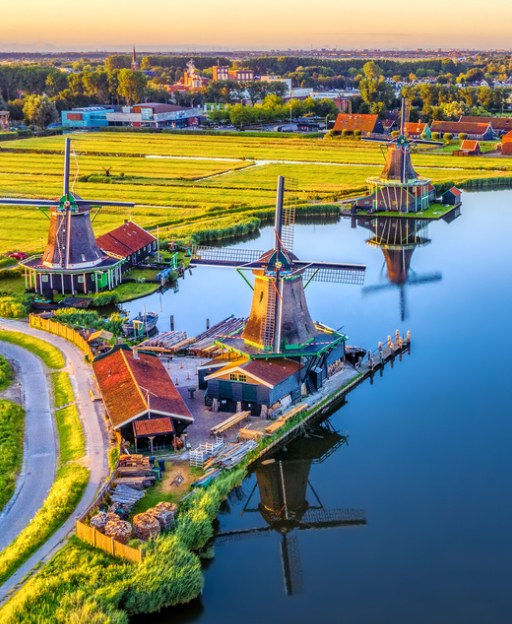
Just 20 kilometres north of Amsterdam, the wooden windmills of Zaanse Schans rise above the flat Dutch landscape in one of the most iconic scenes in the Netherlands. This Zaanse Schans day trip takes around 17 minutes by train from Amsterdam Centraal, making it one of the easiest and most rewarding half-days you can spend outside the capital. Step inside a working windmill, watch craftspeople carve wooden clogs, or wander the riverside path…
Every spring, a Dutch ritual unfolds on the streets of Amsterdam, The Hague, and Scheveningen. Herring stalls put out the year’s first catch — the Hollandse nieuwe — and locals queue to eat it raw, tipped back by the tail, sometimes on a soft white roll with onions. It tastes of the sea and of brine and, if you’re lucky, of nothing at all in the best possible way. Foreigners tend to grimace the first time. The Dutch laugh gently. “Three bites,” they say. “Then you love it forever.” They are usually right.
If you’re enjoying this letter, the best thing you could do is forward it to one friend who’d love the Netherlands too. This newsletter grows by word of mouth alone — every single subscriber came from someone sending it to someone else. Thank you for being one of the first.
Our daily newsletter is free and always will be. But for less than the price of a pint, you can upgrade to our Sunday Premium Edition, which gives you access to our travel deep dives, curated itineraries, and regional stories. Consider buying us a stroopwafel — it’s the Dutch way to say thank you.
Also From Our Family
Love Ireland too? Over 64,000 readers wake up each morning to the Love Ireland newsletter — loveireland.substack.com
Powered by Viator. Some links are affiliate links — we may earn a small commission at no extra cost to you.
Other newsletters you might like
Scottish Rugby Fans
The best Scottish rugby updates, straight to your inbox — Six Nations, the Nations Championship, Glasgow and Edinburgh. Only when there's something worth reading.
A newsletter for Londoners who want to rediscover their own city. Travellers planning their first or fifth visit. Anglophiles who fell in love with London through literature, film, or a rainy afternoon on the South Bank.