

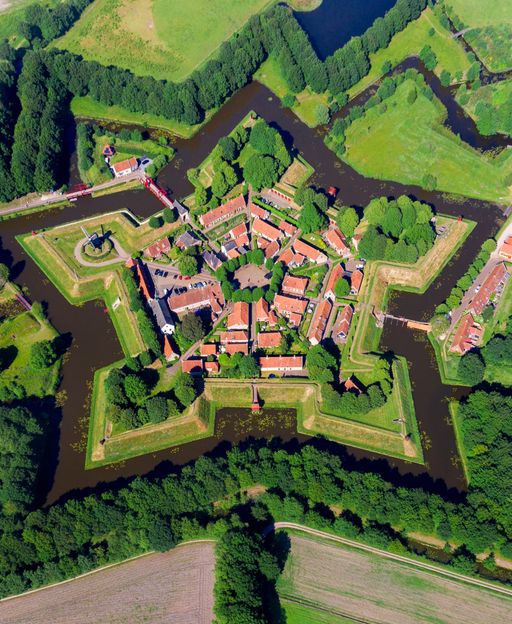
Look at Bourtange on a map — really look at it — and you will see something impossible for a Dutch village. Rising from the flat farmland of Groningen, it forms a perfect five-pointed star, drawn in moats and earthen walls, just as it did in 1593.
This is not a quirk of geography. Someone designed it this way. And the design has outlasted everything else that tried to stand in the Netherlands for four centuries.
Why a Village Needs to Be a Star
In 1593, the Dutch were at war. Spain controlled much of what is now the Netherlands, and a critical supply road — connecting Spanish troops in the south to German reinforcements in the east — ran directly through this corner of Groningen.
William of Orange needed to block that route. His engineers designed a fortress, but not a traditional one with straight walls. Military architects of the era had already learned a hard lesson: straight walls create dead zones where cannons cannot fire.
A star shape fixed that problem. Each pointed bastion gave defenders a clear line of fire along every wall. An attacker advancing on one point would face crossfire from two others. It was pure geometry — mathematics in the service of survival.
The Fortress That Never Fell
Construction started in 1593. Workers dug five deep moats in a star pattern and piled the excavated earth into ramparts. Over time, a small village grew inside the walls: houses, a church, a market square.
Spanish forces besieged Bourtange three times. They never broke through. The fortress served its exact purpose: the supply road was cut, Spanish influence in the northern Netherlands collapsed, and the Dutch revolt gained momentum.
For two more centuries after the war, Bourtange remained an active military post. Different armies used it. Different powers came and went. The star stayed exactly as it was.
What the Nineteenth Century Almost Took
In 1851, the Dutch military decided Bourtange cost more to maintain than it was worth. They handed it over to the municipality and walked away.
What followed was slow erasure. Moats were filled in. Ramparts were flattened. Military buildings became ordinary houses. By the early twentieth century, the star shape had nearly vanished from the ground.
From above, though, the skeleton remained. The outline of the fortification persisted in the land — visible to those who knew where to look, hidden from everyone else. If you enjoy discovering overlooked corners of the Netherlands, our Start Here guide is a good place to begin.
Enjoying this? Get stories like this every week from Love Netherlands — Subscribe free →
How the Star Came Back
In 1967, the Dutch government made a decision that sounds almost impractical: restore Bourtange to its exact 1742 appearance and open it to the public.
Moats were re-dug. Earthworks were rebuilt. Period-style houses replaced later construction. Cannons returned to the ramparts at the precise angles military engineers had calculated four centuries earlier.
Today, about 180 people live inside the star. They are residents of a functioning museum — a community where school runs, morning coffee, and ordinary life happen inside a 16th-century fortification. The north of the Netherlands has its own distinctive character; nearby, Friesland — the province to the west — barely considers itself Dutch at all.
Getting There and What to See
Bourtange sits about an hour east of Groningen city, close to the German border. You reach the village the same way soldiers always did: across a wooden drawbridge, through the old gatehouse.
Inside, historic merchant buildings line the main street. A windmill turns when the wind is right. A 1743 church anchors the central square. The full perimeter of the ramparts is walkable — and the views from the pointed bastions, out over flat Groningen farmland, make the 400-year-old military logic obvious.
Museum Fort Bourtange tells the story of the 80 Years’ War, the Dutch revolt, and the fortress itself. Entry to the village is free. The museum charges a small fee. The Dutch relationship with their landscape runs deep here: the same engineering spirit that shaped Bourtange also reclaimed entire provinces from the sea.
Is Bourtange worth visiting in the Netherlands?
Yes. Bourtange is one of the most unusual places in the country. The star-shaped moats, the walkable ramparts, and the living village inside the walls make it unlike anything else in the Netherlands.
How do you get to Bourtange from Amsterdam or Groningen?
From Amsterdam, allow about two and a half hours by car heading northeast. From Groningen city, the drive east takes roughly one hour. There is no direct public transport — a car or hire car is the practical choice.
When is the best time to visit Bourtange?
Summer (June to August) is the best season. July brings historical re-enactment weekends, when soldiers in period costume demonstrate musket drills and cannon firing on the original ramparts. Spring and autumn are quieter but still worth the journey.
Can you stay overnight in Bourtange?
Yes — a small number of accommodation options exist within or close to the fortress walls, including a traditional guesthouse. Staying overnight is worth considering: once day-trippers leave in the afternoon, the village becomes almost completely quiet.
Four hundred years ago, military engineers drew a star in the earth of Groningen and said: this is where we hold the line. The line held. The star is still there — unchanged, unhurried, and waiting for anyone curious enough to find it.
Love Netherlands — Free Every Week
Canal towns, hidden villages, Dutch stories. A free letter about the Netherlands — written slowly, delivered weekly.
Love more? Join 64,000 Ireland lovers → · Join 43,000 Scotland lovers → · Join 30,000 Italy lovers →
Free forever · One email per week · Unsubscribe anytime
Tours & experiences you might love


Powered by Viator. Some links are affiliate links — we may earn a small commission at no extra cost to you.