

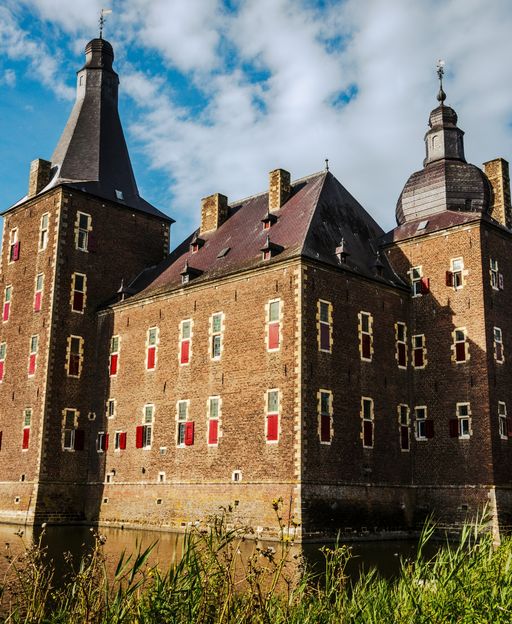
You drive south through the Netherlands and something changes. The flat fields give way to rolling hills. Then, around a bend in the road, a medieval castle appears — towers, moat, and all. Welcome to Limburg. Nobody warned you.
Where the Flat Land Ends
Limburg is the southernmost province of the Netherlands. It stretches down like a thin finger, with Belgium to the west and Germany to the east.
And it has hills. Real ones.
The Heuvelland — the Hill Country — covers the southern tip of the province. The Vaalserberg rises to 322 metres. That sounds modest. In a country mostly below sea level, it feels like a revelation.
The hills make Limburg a hiking province. Well-marked trails wind through wooded valleys and past quiet villages. Wine growers plant vines on south-facing slopes near Maastricht. Dutch wine is real, and it has grown here for decades.
A Province with Its Own Identity
Ask a Limburger where they are from. Many will say simply: “Limburg.” Not the Netherlands. Limburg.
The province has its own language — Limburgish — officially recognised as a regional tongue. It sounds closer to German or Belgian dialects than to standard Dutch. Locals speak it at home, in markets, and in casual conversation.
Limburg is strongly Catholic in a country that is mostly Protestant. That difference runs deep. Saints’ days shape the calendar. Village fêtes happen for reasons most northerners have long forgotten.
And then there is Carnaval. Every February, towns like Maastricht, Venlo, and Sittard transform entirely. Brass bands march. Costumes appear. The famous Dutch reserve vanishes for three full days. This is the most passionate Carnaval in the Netherlands — and most visitors from outside the country have never heard of it.
If you are planning your first visit, start with our guide to the Netherlands before heading south to Limburg.
Enjoying this? Get stories like this every week from Love Netherlands — Subscribe free →
Castles in Every Direction
The hills are not only beautiful. They give Limburg something rare in the Netherlands: strategic high ground. Builders placed castles here for centuries.
Hoensbroek Castle dates to 1360. It sits behind a wide moat in the town of the same name and ranks among the best-preserved castles in the country. You can walk the courtyards, explore the rooms, and stand where medieval lords once stood.
Kasteel Vaalsbroek, Kasteel Daelenbroeck, Kasteel Ter Horst — the province holds dozens of them. Many now operate as hotels or restaurants. Spending a night inside a 14th-century fortress is possible in Limburg, and most visitors never think to look for it.
The Burgundian Table
Limburg has a word for its approach to life: bourgondisch. Burgundian. It means unhurried, generous, devoted to good food and good company. The Dutch language holds many words that resist translation — bourgondisch may be the one that best describes Limburg’s spirit.
White asparagus season runs from April to June. Restaurants build entire menus around it. Farmers grow some of Europe’s finest asparagus on the sandy Limburg soils, and locals treat the harvest as a proper event.
Then there is vlaai — a flat fruit tart with a thin pastry base. Every bakery holds its own recipe. Every family keeps a preferred bakery. Vlaai appears at birthdays, weddings, communions, and any occasion worth marking.
Maastricht itself holds more Michelin-starred restaurants per capita than almost any other Dutch city. A day in Maastricht is one of the best ways to understand what Limburg’s food culture actually means.
What is the best time to visit Limburg in the Netherlands?
Spring is ideal, from April to June. Asparagus season brings the best of Limburg’s food culture, the hills are green, and Maastricht looks beautiful before summer crowds arrive. February is extraordinary if you can plan around Carnaval.
How do you travel to Limburg from Amsterdam?
The train from Amsterdam Centraal to Maastricht takes about two and a half hours with a change at Eindhoven. Direct trains run several times a day. Maastricht is the main gateway to the province.
Is Limburg worth visiting if you have already seen Amsterdam?
Yes — especially because it is nothing like Amsterdam. The pace is slower, the landscape is completely different, and the food culture is richer. Many visitors say Limburg changes how they think about the Netherlands entirely.
What Dutch food should you try in Limburg?
Do not leave without trying vlaai (fruit tart), white asparagus if you visit in spring, and a local beer from Gulpener brewery near Maastricht. Rijstevlaai — rice tart — is a regional favourite and easy to find in any local bakery.
Limburg does not shout for attention. It never has. But once you find it — the hilltop views, the castle walls, the vlaai on the café table — it is very difficult to leave.
Love Netherlands — Free Every Week
Canal towns, hidden villages, Dutch stories. A free letter about the Netherlands — written slowly, delivered weekly.
Love more? Join 65,000 Ireland lovers → · Join 43,000 Scotland lovers → · Join 30,000 Italy lovers →
Free forever · One email per week · Unsubscribe anytime
Tours & experiences you might love


Powered by Viator. Some links are affiliate links — we may earn a small commission at no extra cost to you.