

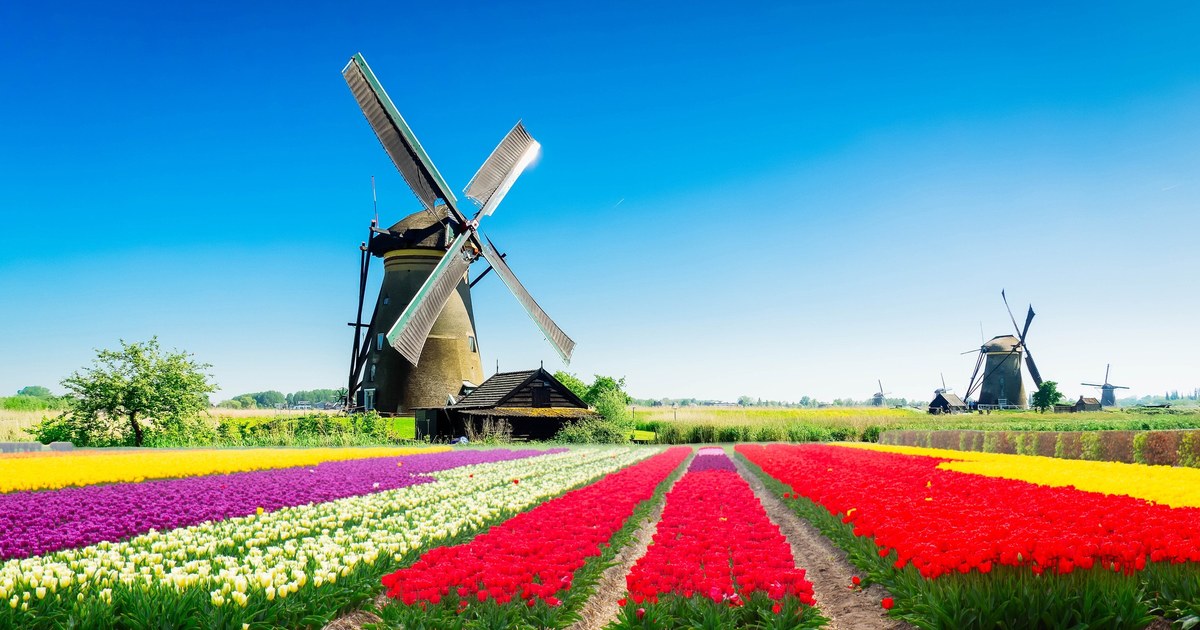
The flower the world treats as the Netherlands’ signature bloom is not Dutch by birth at all. It grew wild in the mountains of Central Asia and was a garden treasure in Persia and the Ottoman court long before a single bulb reached Dutch soil. Even its name comes from the turban: the Dutch word tulp goes back to the Turkish tülbend, from the Persian dulband. In the 1630s a single rare bulb could cost more than a fine canal house, and today the country grows around 8.5 billion flower bulbs a year. This is Guide No. 014 in The Love Netherlands Guide series.
Get the Full Collectible Guide (Free PDF)
The Dutch Tulip — in a beautifully designed, printable booklet. The Love Netherlands Guide № 014.
How a Central Asian Flower Became Dutch
Wild tulips grow from the Pamir and Tien Shan ranges of Central Asia to the mountains of Turkey and Iran. Persian gardeners grew them as early as the 10th century, and in the Ottoman court of Suleiman the Magnificent, who came to the throne in 1520, they became a passion (Amsterdam Tulip Museum).
Bulbs reached the Low Countries in the mid-16th century. The envoy Ogier Ghiselin de Busbecq is traditionally credited with seeing them in the sultan’s gardens, and a cargo of bulbs is said to have reached Antwerp in 1562 (Etymologiebank). The decisive Dutch chapter opened in 1593, when the botanist Carolus Clusius became prefect of the new university garden in Leiden and planted two beds entirely with tulips. The Hortus Botanicus Leiden still has a bulb garden today.
From Leiden the tulip became a growers’ crop, and the sandy soil behind the dunes between Haarlem and Leiden gave the Bollenstreek, the bulb district, its name. Today about half of the country’s tulip fields lie in the reclaimed IJsselmeer polders, mostly in Flevoland, with western Holland (the North and South Holland bulb districts) the other big growing area (CBS, Statistics Netherlands). Tulips fill more than half of all Dutch bulb fields.
Tulip Mania: The First Famous Bubble
In the 1630s rare tulip bulbs became objects of fierce speculation in the Dutch Republic. Prices climbed through 1636 and peaked in the winter of 1636-37, when a single bulb of the famous Semper Augustus was said to cost more than a house on Amsterdam’s grandest canal. In early February 1637 the market collapsed and prices fell by around 90 per cent. Tulip mania is often remembered as the first market bubble.
The picture of a whole nation ruined by flowers is overdrawn. A 2007 study of the surviving contracts (University of Chicago Press) found that the trade ran through a relatively small, prosperous circle of Dutch burghers, that many contracts were broken, and that the crash undermined people’s confidence in each other’s honour rather than the economy. You can trace the period’s love of flowers in the still lifes at the Rijksmuseum.
Why the Most Prized Tulips Were “Broken”
The tulips that fetched the highest prices were the “broken” ones, their petals streaked and feathered with flames of colour. The most legendary was Semper Augustus, with deep crimson flares on a milky white base. No grower could produce these patterns on demand, which only added to their value.
The cause turned out to be a virus spread by aphids, which breaks up the colour in the petals and slowly weakens the bulb. The old broken lines such as Semper Augustus disappeared long ago, and growers no longer sell true broken tulips. Today’s flamed “Rembrandt” tulips are healthy, virus-free plants whose flames are stable and come close to the old look. The story is told in full at the Amsterdam Tulip Museum, Prinsengracht 116.
Where and When to See Them
The best-known place to see tulips by the million is Keukenhof in Lisse, a spring park that shows 7 million spring-flowering bulbs over about eight weeks, from mid-March to early May; check keukenhof.nl for this year’s dates. It is a show garden rather than a production field, and you can pair it with a bike ride through the surrounding Bollenstreek fields.
For a free start to the season, National Tulip Day falls on the third Saturday of January (16 January 2027): growers lay out a picking garden of 200,000 tulips on the Museumplein in Amsterdam, and from 1 pm anyone may pick a free bunch (Tulpentijd). In April the Bloemencorso Bollenstreek, held since 1947, sends floats covered in flowers 42 kilometres from Noordwijk to Haarlem.
Myths Worth Retiring
Myth: Tulips are native to the Netherlands. They are not. Wild tulips come from Central Asia and were grown in Persian and Ottoman gardens long before the first bulbs reached the Low Countries in the 16th century. The Netherlands became the great grower and exporter, not the birthplace.
Myth: Tulip mania bankrupted the whole country. The speculation was real and the 1637 crash was sharp, but the study of the surviving contracts found the trade was concentrated in a small circle and did little lasting damage to the wider economy.
Myth: You can still buy the flame-streaked antique tulips. The original broken varieties carried a weakening virus and vanished long ago. Modern flamed tulips are healthy plants that resemble them.
Frequently Asked Questions
When is the best time to see Dutch tulips in bloom?
The season runs from late March to mid-May, and the flowers are usually at their best in mid-April (Holland.com). Timing shifts a little each year with the weather, so check the garden’s or the region’s own bloom updates before you travel.
Can I take tulip bulbs home to the United States?
Plants and bulbs brought into the US by travellers need a phytosanitary certificate from the country you are leaving, and you must declare all plant products on arrival (USDA APHIS). Buy packs that are sold as certified for the US, keep the paperwork with them, and check the USDA page before you fly.
Why were broken tulips once worth so much?
Their flame-like streaks made every bloom look unique, and no grower could produce them on demand, which drove their rarity and price during the mania. The patterns were later traced to a virus, which is why those exact varieties are no longer grown.
More The Love Netherlands Guides
The Love Netherlands Guide is a numbered series — one tightly focused subject at a time, each with its own downloadable collectible edition. Guide № 001 is Stroopwafel, Guide № 002 is King’s Day (Koningsdag), Guide № 003 is Delft Blue Pottery, Guide № 004 is Dutch Jenever, Guide № 005 is Dutch Cycling Culture, Guide № 006 is Gezelligheid, Guide № 007 is Dutch Beer & Brewing, Guide № 008 is Dutch Brass Bands, Guide № 009 is Wooden Clogs (Klompen), Guide № 010 is Dutch Windmill Folklore, Guide № 011 is Dutch Sayings & Proverbs, Guide № 012 is The Dutch Breakfast (Hagelslag), Guide № 013 is Sinterklaas, This is Guide № 014. More editions are on the way.
🇳🇱 Join Love Netherlands
Free stories and local tips from Netherlands, from people who live and love it.
Tours & experiences you might love


Powered by Viator. Some links are affiliate links — we may earn a small commission at no extra cost to you.