

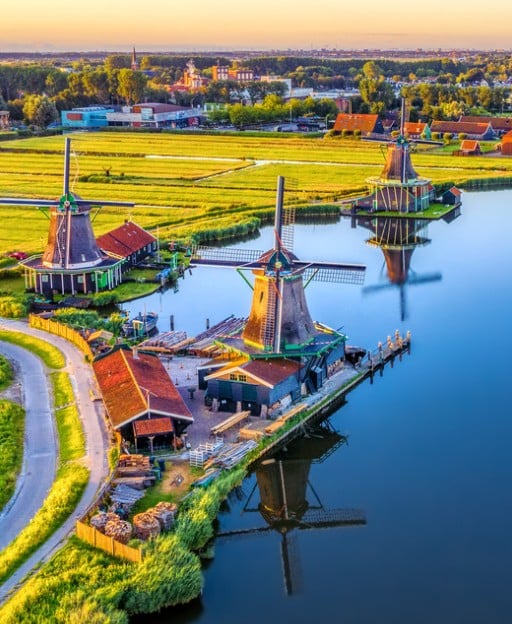
Twenty minutes north of Amsterdam, the air changes. The city noise fades. In its place comes the low creak of giant wooden sails turning in the wind — and, on still mornings, the sweet earthy scent of cocoa being ground in a mill that has stood here for three centuries.
Welcome to Zaanse Schans.
Not a Theme Park — a Working Village
Zaanse Schans sits along the River Zaan in North Holland. It looks like a painting come to life: dark green wooden houses, eight working windmills, and their reflections wobbling in calm water below.
This is not a recreation. The Zaan region built the industrial heart of 17th-century Europe right here. Hundreds of windmills once lined this riverbank, powering sawmills, spice grinders, and paint crushers. Dutch merchants loaded barrels of ground pepper, linseed oil, and timber onto canal boats bound for every major port in the world.
Today, eight of those original mills still operate. Craftspeople still work the looms and the presses. The village still produces.
Eight Mills, Eight Jobs
Most visitors assume windmills are interchangeable. At Zaanse Schans, each one does something entirely different.
The paint mill crushes stone pigment into artists’ colours — the same colours Dutch masters used in the Golden Age. The oil mill presses linseed, hemp, and rapeseed. The mustard mill grinds seeds that still end up in jars on Dutch supermarket shelves. The lumber mill saws timber with a method unchanged since 1686.
Several mills open their doors to visitors. The miller on duty explains how the sails catch wind at different angles. Stopping a windmill, it turns out, requires as much skill as starting one.
The Smell You Won’t Forget
Most visitors come for photographs. They stay because of the smell.
At De Kat, the paint mill, centuries of linseed oil have soaked into every wooden beam. At the spice mill, the warm scent of cloves and nutmeg hangs in the air all morning. Walk past the cheese farm and something rich and milky drifts across the path.
Enjoying this? Get stories like this every week from Love Netherlands — Subscribe free →
Zaanse Schans engages every sense. That’s what sets it apart from a museum — it still makes things.
Wooden Shoes and Green Houses
The dark green wooden houses along the riverbank follow a style called the Zaans house. That distinctive colour came from a pigment ground in the local mills.
At the klompen workshop, a craftsman carves a pair of wooden shoes from a single block of willow in under five minutes. Farmers and fishermen wore klompen as tools — not trinkets. Wood kept feet dry and protected against nails and sharp debris on the docks.
If you want to understand Dutch practicality in one object, look at a clog. It solves the problem completely. It uses local materials. It lasts for years.
For more on the Dutch relationship with water and the land they built their lives on, our guide to getting started with the Netherlands is a good place to begin. And if Zaanse Schans leaves you wanting more windmills, the story behind Kinderdijk’s 19 mills tells the deeper tale of how the Dutch held back the sea.
When to Go and How to Beat the Crowds
Zaanse Schans charges no entry fee to the site itself. The individual workshops and windmill interiors charge a small fee — typically €5 to €7 each.
Tour coaches arrive in force between 10am and 2pm. Arrive before 9am and the windmill reflections belong almost entirely to you.
October mornings, when mist rises off the Zaan and the sails turn slowly against a pale sky, are worth a separate trip. Spring brings tulips in the surrounding fields. Both seasons reward anyone willing to take the early train from Amsterdam Centraal — a 17-minute journey to Koog-Zaandijk station, then a ten-minute walk.
Practical Tips for Your Visit
Wear comfortable shoes — the site covers a large area with uneven wooden paths and bridges. Bring cash for the windmill entry fees, as not all accept cards. The on-site pancake restaurant fills quickly, so arrive early or bring a picnic.
How far is Zaanse Schans from Amsterdam?
Zaanse Schans is 17 kilometres northwest of Amsterdam. The train from Amsterdam Centraal to Koog-Zaandijk takes 17 minutes, then a ten-minute walk brings you to the village entrance. Taxis and tour buses also run from the city centre.
Is Zaanse Schans free to visit?
Entry to the Zaanse Schans site costs nothing. Individual attractions — windmill interiors, the clog workshop, the cheese farm — charge a small fee, typically €5 to €7 each. Allow €20 to €30 for a full visit including two or three windmill interiors.
What is the best time to visit Zaanse Schans?
April to October gives the best weather and working windmills. Arrive before 9am to avoid tour groups and catch the best light on the water. October morning mist rising off the Zaan is particularly beautiful.
Which windmills can you go inside at Zaanse Schans?
Typically three to four mills open their interiors to visitors on any given day, including the paint mill De Kat and the oil mill De Zoeker. Millers operate the sails when wind conditions allow, usually on weekends and in good weather from spring to autumn.
The windmills turn when the wind comes. The millers still climb the same ladders their great-grandparents climbed. The river still carries the scent of ground spice on certain mornings. Zaanse Schans does not perform its history — it simply continues it.
Love Netherlands — Free Every Week
Canal towns, hidden villages, Dutch stories. A free letter about the Netherlands — written slowly, delivered weekly.
Love more? Join 65,000 Ireland lovers → · Join 43,000 Scotland lovers → · Join 30,000 Italy lovers →
Free forever · One email per week · Unsubscribe anytime
Tours & experiences you might love


Powered by Viator. Some links are affiliate links — we may earn a small commission at no extra cost to you.