

Walk into any supermarket outside the Netherlands, and you will spot it immediately. A small, round cheese in bright red wax. Edam. It is one of the most recognised foods in the world.
But ask the Dutch what cheese they actually eat, and most will not mention Edam at all.
A Town That Made Ships Before It Made Cheese
Edam sits on the IJsselmeer, about 20 kilometres north of Amsterdam. Today it feels quiet — beautiful canals, draw bridges, a small market square. But five hundred years ago, this was one of the busiest harbours in the Netherlands.
Edam built ships. Its location gave shipbuilders direct access to the North Sea, and the town’s timber yards thrived through the sixteenth century. Cheese was a sideline. Then the harbour silted up. The ships stopped coming. And the town had to find something else.
The fields surrounding Edam had always produced milk. Local farmers made rounds of cheese — compact, mild, and easy to stack. When the shipbuilding trade collapsed, the cheese trade stepped in.
How a Small Cheese Conquered the World
Sailors discovered that Edam kept well at sea. The natural rind dried hard in the air, resisting mould during long ocean voyages. Dutch trading ships carried it to Europe, South America, South Africa, and Asia.
Dutch merchants coated the export rounds in red wax. It protected the cheese during transit and served as a quality mark. Buyers in foreign markets came to expect the red sphere.
By the seventeenth century, Edam cheese was known across the world. It travelled on the same ships that made the Netherlands the greatest trading power of the age. The round shape fitted neatly into a ship’s hold. The red wax kept it safe for months.
And the world fell in love with it.
The Red Wax Secret
Here is what most visitors never hear. Inside the Netherlands, Edam cheese has a yellow wax coating — or no wax at all. The red coating exists purely for export.
The cheese underneath is the same. But the red wax became so iconic abroad that foreign buyers still expect it today. Walk into a Dutch supermarket and the Edam sits quietly in yellow or plain white packaging. No red in sight.
There is another difference too. Fresh young Edam — bought locally, eaten within weeks — tastes nothing like the mild, slightly rubbery versions sold in supermarkets abroad. The local version is springy and lightly salty, with a clean, delicate flavour that long-distance export cheese never quite achieves.
Enjoying this? Get stories like this every week from Love Netherlands — Subscribe free →
What Edam Looks Like Today
Edam has changed very little in two hundred years. The historic centre is almost perfectly preserved — a network of narrow streets, canal banks, and draw bridges that tourists mostly bypass on their way to Amsterdam.
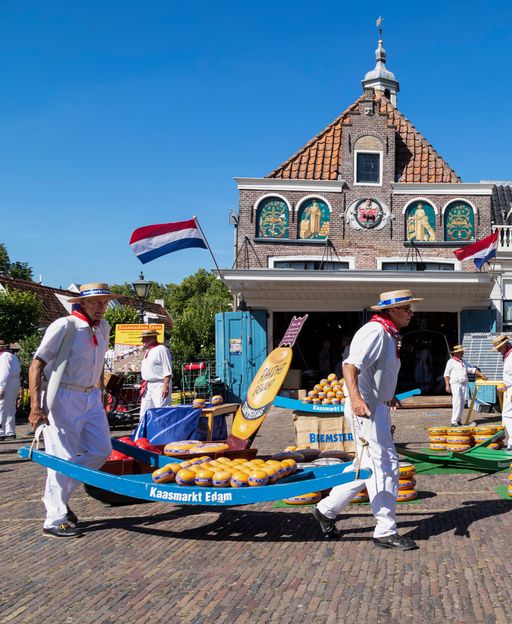
The Waag — the old weighing house where buyers checked and priced the cheese — still stands on the market square. In July and August, a traditional cheese market runs on Wednesday mornings. Cheese carriers in white uniforms and flat straw hats carry wooden sleds loaded with yellow rounds across the cobblestones. It is theatrical, but the practice it imitates is centuries old.
The draw bridges are what surprise most visitors. Edam has several traditional Dutch wooden draw bridges, and some still open to let canal boats pass. Standing on one while a small boat glides beneath you is a quiet moment that stays with you longer than most tourist attractions.
How to Visit Edam From Amsterdam
Regular buses run from Amsterdam Central Station to Edam. Bus 316 and Bus 317 both make the trip in around 30 minutes. There is no train, so the bus is your main option.
Most visitors spend two to three hours in Edam. That is enough to explore the market square, cross the draw bridges, look inside the Waag, and sit with coffee at a canal-side café. It works well as a morning trip before returning to Amsterdam for lunch.
If you want to understand more about Dutch cheese culture, our guide to Dutch cheese explains how Edam compares to Gouda and what makes each one distinct. And if you are planning your first time in the Netherlands, the Start Here guide covers everything you need to know before you go. You might also enjoy reading about Alkmaar’s famous cheese market, which operates on a grander scale and runs through the summer season.
Frequently Asked Questions About Edam
What is the best time to visit Edam in the Netherlands?
July and August are the best months, when the traditional cheese market runs every Wednesday morning. Spring is also excellent — the town is quieter, prices are lower, and the canals are at their most peaceful.
How do you get to Edam from Amsterdam?
Take Bus 316 or Bus 317 from Amsterdam Central Station. The journey takes around 30 minutes. Edam has no train station, so the bus is the only public transport option from Amsterdam.
Why does Edam cheese have red wax?
Dutch merchants developed the red wax coating for export. It protected the cheese during long sea voyages and became a recognisable quality mark in foreign markets. Inside the Netherlands, Edam typically comes in yellow wax or no wax at all.
Is Edam worth visiting as a day trip?
Yes — Edam is one of the most overlooked day trips from Amsterdam. The historic centre, draw bridges, and summer cheese market make it genuinely rewarding for anyone who wants to see a quiet Dutch town at its most authentic.
Edam is not trying to be famous. It lost its harbour, changed its trade, and got on with things — quietly, practically, and without much fuss. That same Dutch self-possession is written into every draw bridge and every wheel of cheese on the market square. The town behind the world’s most iconic cheese has a great deal more to offer than the cheese itself.
Love Netherlands — Free Every Week
Canal towns, hidden villages, Dutch stories. A free letter about the Netherlands — written slowly, delivered weekly.
Love more? Join 64,000 Ireland lovers → · Join 43,000 Scotland lovers → · Join 30,000 Italy lovers →
Free forever · One email per week · Unsubscribe anytime
Tours & experiences you might love


Powered by Viator. Some links are affiliate links — we may earn a small commission at no extra cost to you.