

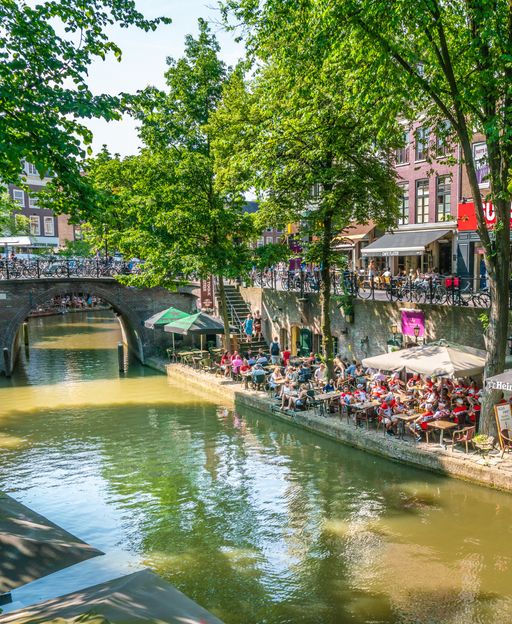
Step off the bridge and follow the stone steps down. The city disappears. Suddenly you are sitting at the edge of a canal, water lapping a metre from your coffee cup, bicycles crossing the bridge just above your head. This is the Oude Gracht in Utrecht — and it is unlike anything else in the Netherlands.
A City Built on Two Levels
Most Dutch canals have towpaths along the top. Utrecht is different. The Oude Gracht — Old Canal — runs for nearly two kilometres through the heart of the city, but it operates on two distinct levels.
At street level: traffic, cyclists, and pedestrians. Below the bridges: a second world entirely. Stone wharfs line both sides of the water, accessible by steep staircases. Medieval merchants built warehouses here so boats could unload goods directly into storage vaults cut into the canal walls.
Those vaults, called werfkelders, date back to the 13th century. For hundreds of years they stored wine, grain, and textiles arriving by barge from across Europe. Today they store something far more important to the Dutch: coffee, beer, and good conversation.
How the Wharfs Became the Best Seats in Town
When canal freight died out in the 19th century, the werfkelders fell empty. For decades they sat abandoned. Then, in the 1970s and 1980s, Utrecht’s residents made a decision that changed the city. They converted the old storage vaults into cafés, restaurants, and bars — each one opening directly onto the water’s edge.
Today more than 150 businesses operate from the wharfs. You eat your kroket below the bridges while tourists photograph you from above. You sip your morning coffee with your feet practically skimming the canal surface. In summer, terraces extend right to the water’s edge. In autumn, candles flicker inside vaulted brick ceilings that have stood for 700 years.
The experience is completely gezellig — that untranslatable Dutch word for cosy, convivial warmth — but it carries a weight of history that most riverside cafés simply do not have.
The Tower Without Its Church
Walk the length of the Oude Gracht and eventually the Dom Tower appears on the skyline. At 112 metres, builders completed it in 1382, and it remains the tallest church tower in the Netherlands.
There is something strange about it, though. The tower stands alone. No nave connects it to the cathedral beside it. A violent storm in 1674 collapsed the roof of the connecting nave in a single afternoon. Rebuilding never happened. The gap remains to this day — an open square between tower and church that Utrecht has lived with for 350 years.
Locals barely notice it. Visitors always do. Stand in the square on a clear morning and the light falls exactly the way it falls in a Vermeer painting — sharp, golden, Dutch.
Enjoying this? Get stories like this every week from Love Netherlands — Subscribe free →
Getting to Utrecht
Utrecht sits at the geographical centre of the Netherlands. Every major Dutch train line passes through Utrecht Centraal, which makes it one of the busiest stations in the country. From Amsterdam, the journey takes 28 minutes. From Rotterdam, 40 minutes. From Eindhoven, 45 minutes.
The station itself is remarkable. Hoog Catharijne — the vast shopping complex attached to Utrecht Centraal — connects the station to the city centre entirely under cover. On a rainy Dutch afternoon, this matters more than you might expect.
Once you arrive, explore on foot or by bicycle. Utrecht has more bikes per square kilometre than almost any city in the Netherlands. If you want to understand why the Dutch cycle everywhere in all weathers, Utrecht is the place to see it in action. The city’s cycling infrastructure is exceptional — even by Dutch standards.
Utrecht Beyond the Canal
The Oude Gracht draws most visitors, but Utrecht rewards those who explore further. Utrecht University, founded in 1636, puts 35,000 students into the city’s streets and cafés. The energy is young and international.
The Miffy Museum (Nijntje Museum) is one of the most charming museums in the Netherlands — Dick Bruna, who created Miffy, lived and worked in Utrecht his entire life. The museum sits a short walk from the canal. It is nominally for children, but adults leave with an unexpected warmth.
On Saturday mornings, a market runs along the Oudegracht. Fresh bread, Dutch cheese, flowers, and the smell of stroopwafels warming on a waffle iron. If you have not yet explored the quieter side of Dutch city life, our Start Here guide will help you plan your visit — including which cities to combine with Utrecht for the perfect Dutch weekend. You might also enjoy reading about why Haarlem surprises so many visitors — it pairs beautifully with a Utrecht day trip.
Frequently Asked Questions About Utrecht
What is the best time of year to visit Utrecht?
May to September brings the best weather for the wharf terraces. Summer evenings on the Oude Gracht, with candles lit inside the old vaults and boats passing at eye level, are genuinely magical. Winter visits have their charm too — the Trajectum Lumen light art route illuminates the city’s buildings and bridges from October onwards.
How do you get from Amsterdam to Utrecht?
Direct intercity trains run every 15 minutes from Amsterdam Centraal to Utrecht Centraal. The journey takes 28 minutes and costs around €8-10. No reservation needed — simply buy a ticket at the station or use an OV-chipkaart.
What are the werfkelders in Utrecht?
Werfkelders are the medieval storage vaults built into the canal walls of the Oude Gracht. Originally used by merchants to store goods arriving by barge, they were converted to cafés, restaurants, and bars from the 1970s onwards. Today over 150 businesses operate from the wharf level, making them one of Utrecht’s most distinctive features.
Is Utrecht worth visiting for a day trip from Amsterdam?
Absolutely. One full day gives you the Oude Gracht wharfs, the Dom Tower (climb it for the view), the Miffy Museum, and a wander through the university quarter. Many visitors wish they had booked an overnight stay instead.
Love Netherlands — Free Every Week
Canal towns, hidden villages, Dutch stories. A free letter about the Netherlands — written slowly, delivered weekly.
Love more? Join 64,000 Ireland lovers → · Join 43,000 Scotland lovers → · Join 30,000 Italy lovers →
Free forever · One email per week · Unsubscribe anytime
Tours & experiences you might love


Powered by Viator. Some links are affiliate links — we may earn a small commission at no extra cost to you.