
Your family left Utrecht generations ago. They crossed oceans and built new lives in America, South Africa, Australia, or Indonesia. But something of them remains in the centre of the Netherlands — in church records, civil registers, and the archives of a province that shaped Dutch history for a thousand years. If you have Utrecht ancestry, this guide helps you find them.
Why Utrecht Ancestry Matters
Utrecht province sits at the geographical heart of the Netherlands. For centuries, it was also the religious heart. The Bishops of Utrecht ruled over what historians call Het Sticht — the ecclesiastical territory that stretched across much of the northern Low Countries. From here, the Dutch Reformed faith spread across the country and, eventually, across the world.
This religious history left something practical behind: meticulous record-keeping. Utrecht churches recorded births, marriages, and deaths long before civil registration became law. Those records survive today. Many are searchable online, right now, for free.
Utrecht also lies at the crossroads of the Netherlands. The Rhine flowed through it. Trade routes crossed it. Armies marched through it. The province sent emigrants to the Americas, to the Cape of Good Hope, and to the Dutch East Indies. Today, millions of people across the world carry genes — and surnames — that trace back to a town, a village, or a farm in Utrecht province.
🇳🇱 Enjoying this? Netherlands lovers get stories like this every week. Subscribe free →
The Towns and Villages of Utrecht Province
Utrecht province is small but densely historic. Its capital, Utrecht city, stands on the site of a Roman fort called Trajectum — the ford across the Rhine. The Romans built a garrison here in AD 47. When you walk through the old town today, you walk ground that soldiers, merchants, monks, and your ancestors all crossed.
Beyond the city, the province contains dozens of towns and villages where Dutch families lived for centuries. Each one has its own archive trail.
- Amersfoort — a walled medieval city north of Utrecht, with a remarkable circular moat and a history of textile trade
- Zeist — home to a famous Moravian Brethren (Hernhutters) community from 1745; many Zeist Moravians emigrated to Pennsylvania and North Carolina
- Woerden — a fortified town on the Hollandse IJssel, where Spanish troops laid siege during the Eighty Years’ War
- Soest — a quiet heathland town that sent families to the Dutch East Indies in the VOC era
- Baarn — a royal residence town where Queen Juliana lived for much of the twentieth century
- Doorn — famous in modern history as the exile home of Kaiser Wilhelm II, who lived at Huis Doorn from 1920 until his death in 1941
- Veenendaal — a peat-cutting town on the Gelderse Vallei, with strong ties to the Reformed faith and to Dutch-American emigrant communities
Each of these communities kept records. Each produced emigrants. If your family name connects to any of them, an archive visit can change what you know about your history.
Utrecht Surnames and What They Reveal
Dutch surnames tell you where your family came from, what they did for a living, or what they looked like. Utrecht surnames follow the same patterns as the rest of the Netherlands — with a few regional flavours.
Van den Berg means “from the hill.” Families with this name lived near one of Utrecht’s ridges — the Utrechtse Heuvelrug, the long forested ridge that runs through the east of the province. Van den Berg is one of the most common Dutch surnames in the world. If you carry it, the Heuvelrug is likely part of your story.
Van der Veen means “from the peat bog.” Utrecht’s western edge was once a vast peat landscape. Families worked that land for centuries, cutting and selling turf.
Van Zuylen is a noble name linked to Slot Zuylen, a castle on the Vecht river north of Utrecht. The Van Zuylen family lived there for centuries. Their most famous daughter, Belle van Zuylen (1740–1805), became one of the great writers of the Enlightenment. If you carry this surname, you descend from the same family line.
De Groot simply means “the great” — often given to the tallest person in a village. Hugo Grotius, the famous Dutch jurist and father of international law, was born De Groot in Delft. The name appears across Utrecht province in records going back centuries.
Van Arkel is an ancient noble name tied to the Van Arkel family, lords of Arkel in the medieval period. Their territory bordered Utrecht province, and branches of the family settled throughout the region.
To trace how your specific surname spread from Utrecht to the world, start with our step-by-step guide to Dutch ancestry research. It covers every major record type and database you will need.
Where the Utrecht Diaspora Went
Utrecht families left the Netherlands in several waves. Each wave went in a different direction — and for different reasons.
Dutch-Americans from Utrecht
The first major wave of Utrecht emigration to North America happened in the seventeenth and eighteenth centuries. Dutch Reformed families from Utrecht and neighbouring provinces founded communities in New Amsterdam (now New York), in New Jersey, and eventually in Michigan and Iowa. The Reformed Church in America traces its roots directly to these communities.
A second wave came in the mid-nineteenth century, driven by the Potato Famine of 1845 and a deep religious schism in the Dutch Reformed Church. Calvinist separatists — the Seceders — left the Netherlands in large numbers. Many came from Utrecht province and settled in Holland, Michigan, and Pella, Iowa. If your Dutch-American family is Baptist or Reformed, check Utrecht records carefully. There is a strong chance your ancestors came from this migration.
Our guide to retracing Dutch-American roots helps you plan a homecoming trip once you have found your family’s town.
The Moravians of Zeist and America
One of the most distinctive Utrecht emigrant communities came from Zeist. In 1745, Count Ludwig von Zinzendorf established a Moravian Brethren settlement there — a planned community of craftsmen, teachers, and missionaries who lived by the rules of the Brethren. The Zeist Moravians sent missionaries across the Atlantic, and many community members emigrated to Bethlehem, Pennsylvania, and Salem, North Carolina.
If your family name appears in American Moravian church records — particularly in Pennsylvania or North Carolina — check the Zeist archives. The Zeist Moravian community kept meticulous records of every member, every emigrant, and every marriage. Many of those records survive and are held by the Zeist Municipality Archive.
Afrikaner Connections to Utrecht
The Dutch East India Company (VOC) recruited workers from across the Netherlands, including Utrecht province. Men who sailed for the Cape of Good Hope in the seventeenth and eighteenth centuries often settled there permanently. Their descendants became the Afrikaners.
If you are South African with Dutch heritage, Utrecht province may be part of your story. The VOC records — held at the National Archives in The Hague — list every employee by name, birthplace, and contract. Many list hometowns in Utrecht province. You can search these records online through the VOC trail guide.
Dutch-Indonesians from Utrecht
After Indonesian independence in 1949, more than 300,000 Dutch-Indonesian families — the Indo community — came to the Netherlands. Many settled in Utrecht city and its suburbs. If your family was part of this repatriation, Utrecht may be the place where your Dutch and Indonesian histories meet. Het Utrechts Archief holds post-war settlement records and colonial-era documentation that can help you piece together this complex heritage.
The Archives: Where to Find Utrecht Records
Utrecht has one of the best-preserved archive systems in the Netherlands. The main repository is Het Utrechts Archief, located at Hamburgerstraat 28 in Utrecht city. It holds records for both Utrecht city and Utrecht province, including:
- Burgerlijke Stand — civil birth, marriage, and death records from 1811 onwards
- Church records (Doop-, Trouw- en Begraafboeken) — baptism, marriage, and burial registers for Dutch Reformed, Catholic, Lutheran, and Mennonite communities, many dating to the seventeenth century
- Notarial archives — contracts, wills, and property transfers that name individuals and their family relationships
- Land and tax registers — useful for locating where your family lived before civil registration began
- Population registers (Bevolkingsregisters) — household-by-household records from the mid-nineteenth century that show who lived where
You can access many Utrecht records for free through WieWasWie.nl, the national Dutch genealogy portal. The portal indexes birth, marriage, and death records from multiple archives, including Het Utrechts Archief. Search there first before booking a visit.
For a full guide to using every Dutch archive resource — including WieWasWie, Delpher, and church record databases — read our complete Dutch ancestry step-by-step guide.
Amersfoort City Archive
If your family came from Amersfoort or its surrounding villages, the Amersfoort Archief holds additional local records not available through the central Utrecht archive. Amersfoort was an independent municipality with its own administrative history. Its records are especially useful for families from the northern part of Utrecht province.
The Zeist Moravian Community Archive
The Zeist Moravian archive is unique in the Netherlands. It holds detailed community records going back to 1745. These records name not just births and deaths, but the character, profession, and spiritual journey of every community member. For Moravian-descended families in America and elsewhere, this archive is irreplaceable.
Contact the Zeist municipality to arrange access. Many researchers find that a single day in this archive transforms what they know about their family’s faith and identity.
Heritage Sites to Visit in Utrecht Province
A roots trip to Utrecht is not just about archives. The province has physical places where history becomes real — where you can stand where your ancestors stood.
Kasteel de Haar
Kasteel de Haar is the largest castle in the Netherlands. The Van Zuylen family rebuilt it in its current Gothic Revival form in the 1890s. It stands at Haarzuilens, just west of Utrecht city. Walking through its rooms and gardens, you sense the scale of wealth and power that defined Utrecht’s noble families for centuries. Many ordinary Utrecht families worked on the estate or in its surrounding village — a feudal relationship that shaped the region for generations.
Slot Zuylen
Slot Zuylen is a smaller, quieter castle on the Vecht river. Belle van Zuylen grew up here in the eighteenth century, writing sharp, funny letters to correspondents across Europe before leaving for good. The castle is open to visitors and offers a window into the domestic life of a wealthy Utrecht family in the Enlightenment era.
The Domtoren and Dom Church
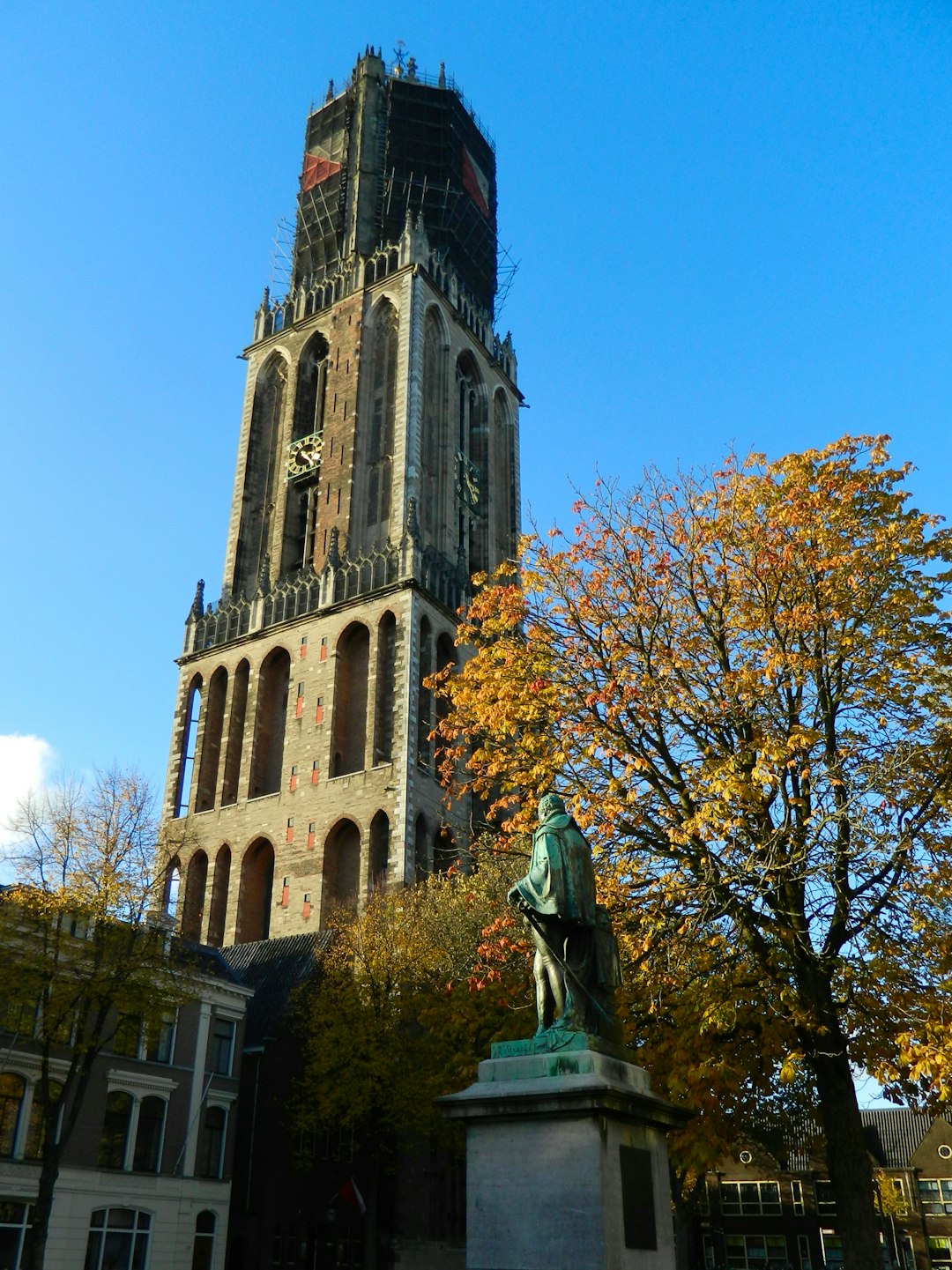
The Domtoren — the great tower of the Dom Cathedral — is Utrecht’s defining landmark. It stands 112 metres tall. You can see it from miles away. The Dom Church itself dates to the thirteenth century. For centuries, it was the most important church in the northern Netherlands. Bishops held court here. Records were kept here. Your ancestors, if they lived anywhere near Utrecht, would have known this tower as a fixed point in their world.
Amersfoort’s Medieval Town
Amersfoort has one of the best-preserved medieval town centres in the Netherlands. Its circular canal system, built in the fourteenth century, still shapes the street plan today. If your family came from Amersfoort, walking inside those old walls connects you to a place that has looked, roughly, the same way for seven hundred years.
For a practical guide to visiting Utrecht’s heritage sites and planning your research trip, read our complete Utrecht heritage travel plan.
How to Start Your Utrecht Ancestry Research
Starting is simpler than you might think. You do not need to visit the Netherlands first. You do not need to speak Dutch. You just need to start with what you know.
Step 1: Collect What Your Family Knows
Ask your oldest relatives what they remember. Write down surnames, towns, dates — even rough ones. A family name, a ship name, a birth year, or a trade can all become the first thread to pull.
Step 2: Search WieWasWie.nl
Go to WieWasWie.nl and search for your surname in Utrecht. The site is in Dutch, but the search fields are simple. Enter a surname, a municipality, and a date range. The results show you birth, marriage, and death records indexed from multiple Dutch archives. Start with the earliest record you can find and work backwards.
Step 3: Contact Het Utrechts Archief
Once you have a specific name, village, and approximate date, contact Het Utrechts Archief directly. Their staff speak English and help researchers from abroad every week. They can tell you which records exist for your family’s municipality, which ones are digitised, and which require a visit.
Step 4: Plan a Heritage Trip
When you have a specific village, plan a visit. Walk the streets. Find the church. See whether a grave survives in the churchyard. Many researchers find that standing in the actual place changes the research — it becomes personal in a way that databases cannot match.
Our guide on how to plan a Dutch heritage trip takes you through every step of building that journey — from booking the archive visit to finding the family farmstead.
You might also enjoy the 5-day Dutch heritage itinerary, which combines archive research with visits to the key heritage sites across the Netherlands.
Connecting with Other Utrecht Diaspora Families
You are not researching alone. Thousands of families across North America, South Africa, Australia, and Indonesia are tracing the same province. Connecting with them can unlock information that no archive holds.
The Centraal Bureau voor Genealogie (CBG) in The Hague maintains one of the largest genealogical databases in Europe. It holds family trees, surname files, and research notes submitted by thousands of researchers over decades. A search there may reveal that someone has already traced your family line back several generations.
The Genealogische Vereniging Prometheus is the regional genealogy society for Utrecht. They run workshops, maintain research files, and can connect you with local volunteers who know the archives intimately. Contacting them before your trip can save hours of searching.
Online, the Geneaknowhow platform and various Facebook groups for Dutch genealogy connect researchers across the world. Post your Utrecht surnames there. Someone may recognise them immediately.
Frequently Asked Questions About Utrecht Ancestry
What is the main archive for Utrecht family history research?
Het Utrechts Archief in Utrecht city holds the main collection of provincial and municipal records. It covers both the city and the entire province. You can contact them in English, and many records are available online through WieWasWie.nl.
How far back do Utrecht church records go?
Many Utrecht church records begin in the early seventeenth century — around 1600–1620 for well-established parishes. Some of the oldest Reformed church registers in the Netherlands survive from Utrecht. Catholic records often start slightly later but are still substantial. Civil registration began in 1811 and is nearly complete from that date.
Can I research Utrecht ancestry without speaking Dutch?
Yes. Staff at Het Utrechts Archief speak English. The WieWasWie.nl portal works without Dutch language skills — you search by name and date, and the results show document images you can read with a basic Dutch glossary. Many online guides explain common Dutch genealogical terms in English.
Were Afrikaner families from Utrecht?
Some were. VOC recruits came from across the Netherlands, including Utrecht province. The VOC’s muster rolls — available online through the Nationaal Archief — list birthplaces for thousands of employees. If your South African family has Dutch ancestry, check the VOC records as an early step. Utrecht appears regularly in those lists.
What were common occupations in Utrecht province for my ancestors?
Utrecht province had a diverse economy. Near the city, many families worked in trade, crafts, and the church administration. In the peat districts to the west, turf-cutting was the main occupation. On the Heuvelrug ridge, forestry and farming dominated. In towns like Amersfoort and Woerden, textile and cheese trades employed large numbers. Church records often list occupations alongside names, giving you a clear picture of your ancestor’s daily life.
You Might Also Enjoy
- Discover Your Friesland Roots: Heritage, Diaspora, and Family History
- Discover Your South Holland Roots: Heritage, Diaspora, and Family History
- Discover Your Gelderland Roots: Heritage, Diaspora, and Family History
Join Netherlands Lovers
Every week, discover the Netherlands beyond the tourist trail — hidden villages, local recipes, cycling routes, and travel insights you won’t find in any guidebook.
Subscribe free — enter your email:
Already subscribed? Explore our archives for more hidden Dutch gems.
Love more? Join 64,000 Ireland lovers → · Join 43,000 Scotland lovers → · Join 30,000 Italy lovers →
Free forever · One email per week · Unsubscribe anytime
Plan Your Netherlands Trip
Ready to start your Utrecht heritage journey? Our Start Here page has everything you need — from planning your first research trip to finding the best base in the Netherlands for a roots visit.
Tours & experiences you might love


Powered by Viator. Some links are affiliate links — we may earn a small commission at no extra cost to you.