
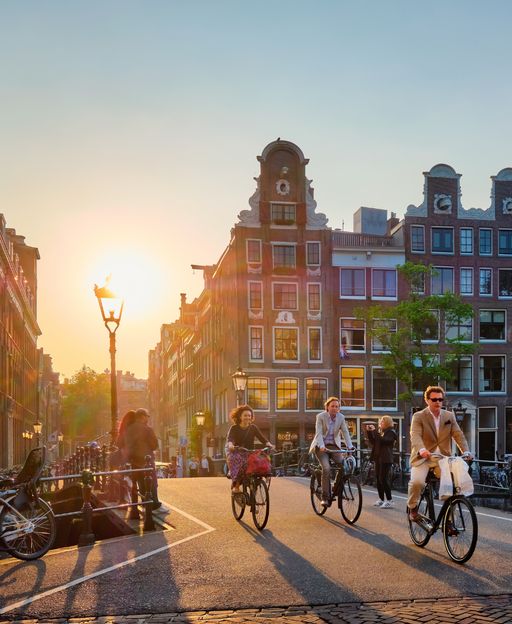
On a Tuesday morning in Amsterdam, a man in a suit cycles through heavy rain. He holds an umbrella in one hand and steers with the other. He does not hurry. He looks, frankly, as if the rain is irrelevant.
Nobody on the pavement finds this unusual. That tells you everything.
More Bikes Than People
The Netherlands has roughly 23 million bicycles for 18 million people. That is not a quirky statistic. It is a clue.
In most countries, cycling is a hobby or a workout. Here, it is infrastructure. Children cycle to school at eight. Grandparents cycle to the market at 80. Office workers cycle to meetings. Nobody thinks this is remarkable.
The Dutch cycle around 15 billion kilometres every year. That works out to roughly 900 kilometres per person — every year, without trying.
If you are new to the Netherlands and want to understand the country from the ground up, the Start Here guide is the best place to begin.
How It Happened — The Protest Nobody Expected
The Netherlands was not always like this. In the 1960s and early 1970s, cars arrived in large numbers. Roads expanded. Children died in traffic accidents at alarming rates.
In 1972, Dutch parents launched a campaign called Stop de Kindermoord — “Stop the Child Murder.” It was not polite. It was not subtle. It worked.
The 1973 oil crisis arrived at exactly the right moment. Fuel prices surged. The Dutch government introduced car-free Sundays. Families discovered the pleasure of empty streets.
Politicians took note. Over the following decades, they built separated cycle lanes — not painted lines, but physical infrastructure. Raised paths. Protected junctions. The design prioritised bikes over cars at almost every conflict point.
What Visitors Always Get Wrong
Tourists in Amsterdam sometimes think the cycle paths are shared paths. They are not.
Step onto a cycle lane and cyclists will not slow down for you. They will ring a bell once, loudly. They do not expect you to apologise. They expect you to move.
This is not aggression. It is a system. The cycle path belongs to cyclists the way the road belongs to cars. Visitors who grasp this quickly have a much better time.
Enjoying this? Get stories like this every week from Love Netherlands — Subscribe free →
Why Nobody Wears a Helmet
Ask a Dutch person why they don’t wear a cycling helmet. They will look at you as if you have asked why they don’t wear a seatbelt while walking.
Helmet use among everyday Dutch cyclists sits below 1%. This is not recklessness. It reflects the infrastructure.
When cycle paths separate bikes from cars, when junctions prioritise cyclists, when average speeds stay around 15 km/h on flat streets — the risk profile changes completely. The danger that makes helmets sensible in Britain or the US does not exist at the same level here.
Dutch cycling advocates argued in the 1990s that compulsory helmets would reduce cycling rates by making the activity feel dangerous. They were probably right.
What a Cycling Country Looks Like from the Inside
In Dutch cities, bike parking is a serious logistical challenge. Not because there is too little — there is a lot — but because there are simply so many bikes.
Amsterdam’s central station has three levels of underground cycle parking. It holds over 7,000 bicycles. It is usually full.
Cycling shapes how Dutch cities feel. Streets are quieter. The air is cleaner. People move at a pace that lets them notice each other. You can stop a friend on a cycle path for a chat in a way you cannot in a traffic jam.
Part of the warmth Dutch cities carry comes from streets built for people rather than engines. If you want to understand the language behind that warmth, read about the Dutch words that have no English translation — words like gezellig that describe what happens when a city slows down enough to breathe.
Where to Experience It as a Visitor
You do not need to be Dutch to cycle here. Most Dutch cities have bike hire shops open from early morning. The infrastructure does most of the work.
Start in a smaller city if Amsterdam feels overwhelming. Utrecht has a cycling network just as extensive, and streets that feel easier for newcomers. Explore Utrecht’s hidden canal wharfs before you arrive — they sit below street level and most visitors walk straight past them.
Rent a bike for half a day. Cycle somewhere without a destination. The Netherlands opens up differently from two wheels.
Frequently Asked Questions
Is it safe to cycle in the Netherlands as a tourist?
Yes. The Netherlands has some of the safest cycling infrastructure in the world. Separated bike lanes and clear road rules make it straightforward for first-time visitors. Learn the basic rule — stay off the red lanes — and you will be fine.
What is the best city in the Netherlands for cycling?
Groningen consistently ranks as the Netherlands’ most cycling-friendly city. Amsterdam, Utrecht, and Delft are all excellent, with well-marked routes and plentiful bike hire options near central stations.
Why do Dutch people cycle without helmets?
Dutch cycling infrastructure separates bikes from cars almost entirely. At lower speeds on dedicated lanes, the risk profile differs fundamentally from cycling in mixed traffic. Helmets are uncommon because the infrastructure makes them unnecessary for everyday journeys.
How much does it cost to hire a bike in the Netherlands?
A day’s bike hire typically costs between €12 and €20 in most Dutch cities. Many train stations have hire shops on the platform, making it easy to cycle from the moment you arrive.
Love Netherlands — Free Every Week
Canal towns, hidden villages, Dutch stories. A free letter about the Netherlands — written slowly, delivered weekly.
Love more? Join 64,000 Ireland lovers → · Join 43,000 Scotland lovers → · Join 30,000 Italy lovers →
Free forever · One email per week · Unsubscribe anytime
The Dutch do not cycle because it is healthy. They do not cycle because it is green. They cycle because the streets were built for it, the habit was handed down, and nobody ever found a reason to stop. If that sounds simple, it is. The best things usually are.
Tours & experiences you might love


Powered by Viator. Some links are affiliate links — we may earn a small commission at no extra cost to you.