
Groningen sits in the far north of the Netherlands, a two-hour train ride from Amsterdam. Most visitors to the country never make it this far. That is their loss.
A City Built Around the Bicycle
Groningen has one of the highest cycling rates of any city on earth. On a busy morning, the Vismarkt square fills with hundreds of bikes locked to every available fence and railing. Students, shopkeepers, professors, and grandparents all ride. Nobody asks why. It simply is how life works here.
The city began redesigning its streets for cyclists and pedestrians in the 1970s, decades before the rest of the world discussed it. The main shopping streets are car-free. Groningen did not do this reluctantly — the city embraced it. If you want to understand why the Dutch cycle everywhere, Groningen is where that story reaches its most complete form.
On a dry spring day, the canal paths fill with cyclists heading in every direction. On a wet Tuesday in November, the same paths fill with cyclists heading in every direction. The weather, here, is not a factor.
The Tower at the Heart of the Old City
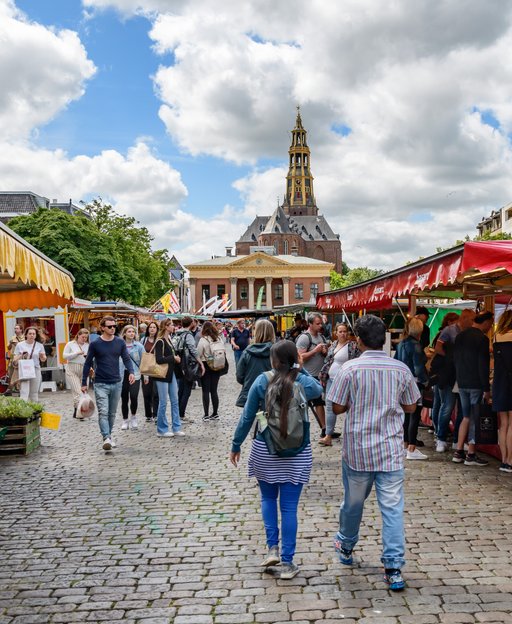
At the centre of Groningen stands the Martinitoren — a 97-metre church tower built in the fifteenth century. Locals call it d’Olle Grieze, which means the Old Grey One. You can climb 262 steps to the top and look out over flat farmland stretching to the horizon in every direction.
Beside it stands the Martinikerk, a church that dates from the thirteenth century. Its interior still holds fragments of medieval wall paintings that survived the Reformation. The tower rings its bells every quarter-hour. After a day in the city, that sound becomes part of the rhythm of the place.
The square around the church connects to the Grote Markt — the main market square. Terraces fill the square in warmer months, and a market runs through the week. The whole area feels lived-in rather than preserved for visitors.
The Museum That Looks Like No Other
The Groninger Museum sits on a small island in the canal between the train station and the old town. The architect Alessandro Mendini designed it in 1994 using a series of interlocking towers, each clad in different colours and materials. It looks like something assembled from oversized building blocks. Nobody could call it subtle.
Inside, the collection moves between contemporary international art and the history of the Groningen region. It tells the story of a province that has always felt slightly apart from the rest of the Netherlands — proud, independent, and with its own distinct character.
Enjoying this? Get stories like this every week from Love Netherlands — Subscribe free →
Forum Groningen and the Energy of the City
Groningen opened the Forum Groningen in 2019 — a large cultural centre just off the Grote Markt. It holds a cinema, a public library, a rooftop café, and an exhibition space about the city and the province. The roof terrace gives a clear panorama over the old centre, with the Martinitoren rising above everything else.
The city has roughly 60,000 students — about a third of its total population. Groningen University dates from 1614. That long history of learning gives the city an energy and openness that many larger Dutch cities struggle to match.
Bars stay open late. Markets run through the week. There is a pace to Groningen that feels different from the busier cities further south. If you are still deciding where to go in the Netherlands, the start here guide covers the full range of what the country offers.
Getting Around — and Getting Out
The old city sits inside a ring canal, and almost everything worth visiting lies within cycling distance. Hire a bike at the train station. The Vismarkt, the Martinitoren, the Groninger Museum, and the Forum all sit within a fifteen-minute ride of each other.
Groningen also works well as a base for the surrounding province. The Wadden Sea coast lies about an hour to the north. The quiet villages of the Groninger countryside spread in every direction — flat, unhurried, and almost entirely unvisited by tourists.
For a different Dutch city experience on a human scale, Haarlem is worth considering alongside a trip north. The two cities share a similar spirit — but Groningen has a distinctly northern character that belongs entirely to itself.
What is the best time to visit Groningen in the Netherlands?
Spring (April to June) and early autumn (September to October) offer the most pleasant weather. Summer brings the terrace season and festivals. Winter is quieter but suits museums and markets well.
How do you get to Groningen from Amsterdam?
Direct trains run from Amsterdam Centraal to Groningen every hour. The journey takes around two hours and ten minutes. The station sits right next to the Groninger Museum and the edge of the old town.
Is Groningen worth visiting as a tourist?
Yes — particularly if you want to experience the Netherlands beyond the standard tourist routes. The city has excellent museums, lively squares, strong cycling culture, and a historic centre that does not feel overrun with visitors.
What is Groningen most known for?
Groningen is known for its cycling culture, the medieval Martinitoren, the colourful Groninger Museum building, the Forum Groningen cultural centre, and a large student population that keeps the city energetic year-round.
Love Netherlands — Free Every Week
Canal towns, hidden villages, Dutch stories. A free letter about the Netherlands — written slowly, delivered weekly.
Love more? Join 64,000 Ireland lovers → · Join 43,000 Scotland lovers → · Join 30,000 Italy lovers →
Free forever · One email per week · Unsubscribe anytime
Most of the Netherlands gets discovered quickly. Groningen has been quietly getting on with things regardless. That, of course, is exactly what makes it worth the journey north.
Tours & experiences you might love


Powered by Viator. Some links are affiliate links — we may earn a small commission at no extra cost to you.