

Walk through any Dutch farm in spring and you will see them by the barn door — mud-caked and battered, lined up like soldiers. Not rubber boots. Not leather shoes. Wooden clogs. Around three million pairs are still made in the Netherlands every year, and most of them never reach a tourist shop.
Why Wood Works
Dutch farmland sits below sea level. It is cold, wet, and soft underfoot for much of the year. When farmers first shaped poplar wood into shoes around the 13th century, they were not making a fashion statement. They were solving a problem that rubber had not yet been invented to solve.
Wood creates a natural air pocket that keeps feet warm even on frozen ground. A fresh pair of clogs is almost impermeable to water — the tight grain seals out moisture better than most leather. Unlike rubber boots, wooden clogs breathe. Wear rubber boots for a full day in a dairy barn and your feet will know about it.
Farmers have known this for centuries. The clog was not tradition for tradition’s sake. It was the right tool for wet, cold, heavy ground.
How to Read a Clog
Not all Dutch clogs look the same. Before railways and mass production, every region of the Netherlands developed its own style. A skilled eye could tell where a person came from by the shape of their shoes.
North Holland clogs curve upward at the toe and sit low at the heel — built for flat polder land. Frisian clogs carry a sharper point and often bear carved patterns. Wooden shoes from Zeeland are wider and sturdier, made for the heavier clay soil of the island province.
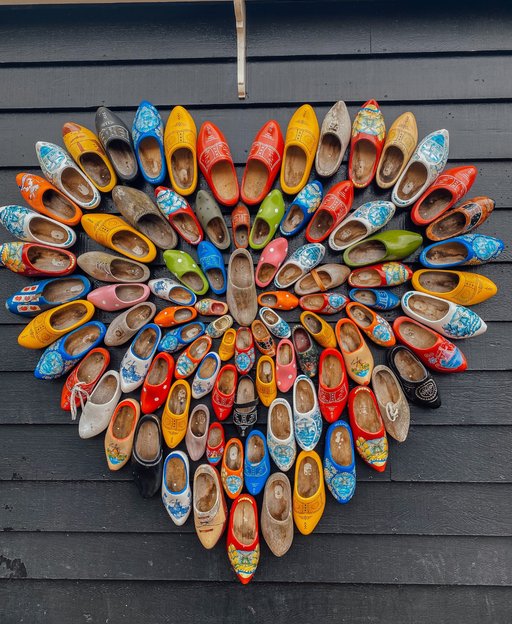
The paint tells its own story. Plain yellow meant working shoes. Decorated clogs — painted with tulips, windmills, or geometric patterns — were kept for market day, weddings, or Sunday church. The painted clog was the dressed-up version. The yellow one did the real work.
Where Clogs Are Still Worn
Enjoying this? Get stories like this every week from Love Netherlands — Subscribe free →
The clogs sold in tourist shops are not the clogs that farmers wear. The tourist version is lightweight, painted, and sometimes made from synthetic materials. A genuine farmer’s clog is cut from a single block of poplar or willow. One standard pair weighs around 900 grams — heavier than a leather boot.
In the Netherlands today, roughly 700,000 people still use clogs regularly. Farmers wear them in barns and fields. Gardeners use them to protect against sharp tools. Florists stand on wet concrete for hours — wooden clogs cushion and warm the feet. Butchers in traditional shops still pull them on before the morning shift.
The clog never disappeared. It simply moved off the tourist trail and back to the farm.
Where Clogs Are Still Made
Zaanse Schans, 20 minutes north of Amsterdam, is one of the last places you can watch a clog carved by hand. A skilled clog-maker shapes a pair from a block of wood in around eight minutes, using chisels and a wooden lathe. The workshop sits alongside windmills and painted houses that this living village has preserved for generations.
Further south, small workshops in North Brabant and Gelderland still supply clogs to farms across the country. Some have been making them in the same family for five or six generations. They do not advertise widely. Most of their customers already know where to find them.
The Clog Makers’ Secret
The key to a good clog is the wood. Poplar is used most often — soft enough to carve quickly, dense enough to hold its shape. The wood must be freshly cut, still containing enough moisture to work without splitting. Rush the drying and the clog will crack.
Old clog-makers say the best pairs come from trees felled in late autumn, when the sap has dropped and the wood is most stable. Some still test the grain by listening — a hollow thud when struck means the wood is wrong. A clear, solid knock means it is ready.
That knowledge does not come from a manual. It comes from standing beside someone who already knows, for years, until the sound becomes obvious.
Why Tourists Got It Wrong
At some point in the 20th century, the wooden clog became a caricature. Painted in garish colours, stacked beside plastic windmills, sold as a joke about a country that had supposedly moved on. It became easy to dismiss.
The farmers lining up their clogs by the barn door have a different view. For them, the clog is simply the best tool for wet ground, cold mornings, and long hours on their feet. It is warm in winter, tough underfoot, and kind to the back after hours of standing. Dutch farmers are famously practical people. If something better had come along, they would use it.
Nothing better has come along. If you want to understand the Netherlands that tourists rarely see, start here.
Are Dutch wooden clogs still worn today in the Netherlands?
Yes. Around 700,000 Dutch people still use clogs regularly, mostly farmers, gardeners, and those who work on wet floors. Roughly three million pairs are produced in the Netherlands each year, and most are sold for everyday use, not as souvenirs.
Where can I see Dutch clogs being made?
Zaanse Schans, around 20 minutes north of Amsterdam, has a working clog workshop where craftspeople shape a pair by hand in around eight minutes. Demonstrations run throughout the day and are free to watch.
What are Dutch clogs made from?
Most clogs are carved from a single block of poplar or willow wood. Poplar is the most common choice — soft enough to work quickly, dense enough to last. The wood is freshly cut and allowed to dry slowly after shaping to prevent cracking.
How long do Dutch clogs last?
A well-made pair of Dutch clogs lasts two to four years with daily farm use. Many farmers rotate their clogs to barn shoes once the soles thin, extending the life of the wood. A good pair bought from a working clog workshop will outlast most leather shoes.
The clog is not a souvenir. It is a solution — one that eight centuries of practical Dutch thinking has not yet found reason to improve.
Love Netherlands — Free Every Week
Canal towns, hidden villages, Dutch stories. A free letter about the Netherlands — written slowly, delivered weekly.
Love more? Join 64,000 Ireland lovers → · Join 43,000 Scotland lovers → · Join 30,000 Italy lovers →
Free forever · One email per week · Unsubscribe anytime
Tours & experiences you might love


Powered by Viator. Some links are affiliate links — we may earn a small commission at no extra cost to you.