
Every year in mid-November, a steamboat eases into a Dutch harbour and a tall figure in a red bishop’s cope and mitre steps ashore to crowds of waving children — and much of the country watches it live on television. This is not Christmas and the man is not Santa Claus: he is Sinterklaas, and his arrival opens a three-week season that ends on the evening of 5 December with poems, sweets, and piles of presents. We have spent years untangling what is genuine tradition here from what visitors assume, and this is Guide № 013 in The Love Netherlands Guide series.
Get the Full Collectible Guide (Free PDF)
Sinterklaas — in a beautifully designed, printable booklet. The Love Netherlands Guide № 013.
Who Sinterklaas Actually Is
Sinterklaas is rooted in Saint Nicholas of Myra, a 4th-century bishop in what is now Demre in southern Turkey, long venerated as the patron saint of children and of sailors. His feast day falls on 6 December, the traditional anniversary of his death, and across the centuries the solemn saint’s day grew into a gift-bringing festival for children in the Low Countries. He is depicted as an elderly man with a long white beard, a red robe, a tall bishop’s mitre, and a gold crosier, and he keeps a large red book said to record whether each child has been good.
The Dutch name “Sinterklaas” is a contraction of “Sint Nicolaas,” and it is also the direct ancestor of the English “Santa Claus” — Dutch settlers carried the tradition to New Amsterdam, later New York, where it merged with other customs into the modern Santa. Saint Nicholas is also the patron saint of Amsterdam, and you can see the theme treated by the Dutch masters: Jan Steen’s painting The Feast of Saint Nicholas hangs in the Rijksmuseum, showing a 17th-century family on the morning after the celebration.
The Arrival and the Steamboat from Spain
Tradition holds that Sinterklaas lives in Spain for most of the year and travels to the Netherlands by steamboat (stoomboot), loaded with gifts and sweets. The national arrival, the landelijke intocht, takes place on a Saturday in mid-November — usually the first weekend after Sint-Maarten on 11 November — and is hosted by a different town each year, with hundreds of smaller local intochten following in the weeks after. The Spanish connection is folklore rather than biography; it is commonly linked to the oranges, mandarins, and spices associated with the season and with trade routes, not to any claim that the saint was Spanish.
Once ashore, Sinterklaas traditionally parades through town on a grey-white horse, long known as Amerigo and, since a 2019 renaming by the public broadcaster, often called Ozosnel. The national intocht is broadcast live, and in the run-up children follow Het Sinterklaasjournaal, a daily news-style programme produced by NTR and shown on the children’s channel NPO Zapp since 2001, which spins a light serial storyline — a missing boat, a mislaid sack of presents — that builds toward 5 December.
Putting Out the Shoe
Between the arrival and the main celebration, Dutch children “set the shoe” (schoen zetten). They place a shoe by the fireplace, the radiator, or the back door, often with a carrot, some hay, or a drawing for the horse, and sometimes sing a Sinterklaas song before bed. In the morning they find a small gift or a handful of sweets, left — so the story goes — by Sinterklaas and his helpers, who are said to come down the chimney. Families vary in how often this happens, from once or twice across the season to several times, and the small finds are deliberately modest to save the larger presents for the end.
Pakjesavond, Poems, and Surprises
The high point is Pakjesavond (“parcel evening”) on 5 December, the eve of the feast day, when the main gifts are exchanged. For younger children, a knock at the door and a sack of presents left on the doorstep stand in for a visit from Sinterklaas himself. Among older children and adults the custom shifts: people draw lots (lootjes) to give to one another and wrap presents inside elaborate handmade creations called surprises (pronounced sur-PREE-ses), each accompanied by a teasing rhyming poem that pokes gentle fun at the recipient. In Belgium and parts of the Dutch Catholic south, gifts traditionally appear on the morning of 6 December instead.
What’s on the Table
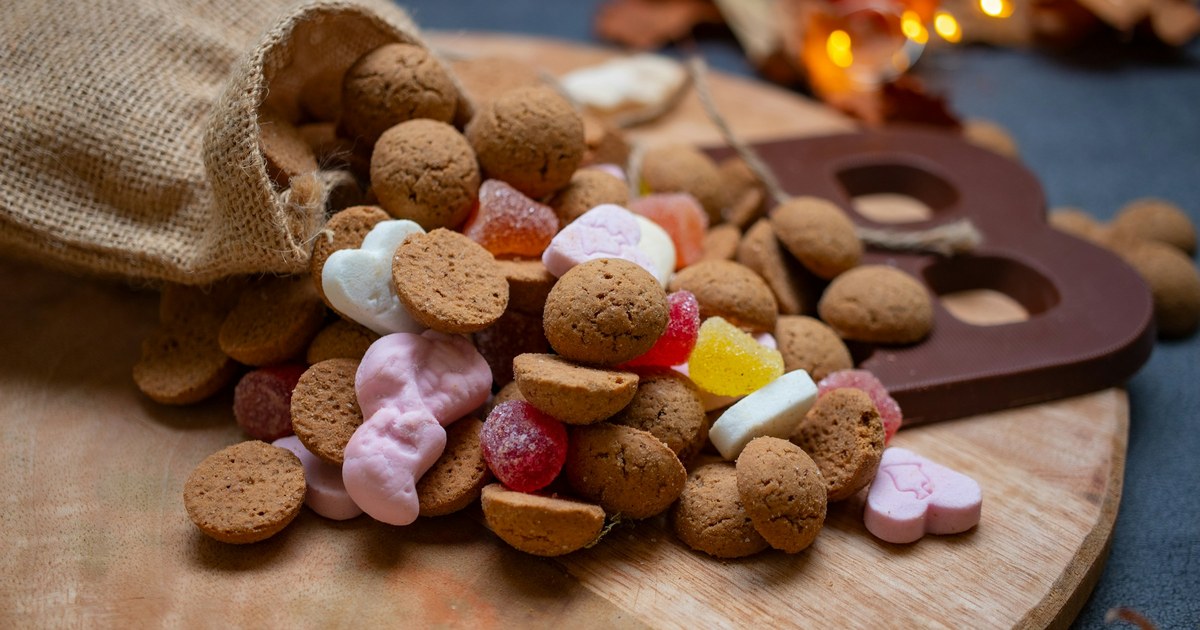
The season has its own pantry. Kruidnoten — small, round, hard spiced biscuits — are scattered by the handful, and are frequently confused with pepernoten, which traditionally are softer and chewier, though the two names are now used almost interchangeably in shops. Other staples include speculaas (thin spiced biscuits often pressed with images of the saint), chewy taaitaai figures, marzipan (marsepein) shaped into fruits and animals, and chocolate coins.
The signature treat is the chocoladeletter, a solid chocolate letter — usually the first initial of the recipient’s name — found everywhere from supermarkets to specialists. Dutch chocolate houses such as Droste and Verkade produce them each autumn, and retailers like HEMA are known for their own house versions. For the wider context of the celebration and regional events, the national tourism site Holland.com is a reliable starting point.
Myths Worth Retiring
Myth: Sinterklaas is just the Dutch word for Santa Claus. It is the other way around — Santa Claus descends from Sinterklaas by way of Dutch settlers in old New York. In the Netherlands the two are separate figures: Sinterklaas celebrated on 5–6 December, and the Kerstman (Father Christmas) associated with 25 December. Many families mark both.
Myth: He comes from Spain because the saint was Spanish. Saint Nicholas was a bishop in Myra, in modern Turkey. The Spanish link is a later tradition, often tied to the oranges, mandarins, and spices of the season rather than to the historical man.
Myth: Pepernoten and kruidnoten are the same thing. Strictly, kruidnoten are the small hard round biscuits most people picture, while pepernoten were traditionally softer and chewier. Everyday shop labelling has blurred the line, but purists still draw the distinction.
Frequently Asked Questions
When exactly is Sinterklaas celebrated?
The season opens with his televised arrival on a Saturday in mid-November, usually the first weekend after 11 November. The main celebration is Pakjesavond on the evening of 5 December, and the feast day itself is 6 December. Shoes are set and gifts appear at intervals across the whole period.
Is Sinterklaas the same as Santa Claus?
No. They share an ancestor — the English Santa Claus grew out of the Dutch Sinterklaas — but in the Netherlands they are distinct. Sinterklaas is a bishop figure celebrated in early December, while the Kerstman belongs to Christmas on 25 December. Treat them as two separate occasions.
What should a visitor try during the season?
Reach for a chocoladeletter in your own initial, a bag of kruidnoten, some speculaas, and a piece of marsepein. If you are invited to a Dutch Pakjesavond, be ready for the custom of giving a small present wrapped in a handmade surprise with a rhyming poem — the humour, not the cost, is the point.
More The Love Netherlands Guides
The Love Netherlands Guide is a numbered series — one tightly focused subject at a time, each with its own downloadable collectible edition. Guide № 001 is Stroopwafel, Guide № 002 is King’s Day (Koningsdag), Guide № 003 is Delft Blue Pottery, Guide № 004 is Dutch Jenever, Guide № 005 is Dutch Cycling Culture, Guide № 006 is Gezelligheid, Guide № 007 is Dutch Beer & Brewing, Guide № 008 is Dutch Brass Bands, Guide № 009 is Wooden Clogs (Klompen), Guide № 010 is Dutch Windmill Folklore, Guide № 011 is Dutch Sayings & Proverbs, Guide № 012 is The Dutch Breakfast (Hagelslag), This is Guide № 013. More editions are on the way.
🇳🇱 Join Love Netherlands
Free stories and local tips from Netherlands, from people who live and love it.
Tours & experiences you might love


Powered by Viator. Some links are affiliate links — we may earn a small commission at no extra cost to you.