
A stopped windmill is still talking. For centuries a Dutch miller could freeze the great sails in a chosen position and announce a birth, a death, a day of rest or a warning — a code read from across the polder long before anyone owned a telephone. That silent language, and the beliefs wrapped around the mills that spoke it, is the subject of Guide № 010 in The Love Netherlands Guide series.
Get the Full Collectible Guide (Free PDF)
Dutch Windmill Folklore — in a beautifully designed, printable booklet. The Love Netherlands Guide № 010.
Most Windmills Pumped Water, Not Flour
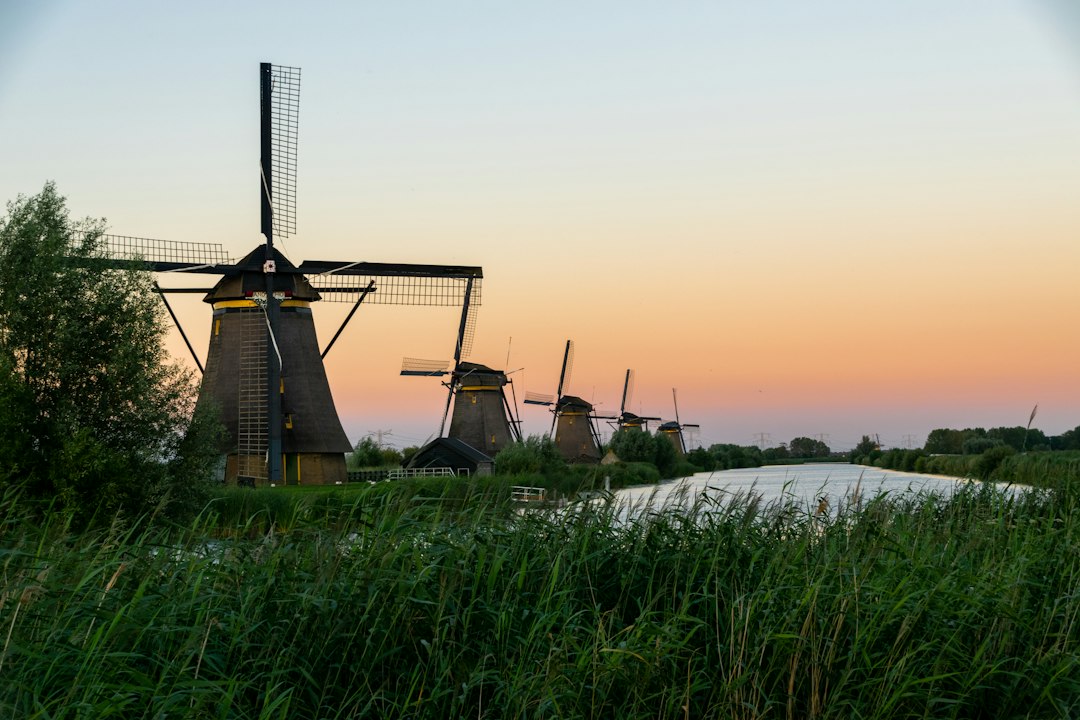
The postcard image is a miller grinding grain, but the majority of historic Dutch windmills were built to move water. Large stretches of the country sit below sea level, and drainage mills (poldermolens) turned scoop wheels or Archimedean screws to lift water out of reclaimed land called polders, stage by stage, into higher canals and out to sea. The nineteen mills at Kinderdijk, built around 1740 to drain the Alblasserwaard, are the best-known survivors and have been inscribed on the UNESCO World Heritage list since 1997.
Grain, oil, paper, dyewood and malt mills existed too, often clustered as industrial estates. The Zaanse Schans near Zaandam preserves working examples of these trade mills, and the nearby Zaans Museum traces the Zaan region’s era as one of the earliest industrial zones in Europe. In Schiedam, mills were built exceptionally tall so their sails could catch wind above the town’s warehouses while grinding malt for jenever.
The Language of the Sails
When a mill is idle, the position of its four sails carries meaning. Millers traditionally use two “rest” positions: sails left as an upright cross — one blade pointing straight up — signal a short pause, with the mill expected to turn again soon, while sails left as a diagonal X signal a longer stop. Over this sit the two emotional positions. A sail halted just before the highest point is the “coming” or joy position (vreugdestand), flown for a birth, an engagement or a wedding. A sail stopped just after the highest point is the “going” or mourning position (rouwstand), set when the miller’s family or the village was in grief.
Because the sails were visible for miles, the code worked as a regional broadcast. It is widely recounted that during the German occupation of 1940–1945 some millers used sail positions and the rigging of canvas to pass signals — warnings to people hiding on farms, or all-clears — though such stories are hard to verify mill by mill. The organisation De Hollandsche Molen, founded in 1923 to protect the country’s windmills, still documents these conventions.
Marks, Blessings and the Miller’s Craft
A working miller “dresses” the sails by spreading canvas over wooden lattice frames and adjusting how much is exposed to the wind, which is why the same mill can look skeletal one day and fully clothed the next. Festive dressing went further: mills were decorated with greenery, flags and painted boards for weddings, royal occasions and the return of a village son. Many mills also carry names — after a saint, a former owner, a trade or a virtue such as Hoop (Hope) — and a name was thought to give the mill its own character.
Keeping the craft alive is a volunteer effort. The Gilde van Vrijwillige Molenaars (Guild of Volunteer Millers) trains and certifies amateur millers who pass a national exam before they may operate a mill unsupervised, since a sudden gust on an unbraked mill is genuinely dangerous. This is why so many historic mills still turn today rather than standing as frozen monuments.
Weather, Luck and the Turning Cross
Millers lived by the wind, so much of the folklore is practical weather-lore dressed as belief: reading cloud and sky, the dread of a dead calm that stopped all income, and the opposite fear of a storm that could tear the sails or spin the mechanism out of control. Fire was the great terror, because friction in the dry, dusty cap could ignite, and a line of carved or painted charms, horseshoes and dates on the beams was as much insurance in spirit as in timber.
The four-armed sail cross also drifted into wider superstition. It is commonly said that a mill turning “the wrong way” — anticlockwise, against the usual sense a miller sets for braking — was read as a bad omen, and leaving the sails in the mourning position by accident was considered unlucky. Whether anyone truly believed it or simply respected the code, the habit of setting the sails deliberately rather than carelessly has survived.
Where the Folklore Still Turns
You can still see these traditions in action. Alongside Kinderdijk and the Zaanse Schans, Amsterdam keeps the fully working Molen van Sloten, a drainage mill open for guided visits, while the tall brick De Gooyer mill presides over the Brouwerij ‘t IJ brewery on the city’s east side. The best single day to catch mills dressed and turning is Nationale Molen- en Gemalendag, held on a weekend in May each year, when hundreds of mills across the country open their doors — details are published through De Hollandsche Molen.
Myths Worth Retiring
Myth: Dutch windmills were mainly for grinding grain. Most were drainage mills built to pump water off reclaimed land; grain, oil and malt mills were a smaller, separate trade.
Myth: The blades are fixed wooden “sails” that never change. They are open wooden frames that the miller rigs with canvas, spreading more or less of it to control the mill in different winds.
Myth: Windmills are purely decorative museum pieces now. Around a thousand historic windmills survive, and many still work, operated by certified volunteer millers.
Frequently Asked Questions
How many windmills are left in the Netherlands?
Roughly a thousand traditional windmills survive, a small fraction of the many thousands that once stood. Figures vary by how you count, but De Hollandsche Molen keeps a national register and campaigns to preserve them.
Can you go inside a working windmill?
Yes. Mills at Kinderdijk, the Zaanse Schans and the Molen van Sloten welcome visitors, often with a volunteer miller on hand, and far more open to the public on Nationale Molendag in May.
What do the sail positions actually mean?
An upright cross signals a short rest and a diagonal X a longer one. A top sail stopped just before the highest point marks joy, such as a birth or wedding, and just after it marks mourning.
More The Love Netherlands Guides
The Love Netherlands Guide is a numbered series — one tightly focused subject at a time, each with its own downloadable collectible edition. Guide № 001 is Stroopwafel, Guide № 002 is King’s Day (Koningsdag), Guide № 003 is Delft Blue Pottery, Guide № 004 is Dutch Jenever, Guide № 005 is Dutch Cycling Culture, Guide № 006 is Gezelligheid, Guide № 007 is Dutch Beer & Brewing, Guide № 008 is Dutch Brass Bands, Guide № 009 is Wooden Clogs (Klompen), This is Guide № 010. More editions are on the way.
🇳🇱 Join Love Netherlands
Every week, get hidden stories, local secrets, and travel inspiration from people who live and love it.
Tours & experiences you might love


Powered by Viator. Some links are affiliate links — we may earn a small commission at no extra cost to you.