
Your great-grandparents left Groningen carrying little. They crossed an ocean to build new lives in Canada, Australia, or South Africa. But they carried something invisible with them — a piece of the flat, wide-skied north that shaped who they were. If your family name traces back to the northernmost mainland province of the Netherlands, you hold a story worth finding. This guide will help you find it.
Groningen is not the Netherlands most people picture. There are no tulip fields or canal houses here. This is a land of sweeping polders, ancient church towers, and farmhouses built on raised mounds to escape the sea. It is a province shaped by hard work, cold winds, and generations of farmers who knew their soil by name. Over 80,000 Dutch people emigrated to Canada alone in the post-war decades — and Groningen sent more than its share.
Whether your Groningen ancestors left in the 1840s or the 1950s, their records exist. This guide shows you where to find them, how to read them, and how to stand in the same fields where your family once lived.
The Province Your Ancestors Called Home
Groningen sits in the far north of the Netherlands, bordered by Friesland to the west, Drenthe to the south, and Germany to the east. The province covers about 2,330 square kilometres of reclaimed lowland. It is flat, open, and vast in a way that feels almost Scandinavian.
The capital city shares the province’s name. Locals call it simply Stad — the city. Groningen city is a university town with a medieval centre, the soaring Martinitoren tower, and a youthful energy that contrasts with the quiet farming villages beyond its gates.
Your ancestors likely lived in one of those villages. Groningen’s countryside is dotted with settlements built on wierden — artificial mounds raised centuries ago to protect communities from flooding. These earthwork mounds are some of the oldest human settlements in the Netherlands. If you trace your family to a village like Winsum, Leens, Ten Boer, or Baflo, your ancestors built their homes on ancient ground.
The province also has a distinct dialect. Gronings is a Low German dialect, quite different from standard Dutch. Some families kept this dialect alive in their new countries for generations. If you have ever heard an older relative use words that sounded like a mix of Dutch and German, that is Gronings.
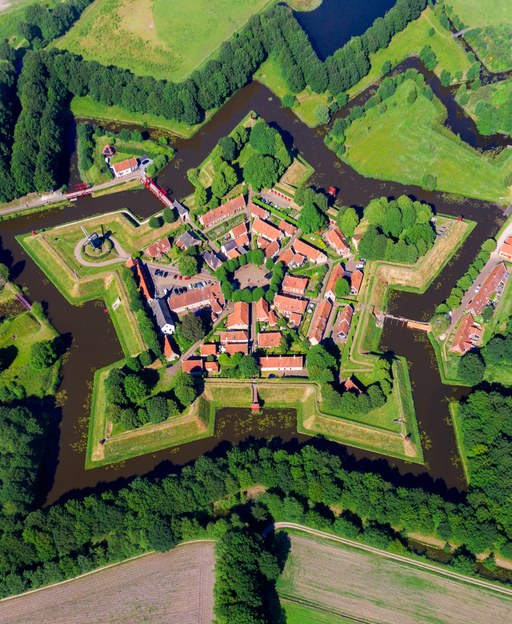
Fort Bourtange stands near the German border, a six-pointed star fortress built in 1593 during the Eighty Years’ War. Your ancestors may have lived in its shadow. It is one of the most extraordinary heritage sites in the country — and one of the best places to feel the weight of Groningen’s history under your feet. Read our Groningen heritage travel plan for a full guide to visiting.
Why So Many Groningers Left
Groningen had two major emigration waves. Each had a different cause.
The first wave ran through the mid-19th century into the early 20th century. Rural poverty drove it. The province was rich in farmland, but most of that land belonged to large landowners. Many Groningers worked as farm labourers with no land of their own. When news arrived of cheap land in America, families packed up and left. Dutch Reformed congregations in Michigan and Wisconsin drew many Groningers, particularly from the clay districts of the north and east.
The second wave was larger and more dramatic. It came after 1945. The liberation of Groningen in April 1945 left much of the province in ruins. German forces destroyed bridges, flooded farmland, and levelled parts of the city. Food was scarce. Farmhouses lay empty. Young men came home from hiding or forced labour to find little opportunity.
Canada actively recruited Dutch farmers. The Canadian government offered passage, land, and help settling in agricultural communities. Groningen families responded in thousands. Many chose Ontario — the Niagara Peninsula, Southwestern Ontario, and the area around Woodstock and Tillsonburg drew Dutch farming families who wanted familiar flat land. Others chose Alberta, where communities like Lacombe and Taber still hold Dutch-Canadian heritage festivals today.
Australia also received Groningen emigrants during this period. The Dutch-Australian migration agreement of 1951 opened a similar path. New South Wales and Victoria both have communities with Groningen roots.
A smaller number emigrated to South Africa, joining existing Dutch-speaking communities in the Cape Colony and Transvaal. Their surnames often appear in South African genealogy records alongside Afrikaner families from earlier centuries.
Where Groningen Families Settled
Here is where to look for Groningen diaspora communities:
- Canada: Ontario is the heartland of post-war Dutch-Canadian settlement. Look for families in Woodstock, Simcoe, Tillsonburg, Aylmer, and the Niagara Peninsula. In Alberta, check Lacombe, Taber, and Picture Butte. The Dutch-Canadian community in these areas maintains strong cultural memory.
- United States: Michigan’s Holland and Zeeland communities drew many 19th-century Groningen emigrants. Sheboygan County, Wisconsin is another Dutch-American stronghold with Groningen roots. Iowa’s Pella community also has northern Netherlands connections.
- Australia: Victoria and New South Wales received post-war Groningen emigrants. Many Dutch-Australian families in these states trace their origins to the northern Netherlands.
- South Africa: Some Groningen emigrants joined existing Dutch-Afrikaner communities in the 19th century. Surnames like De Vries, Mulder, and Prins appear in both Groningen and South African records.
- New Zealand: A smaller but significant Dutch-New Zealand community formed after 1950. Many families settled in the farming regions of the South Island.
🇳🇱 Enjoying this? Netherlands lovers get stories like this every week. Subscribe free →
How to Find Your Groningen Records
Groningen has excellent genealogy resources. Most are free to access online. Here is where to start.
Groninger Archieven
The Groninger Archieven (groningerarchieven.nl) is the provincial archive. It holds civil registration records (Burgerlijke Stand) from 1811 onwards, including births, marriages, and deaths. It also holds church records going back to the 17th century for both Reformed and Catholic congregations. The archive has digitised a large portion of its collection. You can search it online without visiting in person.
Alle Groninger Gezinnen (AGG)
This is one of the most useful genealogy databases in the Netherlands. Alle Groninger Gezinnen — All Groningen Families — is a database of reconstructed family units compiled from church and civil records. If your ancestors came from Groningen, they are likely in here. The database covers most families in the province from the 18th century onwards. Access it free at allegroningergezinnen.nl. Type in a surname and the province will open up to you.
WieWasWie
WieWasWie.nl — Who Was Who — is the national portal for Dutch civil registration records. Type in a surname and select the province of Groningen. You will find birth, marriage, and death records from 1811 to the early 20th century. Most searches are free. This is usually your best first step. Read more about using these records in our complete Dutch ancestry tracing guide.
FamilySearch
FamilySearch (familysearch.org) holds large Groningen collections. Search for “Netherlands, Groningen” in the catalogue. You will find digitised church records, civil registration records, and notarial records. FamilySearch is free and requires only a free account.
Post-War Emigration Records
If your family left for Canada or Australia after 1945, the Dutch National Archives hold emigration records. These include applications, departure documents, and sometimes correspondence. The archive is at nationaalarchief.nl. Search for the Nederlandsche Emigratie Dienst (Netherlands Emigration Service) collection. Many post-war emigrants also registered with the Dutch Red Cross, whose records are partly available online.
For Canadian immigration records, Library and Archives Canada (bac-lac.gc.ca) holds passenger lists and landing records for arrivals in Canadian ports. Dutch arrivals in the 1940s and 1950s are well documented here.
Church Records Before 1811
Before civil registration began in 1811, churches kept the records. Groningen was predominantly Dutch Reformed (Hervormde Kerk). Baptism records (doopregisters) and marriage records (trouwboeken) from the 17th and 18th centuries survive for most parishes. The Groninger Archieven holds these records. Some are digitised; others require a visit to the archive in Groningen city. The address is Cascadeplein 4 in the city centre.
For a full step-by-step plan for visiting the archives in person, read our guide to planning a Dutch heritage trip.
Common Groningen Surnames and Their Meanings
Groningen surnames tell you something about your ancestors. Many are occupational, geographical, or based on a father’s given name. Here are some of the most common:
- De Vries — means “the Frisian”. It marked someone from neighbouring Friesland. Common across the northern Netherlands.
- Mulder — means “miller”. Your ancestor ran a windmill or watermill.
- Boer — means “farmer”. One of the most straightforward Dutch surnames.
- Strating — a distinctly Groningen surname, derived from a place name meaning “at the street” or “road settlement”.
- Brontsema — a typical Groningen farm-name surname, ending in -ma or -ema which indicates Frisian or Gronings origin.
- Wieringa — another Gronings surname, likely from a farm or estate name.
- Prins — means “prince”. Often given to a child born during a royal celebration or to a family with some distinction.
- Venema — a Gronings farm-name surname, ending in -ma. Very common in the eastern districts.
- Scholtens — means “son of the Scholte”, a local official or bailiff. Common in Groningen and Drenthe.
- Drenth / Drent — indicates a family who came from the neighbouring province of Drenthe.
Surnames ending in -ma or -ema are a strong marker of northern Netherlands origin. If your family name ends this way, your roots likely lie in Groningen or Friesland.
Planning Your Heritage Visit to Groningen
No archive can replace standing in the village where your family once lived. Groningen rewards heritage visitors who are willing to look beyond the city.
Start in Groningen city. Visit the Groninger Archieven at Cascadeplein 4. Staff there speak English and can help you find records. The Martinikerk, with its famous tower, stands at the heart of the old city. Your ancestors almost certainly knew this building.
From there, head to your family’s village. Most Groningen villages have a church with a graveyard. Many Reformed church graveyards hold headstones from the 18th and 19th centuries. These graves are free to visit and often contain exactly the dates and names you need.
Fort Bourtange is worth a full afternoon. This star fortress near the German border opened as a museum in 1967. It reconstructs the 17th-century garrison town in extraordinary detail. If your family came from the eastern Groningen district — near Vlagtwedde, Ter Apel, or Wedde — Fort Bourtange was part of their world.
The wierden villages of the north are another highlight. Winsum, Leens, and Baflo sit on their ancient mounds above the surrounding polders. Walking these raised village centres connects you physically to the oldest layers of Groningen’s history. Your ancestors may have farmed the same fields for centuries before emigrating.
For a full itinerary, our 7-day Dutch heritage itinerary includes Groningen as part of a roots journey across the entire country. You can also read our detailed Groningen city guide for practical tips on accommodation, transport, and what to see in the capital.
If your ancestors were Dutch Reformed, the local gemeente (municipality) church is often the best place to ask about family history connections. Many Reformed congregations in Groningen maintain their own records and welcome heritage visitors.
Frequently Asked Questions
How do I know if my ancestors came from Groningen?
Start with what you know. If your family emigrated to Canada in the late 1940s or 1950s, Groningen is a strong possibility — the province sent more post-war emigrants to Canada than almost anywhere else in the Netherlands. Surnames ending in -ma, -ema, or -inga often indicate northern Netherlands origin. If you have a birth certificate or naturalisation document, it will name the original place of birth.
Are Groningen genealogy records available in English?
The records themselves are in Dutch, but the key genealogy databases — WieWasWie.nl, Alle Groninger Gezinnen, and FamilySearch — all have English-language interfaces. You do not need to speak Dutch to search for names and dates. If you find a document you cannot read, the Groninger Archieven staff can often help via email, and many Dutch genealogy Facebook groups have volunteers who translate old documents.
What records exist for Groningen before 1811?
Reformed church baptism and marriage registers survive for most Groningen parishes from the 17th and 18th centuries. The Groninger Archieven holds these at Cascadeplein 4 in Groningen city, and many are partially digitised online. Catholic records are less extensive but also survive for parishes in the south of the province. Some notarial records (legal documents such as wills and land transfers) go back to the 1600s.
Why is the Alle Groninger Gezinnen database special?
Alle Groninger Gezinnen (All Groningen Families) reconstructed entire family units from church and civil records. Instead of finding just an individual birth or marriage, you see the whole family — parents, children, and dates — in a single record. It covers most Groningen families from the 18th century onwards. This makes it much faster to trace family lines than searching record by record. Access it free at allegroningergezinnen.nl.
Can I visit the Groninger Archieven as a heritage tourist?
Yes. The Groninger Archieven at Cascadeplein 4 welcomes researchers, including heritage visitors from abroad. Staff speak English. You will need to register when you arrive and bring identification. The archive is free to use. Bring any names, dates, and places you already know — the staff can often find relevant records very quickly if you have a starting point.
You Might Also Enjoy
- How to Trace Your Dutch Ancestry – Complete Step-by-Step Guide (2026)
- Tracing Your Family in Groningen: A Heritage Travel Plan
- How to Plan a Dutch Heritage Trip to Your Ancestral Town
Join Netherlands Lovers
Every week, discover the Netherlands beyond the tourist trail — hidden villages, local recipes, cycling routes, and travel insights you won’t find in any guidebook.
Subscribe free — enter your email:
Already subscribed? Explore our archives for more hidden Dutch gems.
Love more? Join 64,000 Ireland lovers → · Join 43,000 Scotland lovers → · Join 30,000 Italy lovers →
Free forever · One email per week · Unsubscribe anytime
Plan Your Netherlands Trip
Ready to walk the streets your ancestors walked? Our Start Here guide covers everything you need to plan a trip to the Netherlands — from getting there to finding accommodation near the archives where your family’s records are kept.
Tours & experiences you might love


Powered by Viator. Some links are affiliate links — we may earn a small commission at no extra cost to you.