

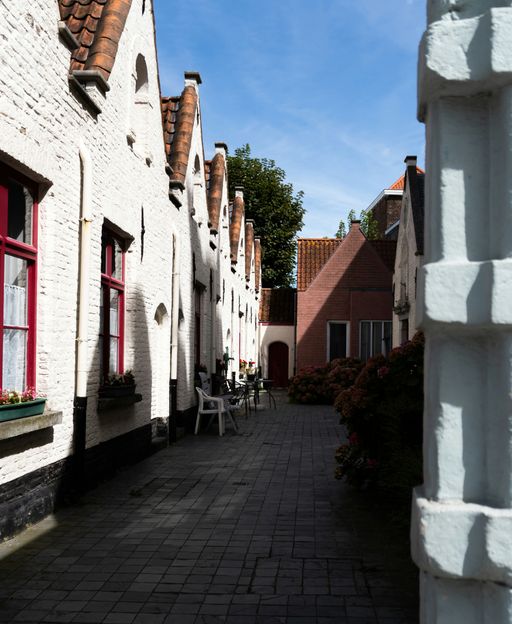
Walk into Thorn and you feel like someone turned down the colour. White walls line every lane. White stone, white plaster, white paint — each building washed clean as a fresh page. This tiny Limburg village looks like it belongs on a Greek island, not the Dutch lowlands. Nobody can quite agree on how it got this way.
A Village at the Edge of Empires
Thorn sits in the south of Limburg, close to the Belgian border, in the rolling hills that most outsiders never expect in the Netherlands. For eight centuries, it functioned as an independent religious state — a Reichsabtei, or imperial abbey — under the rule of a succession of noblewomen. The abbess of Thorn answered only to the Holy Roman Emperor.
French revolutionary troops dissolved the abbey in 1797 and absorbed Thorn into the new Batavian Republic. The ladies of the abbey were gone. The village had to find a new identity.
What followed over the next fifty years shaped the village you see today — though not in any way anyone planned.
Why Did They Paint It White?
Here is where the story gets murky — and far more interesting.
One explanation points to Belgian-Dutch politics. When Belgium separated from the Netherlands in 1830, the border ran straight through this part of Limburg. Residents found themselves in disputed territory. Local tradition says families on both sides painted their houses white as a sign of neutrality — neither Dutch nor Belgian, just Thorn.
A second theory blames a French property tax on bricks. By covering brickwork in lime plaster, homeowners could reduce their assessed value. White was the cheapest option available.
A third theory traces the style back to the abbey itself. The original religious buildings were already white. New owners took over the empty abbey properties after 1797 and kept the look. The rest of the village followed gradually.
Local historians still argue. Nobody has proved any single explanation. What is certain: by the nineteenth century, white had become Thorn’s defining character — and nobody saw any reason to change it.
Walking Through the Village Today
Enjoying this? Get stories like this every week from Love Netherlands — Subscribe free →
Thorn is small. You can walk the entire historic centre in twenty minutes. The streets are narrow and cobbled, lined with whitewashed almshouses dating to the seventeenth and eighteenth centuries. Window boxes trail geraniums in summer. Red shutters add a jolt of colour against all that white.
The church at the centre stands on the site of the original abbey. Its crypt holds some of the oldest stonework in this part of the Netherlands. Locals call Thorn the Witte Stadje — the Little White Town — and the name fits perfectly.
What strikes most visitors is the quiet. Thorn sits an hour from Eindhoven and ninety minutes from Amsterdam, yet the international crowd has not found it yet. That may not last.
Who Lives Here Now?
About 2,500 people call Thorn home. It is a real village, not a museum. Residents garden, walk dogs, and hang washing out. A handful of restaurants and a few shops serve Dutch day-trippers who arrive on summer weekends to cycle the surrounding countryside.
Thorn sits in the heart of the Maasvallei — the Maas valley. The Belgian border is minutes away. Rolling hills stretch in every direction. If you have already explored the castles and hills of Limburg, you will know this corner of the country feels nothing like the flat north. Thorn belongs to that different Netherlands — older, quieter, Catholic, and very much its own thing.
The Best Time to Come
Thorn rewards a visit in almost any season. Summer brings window boxes in full bloom and long golden evenings. Autumn turns the surrounding hills amber and rust. In winter, when the day-trippers stay home, the white streets are entirely empty — and the village looks like something from a Dutch Golden Age painting.
Most visitors combine Thorn with a day in Maastricht, twenty minutes south by car. Together they make a fine loop through southern Limburg — one city, one village, two entirely different atmospheres.
Looking for more of the Netherlands beyond the obvious? Our Start Here guide is the best place to begin.
When is the best time to visit Thorn in the Netherlands?
Late spring and summer (May to September) are ideal. Gardens are in bloom, the light is warm, and the white houses look their most vivid in sunshine. Autumn is beautiful too, with the surrounding Limburg hills turning amber and gold.
Is Thorn worth a day trip from Amsterdam?
Yes, though it takes about 2.5 hours each way by car. Most Dutch visitors come from Eindhoven (one hour) or Maastricht (twenty minutes). Combining Thorn with a stop in Maastricht makes the journey very worthwhile.
Why are all the houses in Thorn painted white?
Nobody knows for certain. The most popular theories involve a Belgian-Dutch border dispute after 1830, a French property tax on bricks, and the influence of the old abbey buildings. All three may be partly true — and local historians still disagree.
What is there to do in Thorn besides see the white streets?
Visit the abbey church and its ancient crypt, walk the cobbled lanes, and explore the Maas valley by bike. Thorn also sits within easy reach of Maastricht and the wider Limburg countryside.
The white of Thorn isn’t blankness — it’s history held very quietly in place. Walk those lanes once and you will find yourself trying to work out the answer the whole drive home.
Love Netherlands — Free Every Week
Canal towns, hidden villages, Dutch stories. A free letter about the Netherlands — written slowly, delivered weekly.
Love more? Join 64,000 Ireland lovers → · Join 43,000 Scotland lovers → · Join 30,000 Italy lovers →
Free forever · One email per week · Unsubscribe anytime
Tours & experiences you might love


Powered by Viator. Some links are affiliate links — we may earn a small commission at no extra cost to you.