
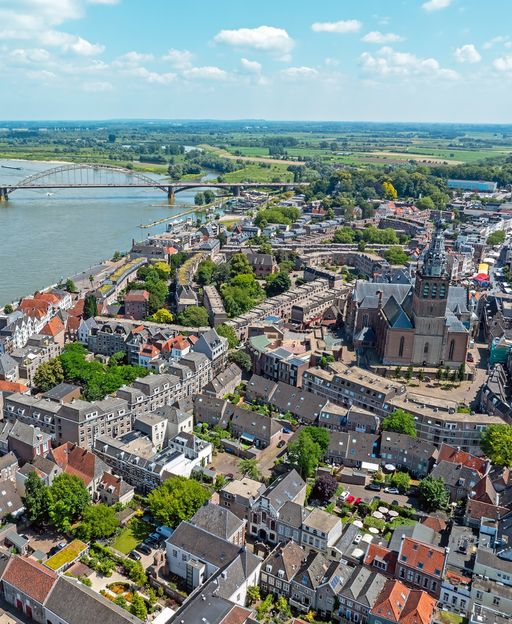
Most people think Amsterdam is old. They’re wrong. While Amsterdam was still a fishing camp in the marshy delta, Nijmegen already had centuries of Roman history behind it. The Netherlands’ oldest city sits on a rare hill above the Waal river — and it still feels like a place that knows something everyone else forgot.
A City Built on the Only Hill in the Netherlands
Most of the Netherlands is famously, exhaustingly flat. Nijmegen chose to ignore this. It sits on a low hill above the flood plains of the Waal, the largest branch of the Rhine.
The Romans spotted this hill around 69 AD and built a fortress here: Noviomagus Batavorum. It grew into one of the most important military and trading settlements north of the Alps.
Centuries later, Charlemagne chose Nijmegen for one of his favourite palaces outside Aachen. For a brief moment in European history, this Dutch hillside stood at the centre of an empire.
The Chapel That Has Stood for a Thousand Years
Walk through the Valkhofpark and you’ll find a small stone building that stops visitors mid-stride. The Sint Nicolaaskapel was built in 1030. It’s one of the oldest brick structures in the Netherlands.
Inside, it’s quiet and cool. The walls carry nearly a thousand years of weight. The chapel stands on the foundations of a Carolingian court chapel — one of the last physical traces of Charlemagne’s palace complex.
On a grey Dutch afternoon, this tiny room feels remarkable. There is nothing like it anywhere nearby.
A WWII Story the World Overlooked
In February 1944, American bombers made a fatal navigation error. They confused Nijmegen with a German city across the border. They dropped their bombs. Eight hundred Dutch civilians died. The historic centre lay in rubble.
Seven months later, Nijmegen found itself at the centre of Operation Market Garden. Allied paratroopers secured the Waal bridge in a daring river crossing under heavy fire. The plan failed at Arnhem to the north — but the Nijmegen bridge held.
The Waalbrug still stands today, arching over the wide river. Walking it, looking back at the rebuilt city skyline, is one of those quietly powerful Dutch moments. To understand why water shaped so much of what happened here, read about why a third of the Netherlands was once the bottom of the sea.
Enjoying this? Get stories like this every week from Love Netherlands — Subscribe free →
The Walking Festival That Fills the City Every July
Each July, Nijmegen fills with walkers from around the world. The Vierdaagse — the Four Days Marches — is the largest multiple-day walking event on earth. Participants cover 30 to 55 kilometres per day for four consecutive days. Up to 50,000 people take part each year.
The event started in 1909 and has only grown. Walkers finish each day by entering the city to enormous crowds, brass bands and cheering locals. The medal at the end is one of the most prized objects in Dutch sporting culture.
If you visit the Netherlands in July, the Vierdaagse transforms Nijmegen into something extraordinary. Book accommodation months ahead.
The Waal Riverfront and the City Itself
The Waalkade, Nijmegen’s riverside promenade, deserves an afternoon. Cafés and restaurants line the water. On warm evenings, students fill the benches and the mood is easy and relaxed.
The Waal is wide and fast here. It carries Rhine water from the Alps to the North Sea. Watching river traffic from a waterside terrace is one of the unhurried pleasures this city does quietly well.
For a different view, walk up into the Kronenburgerpark. Its 14th-century tower anchors one corner of the park. Old city walls run alongside the gardens. In spring, it’s one of the prettiest spots in the eastern Netherlands.
Getting There and What to See
Direct trains from Amsterdam Centraal to Nijmegen take about 75 to 90 minutes. From Utrecht it’s around 45 minutes. The station sits at the edge of the city centre — everything is walkable from there.
The Museum Valkhof holds Roman artefacts and medieval objects alongside modern Dutch art. It’s in a striking contemporary building overlooking the park. Spend an hour there before climbing up to the Valkhofpark itself.
Nijmegen rarely appears on Dutch must-see lists. That’s an oversight worth correcting. If you want to explore more cities beyond Amsterdam, this is what happened when one traveller went looking for the city ten minutes outside Amsterdam. And for planning your whole trip, our Netherlands travel guide is the best place to start.
Frequently Asked Questions
What is Nijmegen famous for?
Nijmegen is the oldest city in the Netherlands, founded by Romans around 69 AD. It’s also known for the Vierdaagse walking festival every July, the Waal bridge from Operation Market Garden in 1944, and the medieval Valkhofpark with the Sint Nicolaaskapel from 1030.
When is the best time to visit Nijmegen?
July is extraordinary if you want to experience the Vierdaagse walking festival. Spring and autumn are quieter and still beautiful — the Waal riverfront works well in almost any season.
How do you get to Nijmegen from Amsterdam?
Direct trains from Amsterdam Centraal take 75 to 90 minutes. From Utrecht it’s about 45 minutes. The city centre is walkable from Nijmegen station.
Is Nijmegen worth visiting for a day trip from Amsterdam?
Yes. The Valkhofpark, Sint Nicolaaskapel, Waalkade and Museum Valkhof fill a day well. Most visitors to the Netherlands miss Nijmegen entirely — which makes it one of the best surprises still left.
Love Netherlands — Free Every Week
Canal towns, hidden villages, Dutch stories. A free letter about the Netherlands — written slowly, delivered weekly.
Love more? Join 64,000 Ireland lovers → · Join 43,000 Scotland lovers → · Join 30,000 Italy lovers →
Free forever · One email per week · Unsubscribe anytime
Nijmegen has stood here for two thousand years. It watched the Romans leave, watched Charlemagne arrive, and watched bombs fall from friendly planes. It rebuilt. The hill is still there. The river still moves. And the oldest city in the Netherlands is still waiting for the visitors who bother to look.
Tours & experiences you might love


Powered by Viator. Some links are affiliate links — we may earn a small commission at no extra cost to you.