
Stand in the middle of Flevoland and look around. Flat fields stretch to the horizon. Wind turbines hum. Cows graze on rich, dark soil. But 70 years ago, this was open water. An inland sea called the Zuiderzee covered every inch of what you see. The Dutch drained it. Then they moved in.
A Country Built on Borrowed Ground
More than a quarter of the Netherlands sits below sea level. Without the dykes, pumps, and drainage systems built over centuries, much of the country would simply flood. This isn’t a quirk of geography. It’s the defining fact of Dutch life.
The word “polder” describes any piece of land reclaimed from water. The Dutch have been building polders since the 12th century. Early ones were small — a marsh drained here, a lake filled there. Over time, the ambition grew considerably.
Windmills played a crucial role in the early centuries. Before electric pumps existed, windmills drove the water out of low-lying land into drainage channels, and from there into rivers or the sea. Kinderdijk’s famous 19 windmills still stand as a reminder of this system — not decorative landmarks, but working infrastructure that once kept thousands of acres dry.
The Day They Decided to Drain a Sea
The Zuiderzee was a large, shallow bay that cut deep into the north of the country. Storms regularly sent waves crashing into coastal towns. In 1916, a catastrophic flood hit hard. The Dutch decided they had endured enough.
Engineer Cornelis Lely had drawn up a bold plan years earlier. A 32-kilometre dam would close off the sea entirely. Parliament approved it in 1920. Workers started building in 1927 and finished in 1932. The dam — the Afsluitdijk — turned the saltwater Zuiderzee into a freshwater lake called the IJsselmeer.
Then the real work began. The Dutch started pumping out sections of the new lake one by one, exposing the seabed beneath.
Flevoland: A Province From Nothing
Each drained area became a polder. The soil — rich, black, and fertile — had been forming on the seabed for thousands of years. Farmers moved onto land that had never once been farmed before. They planted crops in fields that had been fish habitat the previous decade.
Four polders now cover what was once the Zuiderzee. The largest is Flevoland, which became an official Dutch province in 1986 — the newest province in the country. Two entirely new cities, Lelystad and Almere, grew from nothing on reclaimed land. Around 400,000 people live there today, on what was once the bottom of the sea.
If you’re new to the Netherlands, the Start Here guide is the best place to begin planning your visit — including tips on which regions to explore and why Flevoland surprises almost everyone who goes.
Enjoying this? Get stories like this every week from Love Netherlands — Subscribe free →
Life Below Sea Level
In Flevoland, the land sits roughly five metres below the level of the IJsselmeer beside it. Only dykes, pumping stations, and drainage channels keep it dry. The pumps run continuously — stop them for long enough and the fields would flood again.
The Dutch are matter-of-fact about all of this. Ask a local and they’ll shrug. “We manage the water,” they say. “That’s what we do.”
In Amsterdam, parts of the city centre sit below sea level too. Centuries-old buildings rest on wooden piles driven deep into the waterlogged ground. Rotterdam, rebuilt entirely after WWII, took the challenge even further — designing an entire modern city to coexist with flood risk rather than pretend it isn’t there.
What the Polders Look Like Today
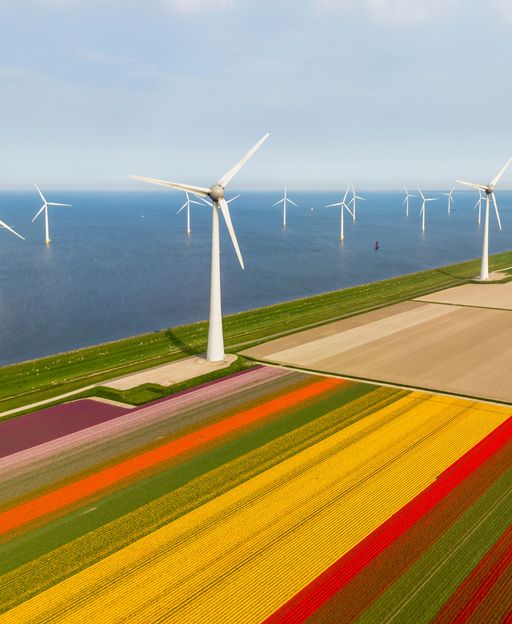
Fly over Flevoland and the geometry is striking. Straight canals divide perfectly square fields. Roads run at right angles. Towns sit exactly where planners decided they would go, decades before anyone lived there.
It looks nothing like the organic sprawl of old Dutch cities. That’s because engineers designed it on paper before the first spade went into the ground. Every road, canal, and field was drawn before the polder existed.
The landscape has its own quiet beauty. Huge skies press down on flat land. Lines of tall windbreak trees run to the horizon. In spring, tulip fields colour the polders red, yellow, and pink — the kind of landscape you can only see from above, where the sheer scale becomes clear.
Can You Visit the Polders?
Absolutely. Flevoland is easy to reach from Amsterdam by train — Lelystad takes under an hour.
Batavialand in Lelystad tells the full story of the Zuiderzee reclamation. The museum holds a reconstructed 17th-century VOC merchant ship and outdoor exhibits on the polder landscape. Children love it. Adults find themselves staying twice as long as planned.
The Afsluitdijk itself has a visitor centre at its midpoint, with panoramic views across the IJsselmeer. You can drive or cycle the entire 32 kilometres across the dam — the lake on one side, the Wadden Sea on the other.
For cycling, Flevoland offers hundreds of kilometres of flat, well-signed routes through the polder landscape. You won’t find dramatic mountain scenery. What you will find is something quietly extraordinary — farmland that the sea gave up less than a century ago.
Frequently Asked Questions
What is a Dutch polder?
A polder is an area of land reclaimed from water — usually the sea or a lake — and kept dry by dykes and pumping systems. The Netherlands has hundreds of polders, ranging from small medieval drainage projects to the enormous Flevoland reclamation completed in the 20th century.
How much of the Netherlands is below sea level?
Around 26% of the Netherlands lies below sea level, with another 29% sitting at or very near sea level. Without dykes and continuous water management, large parts of the country — including much of Amsterdam — would flood regularly.
Can you visit Flevoland from Amsterdam?
Yes. Lelystad, the capital of Flevoland, sits about 60 kilometres from Amsterdam and takes under an hour by train. The Batavialand museum in Lelystad explains how the province was built from the sea floor, with exhibits on the Zuiderzee Works and Dutch water management history.
What is the Afsluitdijk?
The Afsluitdijk is a 32-kilometre dam that separates the North Sea from the IJsselmeer in northern Netherlands. Workers completed it in 1932, and it became the foundation of the entire Zuiderzee reclamation project. Visitors can drive or cycle its full length today, and a visitor centre sits at the midpoint.
The Dutch didn’t choose their geography. They chose to fight it, reshape it, and live proudly on what they made. Every polder is a quiet act of defiance — land taken from the water and kept, one pump at a time.
Love Netherlands — Free Every Week
Canal towns, hidden villages, Dutch stories. A free letter about the Netherlands — written slowly, delivered weekly.
Love more? Join 64,000 Ireland lovers → · Join 43,000 Scotland lovers → · Join 30,000 Italy lovers →
Free forever · One email per week · Unsubscribe anytime
Tours & experiences you might love


Powered by Viator. Some links are affiliate links — we may earn a small commission at no extra cost to you.