
Urk does not feel like the rest of the Netherlands. There are no tourists with maps. No trendy coffee bars. No flat fields fading into a polished horizon. Urk feels like itself — completely, stubbornly, defiantly itself. And once you know its story, that stubbornness makes perfect sense.
Once an Island, Always an Island
For over a thousand years, Urk was an island. A rocky outcrop in the Zuiderzee — the great inland sea that once covered central Netherlands — it sat several kilometres from any shore. A small community of fishermen built their lives there, navigating by the lighthouse, speaking their own language, relying entirely on each other.
In 1942, the Dutch drained the Noordoost Polder — 470 square kilometres of seabed — and turned it into farmland. The water retreated. Urk, overnight, was no longer surrounded by sea. It was surrounded by fields.
The people of Urk never really got over it.
A Fleet That Still Fishes Before Dawn
Urk is home to the largest fishing fleet in the Netherlands. More than a hundred vessels leave the harbour before first light, just as they have for centuries. The fish market opens early — the catch is auctioned before most towns have finished breakfast.
Walk the quayside on a working morning and you will see what fishing culture looks like when it has not been turned into an attraction. The smell is real. The men in waterproofs are real. The crates of eel, cod, and plaice are real.
The harbour here is not preserved — it is working. That difference matters.
Enjoying this? Get stories like this every week from Love Netherlands — Subscribe free →
A Language Nobody Else Speaks
Urk developed its own dialect over centuries of island isolation. “Urks” — as locals call it — is a form of Dutch that evolved independently, absorbing older words that vanished from the mainland long ago. Two elderly Urkers in conversation can sound, to Dutch ears, like a foreign language entirely.
This is not a museum piece. The dialect is still spoken at home, in the market, between generations. Children grow up knowing both Urks and standard Dutch, switching between them depending on who is listening.
Few places in Europe have preserved local speech so completely without it becoming a performance for visitors. If you arrive expecting a quaint Dutch village, Urk will surprise you.
A Community That Holds Together
Urk is one of the most religiously observant communities in the Netherlands. In a country known for its secular, pragmatic character, Urk stands apart. On Sundays, the town quiets. Most shops close. The harbour rests.
The church is not background here — it is architecture, calendar, and community. The rhythm of life in Urk follows the religious week more closely than almost anywhere else in the country.
This has created something rare: a tightly knit culture where isolation, faith, and tradition have combined into a community unlike any other in the Netherlands. Visitors who expect standard Dutch hospitality sometimes find Urk surprising. It is not cold — it is simply not performing for you.
If you are new to the Netherlands and wondering where to start, our Start Here guide covers everything you need to know about exploring the country.
What to Do in Urk
Urk rewards slowness. Come with a few hours and no agenda.
The Urk Lighthouse
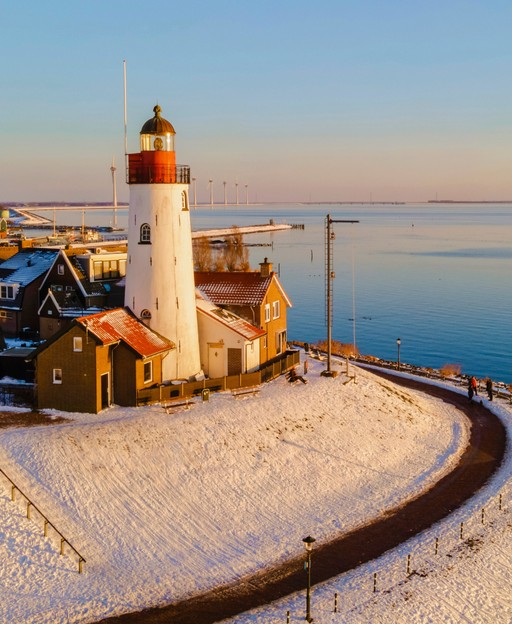
The red-and-white lighthouse dates to 1844 and still stands at the edge of what was once an island shore. Walk the path around the old harbour as the afternoon light drops. This is where the island used to end — and in some ways, still does.
Urker Vissersmuseum
The Fishermen’s Museum is small, focused, and excellent. It holds models of traditional Urk fishing vessels, historical photographs, and a room dedicated to those lost at sea. The memorial outside — listing names going back generations — is one of the most quietly moving sights in the Netherlands.
The Harbour Fish Stalls
Smoked eel, fresh herring, nothing pretentious. The fish stalls at Urk harbour are among the best in the country. Buy something, sit on a bollard, and watch the boats.
If you are exploring the IJsselmeer coast, the old trading city of Hoorn lies an hour to the south — another Dutch water story, very different in character. For island life of a different kind, Texel, where sheep outnumber people, is not far away.
Frequently Asked Questions
How do I get to Urk from Amsterdam?
Urk is about 90 minutes from Amsterdam by car. There is no direct train — take the train to Lelystad, then a bus toward Urk. A car makes exploring the harbour and surrounding polder much easier.
What is Urk most famous for?
Urk is known for its working fishing fleet — the largest in the Netherlands — its own dialect called Urks, and its strong religious identity. The town was an island for over a thousand years before the surrounding sea was drained in 1942.
When is the best time to visit Urk in the Netherlands?
Weekday mornings in spring and summer give you the best chance of seeing the harbour in action, with fishing boats returning and the early fish market running. Avoid Sundays if you want to see the town alive — most of Urk observes the Sabbath strictly.
Is Urk worth visiting for a day trip from Amsterdam?
Yes — especially if you want Dutch life that has not been packaged for tourists. Urk is one of the most culturally distinct communities in the Netherlands. Its story of island identity surviving the draining of an entire sea is genuinely fascinating. Allow two to three hours.
The Dutch spent centuries fighting the sea — draining it, reclaiming it, reshaping it. In Urk, they built an entire world inside it. That the world survived the sea’s disappearance — still fishing, still speaking its own language, still holding together — feels like something close to remarkable.
Love Netherlands — Free Every Week
Canal towns, hidden villages, Dutch stories. A free letter about the Netherlands — written slowly, delivered weekly.
Love more? Join 64,000 Ireland lovers → · Join 43,000 Scotland lovers → · Join 30,000 Italy lovers →
Free forever · One email per week · Unsubscribe anytime
Tours & experiences you might love


Powered by Viator. Some links are affiliate links — we may earn a small commission at no extra cost to you.