

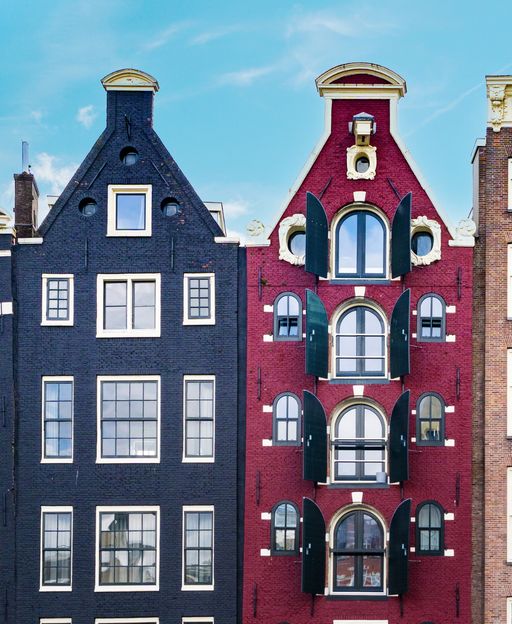
Walk down any Amsterdam street after dark. Every house glows like a stage set. The lamps are on, the rooms are visible, and nobody has pulled the curtains. This is not an oversight. It is the Netherlands doing exactly what it has always done.
The Calvinist Root of the Open Window
The tradition stretches back to the 17th century, when Calvinism shaped Dutch society. Calvin’s teaching was straightforward: a righteous household had nothing to hide. If your home was clean, your life was orderly, and your faith was sincere — open the curtains and let the neighbours see.
Calvinism ran deep in Dutch life. It gave the Netherlands its work ethic, its directness, and its distrust of unnecessary display. Closed curtains, in that world, suggested something hidden. Open curtains said: we live well, and we know it.
The church did not need to enforce this. The community did it naturally. A house with drawn curtains in a 17th-century Dutch town raised questions. And the Dutch, then as now, preferred clear answers.
Light Is Precious in the North
There is a practical reason that reinforces the tradition.
The Netherlands sits at 52 degrees north. In winter, daylight is short and the sky turns grey by mid-afternoon. Dutch homes were built to capture as much natural light as possible — which explains why the windows are so tall and wide in the first place.
Pulling the curtains means losing the light. In a northern country where sunlight is scarce, that is an act of waste. Dutch homeowners learned centuries ago that the window is not something to be blocked. It is something to be opened to the world.
The Social Logic: Nothing to Hide
Here is what many visitors miss. Keeping curtains open is not just about Calvinist virtue. It is about belonging to a community.
Dutch culture has a well-known phrase: doe maar gewoon, dan doe je al gek genoeg. It means: just act normally — that is already strange enough. The open curtain fits this logic perfectly. You live as your neighbours live. You show that you are part of the street, not hiding from it.
There is a social trust element too. Open windows mean a neighbourhood where people look out for each other. Someone passing might notice if something was wrong. The transparency builds safety — and the Dutch have long placed high value on civic trust and community accountability.
Enjoying this? Get stories like this every week from Love Netherlands — Subscribe free →
The Interior as a Statement
The Dutch take pride in their interiors. A well-arranged room, a good lamp, a tidy bookshelf — these are things worth displaying. The open curtain is partly about showing care for the home.
This is different from showing off. Dutch culture dislikes ostentation. What you see through a Dutch window is rarely grand — it is a cosy corner, a plant on the sill, a candle burning in winter. The goal is warmth and order, not wealth.
This is, in a word, gezelligheid — the Dutch idea of cosiness and belonging — made visible from the street. The lit window is an invitation to feel that warmth, even from outside. If you want to explore how the Dutch build community through everyday life, our Start Here page is a good place to begin.
The Modern Dutch Take
Not every Dutch household follows this tradition today. Cities with diverse populations have more variation in privacy norms. In newer suburbs, you will find more closed curtains. Ground-floor apartments on busy streets sometimes draw the blinds after dark.
But the tradition holds strongly in smaller towns and older neighbourhoods. Walk through Utrecht’s medieval canal streets or the historic lanes of Leiden after sunset, and you will see it: house after house, glowing and open to view.
Visitors often feel they are intruding by looking in. They are not. Looking is allowed. It is expected. The Dutch left the curtains open deliberately — the same unapologetic directness that defines how they cycle in any weather without a second thought.
Why do Dutch people not close their curtains?
The tradition comes from 17th-century Calvinism, which taught that a righteous household had nothing to hide. Open curtains showed the community that your home was clean, orderly, and honest. The habit deepened over time because Dutch culture values civic transparency and social trust.
Is it acceptable to look into Dutch homes through the window?
Yes. The Dutch leave their curtains open deliberately. Looking in is accepted and not considered intrusive. The interior is on display as a statement of pride and belonging — not an accidental exposure.
Do all Dutch people keep their curtains open?
Most do, especially in older towns and historic city centres. Larger cities and newer suburbs have more variation. In places like Utrecht, Delft, and Leiden, open curtains after dark are still the clear norm.
When did the Dutch open-curtain tradition begin?
The roots go back to the Dutch Golden Age in the 17th century, when Calvinism shaped social norms across the Netherlands. The open-window tradition developed alongside the culture of civic accountability that defined Dutch society in that era.
Love Netherlands — Free Every Week
Canal towns, hidden villages, Dutch stories. A free letter about the Netherlands — written slowly, delivered weekly.
Love more? Join 64,000 Ireland lovers → · Join 43,000 Scotland lovers → · Join 30,000 Italy lovers →
Free forever · One email per week · Unsubscribe anytime
The next time you walk through a Dutch town at dusk, stop at a lit window. Look at the lamp, the books on the shelf, the plant in the corner. The Dutch have left it all open for a reason — and they have been doing so for four hundred years.
Tours & experiences you might love


Powered by Viator. Some links are affiliate links — we may earn a small commission at no extra cost to you.