

Amsterdam’s Museum Quarter is one of Europe’s finest concentrations of art and culture. Clustered around Museumplein — a broad green square in the city’s south — you’ll find the Rijksmuseum, the Van Gogh Museum, and the Stedelijk Museum within a five-minute walk of each other. Whether you have half a day or a full day to spare, this neighbourhood rewards anyone with even a passing interest in art, Dutch history, or simply watching Amsterdam life unfold on the grass below.
Love the Netherlands? Join our free newsletter for hidden Dutch gems → inlovewithnetherlands.com/subscribe
What Is Amsterdam’s Museum Quarter?
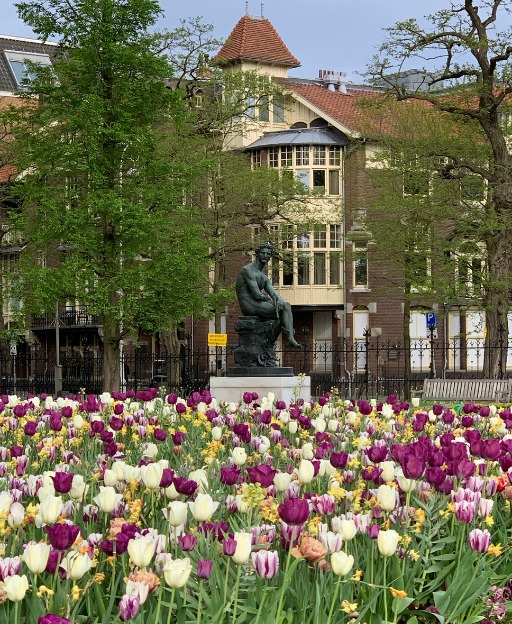
The Museum Quarter (Museumkwartier in Dutch) is a neighbourhood in Amsterdam’s Oud-Zuid district, centred on Museumplein — a rectangular public park roughly the size of several football pitches. The square itself serves as a daily gathering place for Amsterdammers: locals sunbathe on the grass, children splash in the shallow wading pool at one end, and cyclists cut through on their way across town.
Surrounding the square are four major museums, a concert hall that ranks among Europe’s finest, and some of Amsterdam’s most elegant nineteenth-century streets. It sits just south of the city centre, easily reached on foot from the Vondelpark or by tram from Central Station. Most visitors find it absorbs at least a full morning — and quite often an entire day if you linger.
The Rijksmuseum: The Netherlands’ Greatest Art Collection
The Rijksmuseum is the centrepiece of Amsterdam’s Museum Quarter and, for many visitors, the single most important stop in the entire country. Housed in a vast neo-Gothic building designed by Pierre Cuypers and opened in 1885, it holds the national collection of Dutch and Flemish art, history, and decorative objects — roughly a million items in total, with around eight thousand on permanent display.
The collection spans eight centuries, but most visitors come for the Dutch Golden Age rooms on the second floor. Here you’ll find Rembrandt’s The Night Watch — one of the most famous paintings in the world — hanging in its own dedicated gallery, the Eregalerij (Gallery of Honour). The scale of the painting surprises almost everyone who sees it for the first time: it measures over four metres wide and commands an entire wall. Nearby, Johannes Vermeer’s The Milkmaid and The Love Letter offer a quieter, more intimate counterpoint.
Beyond paintings, the Rijksmuseum’s collections of Delftware, silver, furniture, dollhouses, and ship models are exceptional. The blue-and-white Delftware pottery alone deserves thirty minutes. The building’s interior is equally remarkable — the Atrium connecting the two wings is a beautifully restored space that was originally an open passage for cyclists and pedestrians.
How Long to Spend at the Rijksmuseum
If you’re visiting for the first time and want to see the highlights — the Night Watch, the Vermeer rooms, the dolls’ houses, and the Delftware galleries — allow a minimum of two hours. If you’re a serious art lover or want to explore the full collection including the Asian pavilion and the history galleries, a full day is not unreasonable. The museum has a good café on the ground floor and a terrace garden, making it easy to break your visit without leaving the building.
Rijksmuseum Tickets and Opening Hours
The Rijksmuseum is open daily from 09:00 to 17:00. Booking timed-entry tickets in advance online is strongly recommended, particularly between April and October when queues at the door can be long. Children aged 17 and under enter free. The museum is a short walk from the Museumplein tram stops served by lines 2, 3, 5, and 12 from Central Station.
The Van Gogh Museum: More Than Sunflowers
A five-minute walk from the Rijksmuseum, the Van Gogh Museum holds the world’s largest collection of work by Vincent van Gogh. The museum is built around the collection inherited by Van Gogh’s nephew, Theo’s son, who preserved hundreds of paintings, drawings, and letters that might otherwise have been dispersed or lost. Today the permanent collection includes around 200 paintings, 500 drawings, and 750 personal letters, displayed across four floors.
The collection traces Van Gogh’s artistic development from his early dark Dutch period — typified by The Potato Eaters, painted in Nuenen — through his time in Paris, where his palette brightened under the influence of the Impressionists, to the vivid, swirling canvases of Arles and Saint-Rémy. The famous Sunflowers and Almond Blossom are both here. So is the lesser-known but equally striking series of self-portraits that charts his emotional state across different years.
The museum’s permanent collection benefits from its tight focus. Unlike the Rijksmuseum, where you’re navigating eight centuries of art, the Van Gogh Museum tells a single life story in a logical, chronological sequence. Even visitors who don’t consider themselves art lovers tend to find it moving. If you’ve spent time in the Dutch countryside where Van Gogh painted, the early works in particular will resonate differently.
Van Gogh Museum Tickets and Booking
The Van Gogh Museum is open daily, generally from 09:00 to 17:00 (with extended hours on Fridays). This is the most-visited museum in Amsterdam and advance booking is essential — walk-up tickets are often sold out by mid-morning during peak season. Book directly on the museum’s own website for the best availability. The I amsterdam City Card includes entry, but timed-entry slots must still be reserved in advance through the card’s portal.
The Stedelijk Museum: For Modern and Contemporary Art
The Stedelijk Museum occupies a late nineteenth-century building with a striking modern extension — nicknamed “the bathtub” by Amsterdammers — added in 2012. It houses Amsterdam’s collection of modern and contemporary art and design, with particular strengths in Dutch Modernism, the De Stijl movement (Mondrian and Van Doesburg), Cobra (the postwar Dutch expressionist group), and international figures such as Warhol, Lichtenstein, and Matisse.
The Stedelijk is less crowded than its neighbours and rewards visitors who want to move at their own pace without navigating large tour groups. The permanent collection galleries are spread across both the old building and the extension. Allow ninety minutes to two hours. It sits directly adjacent to the Van Gogh Museum on Museumplein.
The Moco Museum: Banksy, Warhol, and Accessible Modern Art
The Moco (Modern Contemporary) Museum occupies a nineteenth-century villa at the northern edge of Museumplein and feels quite different from the grand national institutions nearby. It is a private museum focused on contemporary and street art, best known for its large and rotating Banksy collection, which regularly includes authenticated works alongside immersive installations. Works by Warhol, Basquiat, Hirst, and Jeff Koons also feature in the permanent collection.
The Moco is particularly popular with younger visitors and those who find the classical collections less engaging. Tickets are timed, queues are managed well, and the experience moves quickly — most visitors complete the circuit in around ninety minutes. It lacks the depth of the Rijksmuseum or the emotional narrative of the Van Gogh Museum, but as an introduction to contemporary art it is well-curated and genuinely enjoyable.
The Concertgebouw: Worth Visiting Even Without a Ticket
On the south side of Museumplein stands the Concertgebouw, one of the world’s most acoustically celebrated concert halls. Opened in 1888, it is the home of the Royal Concertgebouw Orchestra and hosts over 700 performances a year. The main hall, the Grote Zaal, seats over 2,000 people and is widely regarded as among the finest concert venues in Europe. If you’re visiting on a Wednesday morning between September and June, the Concertgebouw runs free lunchtime concerts — an exceptional way to experience the hall without advance planning.
Practical Tips for Visiting Amsterdam’s Museum Quarter
The most important advice for any visit to Amsterdam’s Museum Quarter is to book your tickets in advance. Both the Rijksmuseum and the Van Gogh Museum operate timed-entry systems and regularly sell out on busy days, particularly Saturdays and on public holidays. Booking a week ahead is sensible in summer; two or three days ahead is usually sufficient in autumn and winter.
If you’re planning to visit multiple museums in a single day, be realistic about your energy. The Rijksmuseum alone can absorb several hours. A sensible combination is the Rijksmuseum in the morning (arrive at opening time) followed by the Van Gogh Museum in the afternoon — with lunch at one of the museum cafés in between. Attempting all four major museums in a single day tends to result in fatigue rather than meaningful engagement with any of them.
Getting to the Museum Quarter
The Museum Quarter is easy to reach from central Amsterdam. Tram lines 2 and 12 both stop at Museumplein, running from Central Station via Leidseplein. Line 3 stops at Van Baerlestraat, right alongside the Concertgebouw. The journey from Central Station takes around fifteen minutes by tram. Cycling is also straightforward — Museumplein lies at the southern end of the Vondelpark, and the streets approaching it from the north have dedicated cycle lanes throughout.
When to Visit for Smaller Crowds
The Museum Quarter is busiest on Saturdays, public holidays, and during the spring tulip season (roughly April to early May). Weekday mornings are significantly quieter, particularly Tuesdays and Wednesdays. Opening time is consistently the calmest period across all museums — arriving at 09:00 when doors open means you’ll have the Night Watch gallery almost to yourself for the first twenty minutes. Late afternoon, after 15:00, is also calmer as tour groups tend to have cleared out by then.
Where to Eat Near Museumplein
All three major museums have their own cafés. The Rijksmuseum café on the ground floor serves decent sandwiches, soup, and Dutch coffee and stroopwafels — convenient without venturing back outside. The Van Gogh Museum has a small café in the entrance area.
For a sit-down meal, the streets immediately surrounding Museumplein offer plenty of options. Van Baerlestraat and PC Hooftstraat are lined with cafés and restaurants ranging from Dutch pancake houses to Japanese and Italian options. For something more local, the Vondelpark’s café pavilion is a short walk away and popular with Amsterdammers on warmer days.
A Note on the I amsterdam City Card
The I amsterdam City Card includes entry to the Rijksmuseum, Van Gogh Museum, and Stedelijk Museum, as well as unlimited public transport and a canal boat tour. Whether it offers value depends on how many attractions you intend to visit — if you’re planning at least three major museums, the maths usually works in your favour for a 48-hour or 72-hour card. Check the current list of included venues before purchasing, as the partnership roster changes periodically.
You Might Also Enjoy
- 3 Days in Amsterdam: The Perfect Itinerary — Museum Quarter in context of a full Amsterdam visit
- Amsterdam Canal Cruise Guide — the classic way to see the city between museum visits
- Delft Day Trip from Amsterdam — for those inspired by the Delftware collections at the Rijksmuseum
Plan Your Netherlands Trip
Ready to plan your visit to Amsterdam and beyond? Our Netherlands travel start guide covers where to stay, when to go, which regions to explore, and how to structure your trip from a few days to a few weeks.
Frequently Asked Questions
What is the best order to visit museums in Amsterdam’s Museum Quarter?
Most visitors start with the Rijksmuseum in the morning when it opens at 09:00, as the Night Watch gallery is at its least crowded in the first hour. The Van Gogh Museum works well as an afternoon visit. This order makes for a satisfying full-day itinerary without feeling rushed at either museum.
Do I need to book Amsterdam Museum Quarter tickets in advance?
Yes — advance booking is strongly recommended for both the Rijksmuseum and the Van Gogh Museum, especially between April and October. Both operate timed-entry systems and frequently sell out on weekends. The Stedelijk Museum and Moco Museum are less likely to sell out but timed-entry booking is still advisable in high season.
How long does it take to visit Amsterdam’s Museum Quarter?
Allow a full day if you want to visit the Rijksmuseum and Van Gogh Museum properly — two hours minimum at each. Adding the Stedelijk or Moco Museum extends the visit comfortably to seven or eight hours. Half a day is sufficient for a highlights-only visit focused on just one museum.
Join Netherlands Lovers
Every week, discover the Netherlands beyond the tourist trail — hidden villages, local recipes, cycling routes, and travel insights you won’t find in any guidebook.
Subscribe free — enter your email:
Love more? Join 64,000 Ireland lovers → · Join 43,000 Scotland lovers → · Join 30,000 Italy lovers →
Free forever · One email per week · Unsubscribe anytime
Tours & experiences you might love


Powered by Viator. Some links are affiliate links — we may earn a small commission at no extra cost to you.