
Most visitors to the Netherlands head south from Amsterdam. They see Utrecht. They find Delft. If they’re ambitious, they reach Rotterdam. Almost none of them turn north. That is a mistake that Groningen’s 200,000 residents are quietly happy you keep making.
Groningen is the northernmost major city in the Netherlands. It is loud, energetic, ancient, and fiercely itself. And it barely appears on the radar of international travel.
A City That Calls Itself Just “Stad”
Locals don’t say “Groningen.” They say Stad — the City. Singular. As if there is only one worth mentioning. That confidence is earned.
Groningen grew rich on grain in the Middle Ages. It ran its own mint and negotiated with European powers on its own terms. When it joined the Dutch Republic in 1594, it arrived as something close to an equal — not a conquered province.
That independent spirit never left. Groningers have their own dialect — Gronings — that other Dutch speakers genuinely struggle to follow. They have their own sense of humour. Their reputation for bluntness is noteworthy even by Dutch standards.
The Martinitoren — 97 Metres of Medieval Ambition
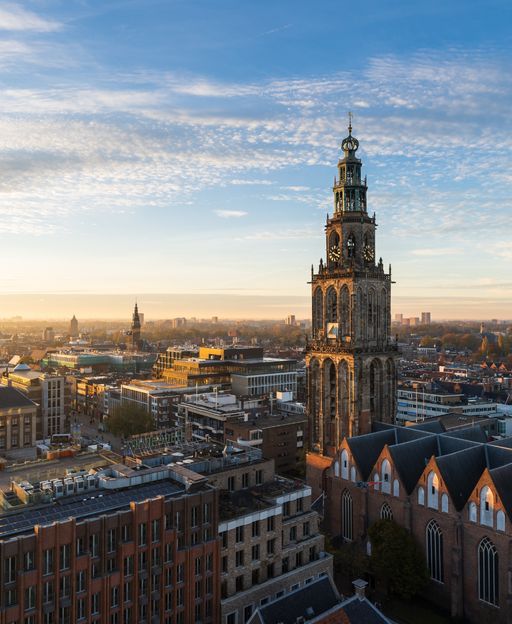
The Martinitoren is Groningen’s defining landmark. At 97 metres, it is the tallest church tower in the Netherlands. It has been marking time here for more than 600 years.
You can climb it. The view from the top stretches over the flat green north — an endless patchwork of fields, canals, and villages. On a clear day, you can see all the way to Germany.
Below the tower stands the Martinikerk, a Gothic church whose interior surprises almost everyone who enters. Medieval frescoes cover the walls — hidden beneath centuries of whitewash and only uncovered in the 1980s. They are extraordinary and almost entirely unknown outside the Netherlands.
The Vismarkt — Where Groningen Actually Lives
Every Dutch city has a main square, but few feel as genuinely alive as the Vismarkt. On market days — Tuesdays, Fridays, and Saturdays — stalls fill the square with fresh fish, Dutch cheese, flowers, and street food.
But the Vismarkt is busiest when there is no market at all. On summer evenings, every terrace fills with students, locals, and the occasional bewildered tourist. They sit with a coffee or a cold beer, watching nothing much in particular. This is gezelligheid at its most honest — warmth without effort, company without performance.
The square takes its name from the fish trade that operated here from the 15th century. The fish are largely gone. The spirit of a city gathering around itself has not changed.
Enjoying this? Get stories like this every week from Love Netherlands — Subscribe free →
A University Town Unlike Any Other
The University of Groningen was founded in 1614. It is one of Europe’s oldest institutions, and it has been shaping this city ever since.
Today, roughly one in four Groningen residents is a student. That ratio gives the city its particular energy. Cafés fill at all hours. The arts scene punches far above its weight. Cycling is the only sensible way to move — which is true across the Netherlands, but Groningen takes it further than most.
The university’s alumni include four Nobel Prize winners. Heike Kamerlingh Onnes discovered superconductivity here in 1911 and was the first person to liquefy helium. That level of quiet ambition still runs through the city.
The Groninger Museum — Art That Refuses to Blend In
The Groninger Museum sits on an island in the city’s main canal. Its architecture is deliberately disruptive — pavilions designed by different architects that refuse to settle on a single vision.
Inside, the collection spans ancient Chinese porcelain, Dutch design, and contemporary international art. Temporary exhibitions here are ambitious and internationally noticed.
Whether you find the building exciting or baffling from the outside, the interior tends to shift the conversation. It is, at the very least, not what you expected to find in a northern Dutch city most people cannot place on a map.
Getting to Groningen and Getting Around
Direct trains from Amsterdam Centraal to Groningen run throughout the day and take around two hours. From Utrecht, it is about 90 minutes. From Leeuwarden — Friesland’s capital, where people speak a language older than Dutch itself — the train takes just 45 minutes.
Once you arrive, hire a bike at the station. The city centre is compact, flat, and built for cycling. Groningen is not a city you drive through. You cycle it, walk it, and gradually stop wanting to leave. If you are planning your first trip to the Netherlands, our travel planning guide has everything you need to build your itinerary.
Frequently Asked Questions About Visiting Groningen
What is Groningen best known for in the Netherlands?
Groningen is known for its university, its fierce regional independence, and its cycling culture. The Martinitoren, the Vismarkt, and the Groninger Museum are the three main landmarks. The city also has a lively student scene that surprises visitors expecting a quiet northern city.
How long does the train from Amsterdam to Groningen take?
Direct trains from Amsterdam Centraal take around two hours. They leave regularly from early morning until late at night, making a day trip possible — though an overnight stay gives you time to experience Groningen properly.
When is the best time to visit Groningen?
May to September is ideal. Markets are at their busiest, terraces fill up, and the long northern evenings stretch past nine o’clock. Groningen’s December Christmas market is also worth the journey if you enjoy winter atmospheres — the city looks entirely different under snow.
Is Groningen worth visiting compared to other Dutch cities?
Absolutely. Groningen offers a genuine city experience without the tourist crowds of Amsterdam or the museum-circuit pace of The Hague. It has deep history, a lively arts scene, and a regional identity that sets it apart from every other Dutch city. Most visitors who make the trip say they wished they had come sooner.
Groningen doesn’t need you to arrive. But if you do, you are unlikely to leave unchanged. It is the kind of city that turns a two-hour train journey into the best decision of the trip.
Love Netherlands — Free Every Week
Canal towns, hidden villages, Dutch stories. A free letter about the Netherlands — written slowly, delivered weekly.
Love more? Join 64,000 Ireland lovers → · Join 43,000 Scotland lovers → · Join 30,000 Italy lovers →
Free forever · One email per week · Unsubscribe anytime
Tours & experiences you might love


Powered by Viator. Some links are affiliate links — we may earn a small commission at no extra cost to you.