

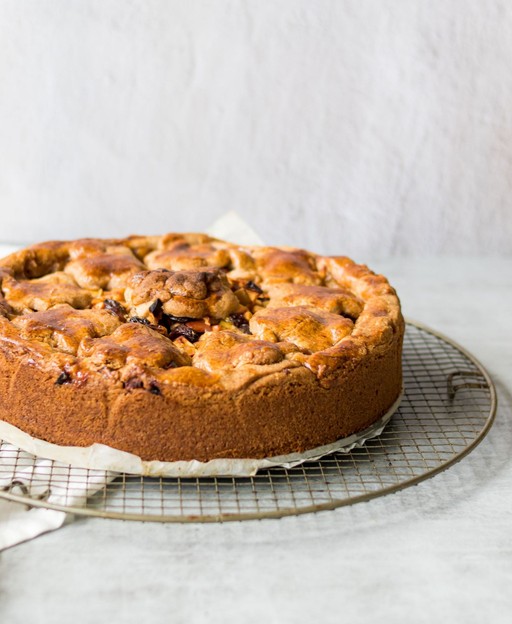
Walk into a Dutch café and there is a good chance an appeltaart is waiting on the counter. A Dutch apple pie is tall, packed with apples and topped with a thick pastry lattice, and the Dutch have been baking it for five hundred years.
Free Netherlands Travel Guide
The Ultimate Netherlands Travel Guide (PDF), 2026 edition. All 12 provinces in one place. Free when you join our newsletter.
A Recipe Printed in 1514
In 1514 one of the very first Dutch-language cookbooks was printed in Brussels: Een notabel boecxken van cokeryen, “a notable little book of cookery”. As Muiderslot castle tells the story, it holds the first Dutch recipe for apple pie. Its advice still holds: peel the apples well and make sure no pips or cores fall in, because they would spoil the whole pie.
That early pie looked nothing like ours. The filling was what mattered, and the crust was an afterthought; many pies had no bottom at all and were baked in thick earthenware dishes. The apples went in with cinnamon, ginger, cloves and other costly spices, which made it a pie for people with deep pockets. Muiderslot’s writers add that many of those spices were thought to stir up love, so perhaps, they say, we should call it a love pie.
Baked by the Prayer
Dutch food writer Janny de Moor, author of some 30 cookbooks and a history of Dutch royal dining, calls appeltaart the national sweet pastry of the Netherlands. In the oldest recipes, she writes, the baking time was given as a number of paternosters to pray, and the result was unpredictable. Ovens with heat control in the 18th century solved that. Today, she says, it is the first cake a Dutch child learns to bake, and you will find it under glass on café counters and in waiting rooms all over the country.
The Apple That Matters
The Dutch favourite apple for it is the Goudreinet, a firm, tart apple. Janny de Moor says the pie is still best with it, and the Amsterdam bakers of Weekend Bakery use Goudreinet or Boskoop. Neither is easy to find in America. Janny’s daughter, who lived in the US for several years, suggests Granny Smith, because softer varieties turn too juicy. And eat it cold: when a Dutch reader told Weekend Bakery that no Dutchman eats it warm because the crust is too rich, the bakers agreed.
Where to taste it: Winkel 43, a café in a corner building on the Noordermarkt in Amsterdam’s Jordaan, serves what it calls Amsterdam’s famous appeltaart, with whipped cream if you ask. Come on a Saturday and the organic farmers’ market is right outside.
Appeltaart (Dutch Apple Pie with a Lattice Top)
Ingredients
Method
- Mix the flour, brown sugar, salt and lemon zest in a bowl. Rub in the cold butter with your fingertips until it looks like breadcrumbs. Add the egg (minus the tablespoon you kept back) and knead quickly into a smooth dough. Wrap and chill for 1 hour.
- Peel and core the apples, cut each into quarters and each quarter into 4-5 thick slices. Toss with the lemon juice, sugar, cinnamon and raisins.
- Heat the oven to 180°C / 160°C fan / 350°F / Gas 4. Butter a 24 cm (9 1/2 in) springform tin; a 23 cm (9 in) tin also works.
- Take about two thirds of the dough and press it over the base and up the sides of the tin to the top, about 5 mm (1/4 in) thick. Patch any cracks with your fingers. Scatter the breadcrumbs over the base: they soak up the apple juice.
- Pack in the apples firmly and evenly, shaking the tin to settle them: they shrink as they bake.
- Roll out the rest of the dough between two sheets of baking paper and cut it into strips about 1.5 cm (5/8 in) wide. Lay them over the apples as a lattice and press the ends onto the edge. Brush with the kept-back egg mixed with a little water.
- Bake on the lower-middle shelf for 60-70 minutes, until deep golden and a skewer slides easily into the apples. Cover loosely with foil if the top browns too fast.
- Brush the warm top with the apricot jam, if using. Let it cool in the tin for 20 minutes, then remove the ring and leave to cool completely, at least 2 hours, before slicing. Serve with whipped cream.
Notes
Frequently Asked Questions
What makes Dutch apple pie different from American apple pie?
It is baked in a deep springform tin and packed with apples, the crust is a sweet, buttery dough made with self-raising flour and sugar rather than flaky pastry, and the top is a lattice of dough strips (Weekend Bakery, America’s Test Kitchen).
Which apples should I use in the US?
Goudreinet is the Dutch favourite but rare in America. Janny de Moor suggests Granny Smith (Janny de Moor); America’s Test Kitchen uses Golden Delicious, cooked briefly first (America’s Test Kitchen).
Do the Dutch eat appeltaart warm or cold?
Cold, as a rule. Weekend Bakery likes it best once it has cooled completely, and recommends eating it cold (Weekend Bakery). A spoonful of whipped cream is the usual extra (Winkel 43).
Sources: Muiderslot, “Apple pie with spices”; Janny de Moor, “Dutch apple pie”; Janny de Moor, “About Janny”; Weekend Bakery, “Classic Dutch Apple Pie”; America’s Test Kitchen, “Appeltaart (Dutch Apple Pie)”; Winkel 43. Checked November 2026.
Free Netherlands Travel Guide
The Ultimate Netherlands Travel Guide (PDF), 2026 edition. All 12 provinces in one place. Free when you join our newsletter.
Tours & experiences you might love


Powered by Viator. Some links are affiliate links — we may earn a small commission at no extra cost to you.