
Most visitors arrive in Rotterdam expecting old Holland. They expect canal houses, cobbled squares, and that timeless Dutch postcard.
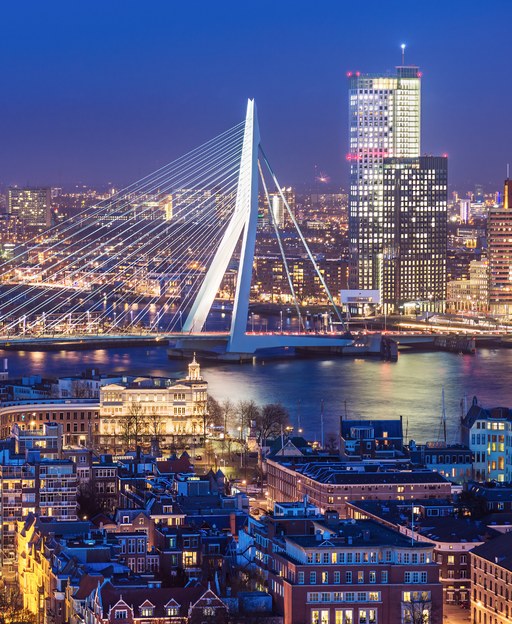
What they find instead feels closer to a film set from the future — glass towers, a village of tilted yellow cubes, and a covered market so large that artists painted the entire inside of its ceiling.
Rotterdam was not always like this. Once, it was medieval. That changed in a single afternoon in 1940.
The Night the City Disappeared
On 14 May 1940, German bombers flew over central Rotterdam and dropped incendiary bombs. In under 15 minutes, roughly 2.6 square kilometres of medieval city simply vanished. Around 800 people died. Over 85,000 lost their homes overnight.
The Dutch government surrendered the following day.
When the smoke cleared, Rotterdam’s centuries of history had gone with it. The guild halls, the harbour quarter, the merchant rows — all of it existed only in photographs. The city centre stood almost entirely empty.
The Decision Not to Look Back
Rotterdam’s planners faced a choice that other bombed European cities never made so boldly. Warsaw rebuilt its old town brick by brick from pre-war photographs. Rotterdam decided the empty ground was an invitation.
From the 1950s onwards, architects arrived from around the world. Experiments that would never pass planning permission elsewhere got built here. The result is a city that looks different from decade to decade — and nothing like anywhere else in the Netherlands.
Rotterdam has been reinventing itself ever since, with no sign of stopping.
What You’ll Find in Rotterdam Today
The Markthal is as good a place to start as any. It opened in 2014 as a horseshoe of apartment blocks that arches over a covered food market. The vaulted ceiling carries an 11,000-square-metre mural of fruits, flowers, seeds, and insects. Eating a stroopwafel underneath it feels slightly absurd, in the best possible way.
A short walk away, the Cube Houses at Blaak are almost as famous. Piet Blom designed 38 homes in 1984, tilting each one 45 degrees on a hexagonal pillar. The houses stand in a cluster above the street, forming a yellow village in mid-air. People still live in them today.
For the full picture, the Euromast puts it all at your feet. At 185 metres, the tower offers an unobstructed view over the Maas river and the port of Rotterdam — Europe’s largest — fading into the industrial haze beyond.
Enjoying this? Get stories like this every week from Love Netherlands — Subscribe free →
The Corner That Survived
One district of Rotterdam escaped the bombs entirely: Delfshaven.
Walk there from the city centre and Rotterdam changes completely. Narrow streets, leaning gabled houses, a working windmill at the water’s edge. Here is the city that existed for three hundred years before anyone thought of a cube house.
In 1620, the Pilgrim Fathers said their final prayers in Delfshaven before sailing to America. The church still stands on the same spot.
Eating and Drinking Like a Rotterdammer
For the best food experience, head to Fenix Food Factory in the Katendrecht neighbourhood. A restored 1920s warehouse now holds local cheese, craft beer, Zeeland oysters, and Dutch gin. It has become the city’s unofficial gathering place for anyone arriving from Amsterdam who cannot quite believe what they are seeing.
Witte de Withstraat is the other street worth knowing — galleries, independent restaurants, and a stretch of brown cafés that fill from early evening.
Getting to Rotterdam
Rotterdam sits 75 kilometres south-west of Amsterdam. The Intercity Direct train from Amsterdam Centraal to Rotterdam Centraal takes around 40 minutes. Trains run every 15 minutes through the day.
A day trip works well. Staying overnight rewards the effort — especially if you plan to visit the Kinderdijk windmills, just 15 kilometres east, the following morning.
From Rotterdam you can also travel south into Zeeland, where the Netherlands turns coastal and quiet. If you are still planning your wider trip, the Love Netherlands Start Here guide covers everything before you travel.
What is Rotterdam most famous for in the Netherlands?
Rotterdam is famous for its modern architecture and Europe’s largest port. German bombers destroyed the medieval city centre on 14 May 1940. Architects rebuilt it in a bold contemporary style, creating landmarks like the Markthal, the Cube Houses, and the Erasmus Bridge.
How long does the train from Amsterdam to Rotterdam take?
The Intercity Direct from Amsterdam Centraal to Rotterdam Centraal takes approximately 40 minutes. Trains run every 15 minutes during the day. A standard single ticket costs around €17–18.
Is Rotterdam worth visiting on a day trip from Amsterdam?
Yes. Rotterdam rewards a full day easily. The Markthal, Cube Houses, Delfshaven, and the waterfront are all walkable from Rotterdam Centraal. Stay overnight to reach the Kinderdijk windmills the following morning.
What is the best neighbourhood to explore in Rotterdam?
Delfshaven is the most atmospheric — it is the only district that survived the 1940 bombing and still carries the feel of old Dutch Rotterdam. For food and a local crowd, Katendrecht (home of the Fenix Food Factory) is the alternative worth knowing.
Rotterdam should not feel as alive as it does. A city that lost everything in a single afternoon and filled the space with glass and angles should feel cold. It does not. It feels like a city that decided, after the worst possible start, to stay genuinely curious about what comes next.
Love Netherlands — Free Every Week
Canal towns, hidden villages, Dutch stories. A free letter about the Netherlands — written slowly, delivered weekly.
Love more? Join 64,000 Ireland lovers → · Join 43,000 Scotland lovers → · Join 30,000 Italy lovers →
Free forever · One email per week · Unsubscribe anytime
Tours & experiences you might love


Powered by Viator. Some links are affiliate links — we may earn a small commission at no extra cost to you.