

Schiedam sits just ten minutes from Rotterdam by train. Most visitors to the Netherlands walk straight past it. That is a significant mistake. This compact South Holland city holds five of the tallest historic windmills in the world, a museum dedicated entirely to Dutch jenever — the spirit that gave gin its origins — and a well-preserved old town that feels centuries removed from the tourist trail. If Rotterdam is on your itinerary, Schiedam earns a half-day without argument.
Love the Netherlands? Join our free newsletter for hidden Dutch gems → inlovewithnetherlands.com/subscribe
Why Schiedam Stands Apart from Other Dutch Cities
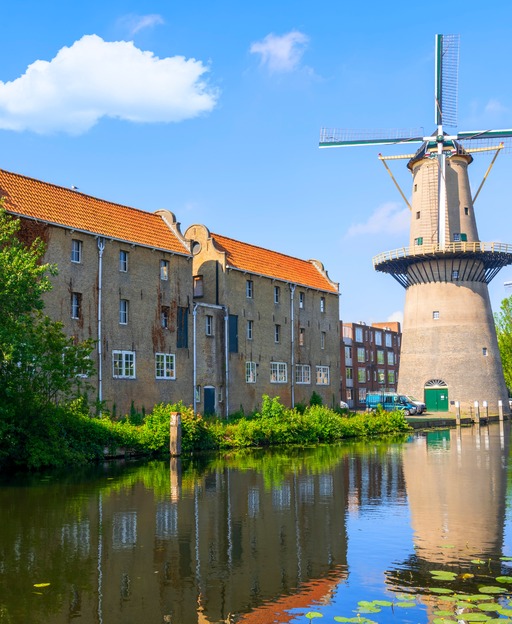
Every Dutch town has a windmill or two. Schiedam has five — and they stand unlike any others in the Netherlands. During the height of the city’s jenever industry in the eighteenth and nineteenth centuries, engineers raised the windmills taller than any standard design. The extra height gave the sails clearance above the surrounding distillery rooftops, letting them catch the wind that the buildings blocked below. The result is a cluster of giant structures that rise dramatically above the old town and rank among the most impressive historic windmills anywhere in Europe.
Add a medieval church, a network of narrow canals, a National Jenever Museum, and a waterfront that once made Schiedam one of the most important industrial ports in northern Europe, and you have a city that offers far more depth than its compact size suggests. It rewards travellers who walk slowly and look up.
The Tall Windmills: Schiedam’s Most Iconic Sight
Five surviving windmills — De Nolet, De Drie Koornbloemen, De Walvisch, De Vrijheid, and De Nieuwe Palmboom — define Schiedam’s skyline. Each carries a name, a history, and a story tied directly to the city’s centuries of grain milling and spirit production.
De Nolet, still in partial operation, ranks among the tallest operational windmills in the world. Its sheer scale strikes you up close. The structure towers over the surrounding streets and gives a genuine sense of how industrial Schiedam once was at its peak. De Walvisch (The Whale) and De Vrijheid (Freedom) stand nearby, and all five are reachable on foot within a short walk of the city centre.
These windmills are not just picturesque remnants. They ground the grain that went into the distilleries below, and their unusual height was a direct engineering response to a practical problem. The surrounding warehouses and factory buildings blocked the wind at standard height. So the millers built higher. When you understand that context, the sheer ambition of the original builders becomes clear.
Several windmills open their interiors to visitors on certain days of the week. The local tourist board (VVV Schiedam) offers a guided walk taking in all five in sequence. Allow at least ninety minutes to do the route properly, and go on a weekday morning to enjoy it at your own pace.
The National Jenever Museum: Where Dutch Gin Was Born
Jenever — pronounced yeh-NEH-ver — is the Dutch ancestor of what the British eventually shortened and anglicised into gin. If you have ever wondered where gin actually came from, the National Jenever Museum in Schiedam (Nationaal Jenevermuseum) gives you the complete answer inside a beautifully restored historic distillery building on the main canal.
At its peak in the nineteenth century, Schiedam supported hundreds of jenever distilleries. Merchants exported the spirit across Europe, carrying Dutch influence into the drinking cultures of Britain, Belgium, and beyond. Schiedam’s position on the river Maas made it a natural export hub. The distilling industry shaped every aspect of the city’s economy and architecture for over two centuries.
The museum traces this story through restored copper stills, original production equipment, and exhibits on the grain trade that fed the industry. A tasting bar at the end of the tour lets you try several styles of jenever — from young, clear varieties to aged, barrel-matured ones with rich malt and vanilla notes quite unlike their British gin descendants. The contrast between a jonge jenever and a mature oude jenever is striking. The tasting makes the distinction immediately clear in a way no description can manage.
The museum opens Tuesday to Sunday and sits on the Lange Haven canal, making it easy to pair with a waterside walk. Check the website for current opening hours, as seasonal schedules apply.
The Historic Old Town and Harbour
Between the windmills and the museum lies Schiedam’s old town — a grid of canals, historic warehouses, and independent shops that visitors have not yet polished into a tourist version of themselves. The Lange Haven and Korte Haven canals form the backbone of the centre, lined with buildings that still carry the heavy, industrial confidence of a city that once traded on a global scale.
The Grote Kerk (Great Church) anchors the market square and dates from the fourteenth century. Its tower stands as one of the city’s landmarks, visible from some distance, and worth walking around the outside of even if you skip the interior. The interior holds original medieval stonework and carries a quiet, substantial atmosphere that contrasts pleasantly with the busy streets outside.
The Havenhoofd — the old harbour head — delivers a fine view over the river Maas towards Rotterdam. Walking along the waterfront in either direction takes you past a mix of repurposed warehouse buildings, small restaurants, and the occasional working boat. The city has restored parts of the harbourfront thoughtfully, and the result feels authentic rather than staged.
Schiedam is compact enough to cover entirely on foot. A comfortable loop from the train station to the windmills, around the Lange Haven canal, into the market square, and back via the jenever museum takes around two hours at a relaxed pace. A half-day suits visitors who want to go inside the museum properly and stop for lunch.
Where to Eat and Drink in Schiedam
Start your drinking in Schiedam the traditional way: order a small glass of jenever in a local proeflokaal (tasting café). Bars serve it filled to the brim, so you lean down to take the first sip. This is not affectation — it is the authentic Dutch way, and it still happens without self-consciousness in Schiedam’s old brown cafés.
For food, restaurants cluster around the market square and the Lange Haven. Schiedam is not a food destination in the way that Rotterdam or Amsterdam are, but solid Dutch and international options suit a day-trip itinerary well. Several places close on Mondays and Tuesdays, so check ahead if your visit falls mid-week.
How to Get to Schiedam from Rotterdam and Amsterdam
Schiedam Centrum station sits on the main Rotterdam–The Hague railway line, which makes it straightforward to reach from almost anywhere in the Netherlands.
From Rotterdam: Direct trains run every few minutes. The journey takes approximately ten to twelve minutes. You can add Schiedam to a Rotterdam day with very little extra effort.
From The Hague (Den Haag): Direct trains take around twenty to twenty-five minutes, with frequent services throughout the day.
From Amsterdam: Intercity trains via Rotterdam complete the journey in approximately fifty-five to sixty-five minutes. Schiedam works best as an addition to a Rotterdam day trip from Amsterdam rather than a standalone excursion from the capital, though it manages perfectly well as one if you start early.
From Utrecht: About forty-five minutes with one change, usually at Rotterdam Centraal.
Most visitors combine Schiedam with Rotterdam. Exit the train at Schiedam Centrum rather than Rotterdam Centraal, spend two to three hours in Schiedam, then continue into Rotterdam for the afternoon. Our full Rotterdam day trip guide covers how to structure the wider day. See also our Netherlands by train guide if you are planning a multi-city trip around the country.
Practical Tips for Visiting Schiedam
- Best time to visit: Spring and early summer bring clear light and strong canal reflections — perfect for photographing the windmills. Autumn works well too, with warm low afternoon sun. Winter is quiet but the museum and cafés stay open.
- How long to spend: Two to three hours covers the main sights comfortably. A half-day allows a proper museum visit and a long lunch.
- Entry costs: The National Jenever Museum charges a modest entrance fee; check the museum website for current prices. You can view all five windmills from outside at no cost, with interior visits on scheduled open days.
- Accessibility: The old town centre is largely flat and walkable. The museum and most windmill viewing points suit mobility-impaired visitors well.
- Language: English speakers face no difficulty in Schiedam. Staff at the museum, cafés, and shops all communicate confidently in English.
For broader trip planning across the Netherlands, our guide to the best day trips from Amsterdam covers the full range of options beyond the capital, and our Rotterdam complete guide covers everything you need for the city itself.
Frequently Asked Questions About Visiting Schiedam
How do I get from Rotterdam to Schiedam by train?
Direct trains run between Rotterdam Centraal and Schiedam Centrum approximately every five to ten minutes throughout the day. The journey takes around ten to twelve minutes. Schiedam is one of the simplest side trips from Rotterdam — the frequent service means you can add it to a Rotterdam day without any complex planning.
What is Schiedam famous for in the Netherlands?
Schiedam is famous for two things: its exceptionally tall historic windmills, which engineers built extra high to catch wind above the surrounding distillery rooftops, and its central role in the history of jenever — Dutch gin. At the height of its distilling industry in the nineteenth century, Schiedam supported hundreds of distilleries and held the title of jenever capital of the world. The National Jenever Museum on the Lange Haven canal tells this story in full.
Is Schiedam worth a visit for a day trip?
Schiedam is well worth a half-day, particularly when you combine it with Rotterdam. The windmills are genuinely impressive up close — tall enough to stop you in your tracks — and the National Jenever Museum offers one of the more engaging specialist museum experiences in the Netherlands. The old town is compact, unhurried, and authentic in a way that many Dutch cities near Amsterdam are not. Most travellers who make the effort to stop here are glad they did.
Can you go inside the windmills in Schiedam?
Yes. Several of Schiedam’s windmills open their interiors to visitors on designated days, typically at weekends and on specific public days throughout the year. Entry is usually free or very low cost. Check the schedule on the Schiedam tourism website before your visit, as opening days vary by windmill and season. All five windmills are easy to view from outside at any time, which still gives a strong impression of their extraordinary scale.
You Might Also Enjoy
- Rotterdam, Netherlands: Complete Guide to Things to Do and See
- Best Day Trips from Amsterdam: 12 Unmissable Destinations (2026)
- The Love Netherlands Guide: Dutch Jenever
Plan Your Netherlands Trip
Ready to explore more of the Netherlands beyond Schiedam? Our Start Here guide covers everything from where to go first to how to get around — the perfect starting point for building your Dutch itinerary.
Join Netherlands Lovers
Every week, discover the Netherlands beyond the tourist trail — hidden villages, local recipes, cycling routes, and travel insights you won’t find in any guidebook.
Subscribe free — enter your email:
Love more? Join 64,000 Ireland lovers → · Join 43,000 Scotland lovers → · Join 30,000 Italy lovers →
Free forever · One email per week · Unsubscribe anytime
Tours & experiences you might love


Powered by Viator. Some links are affiliate links — we may earn a small commission at no extra cost to you.