

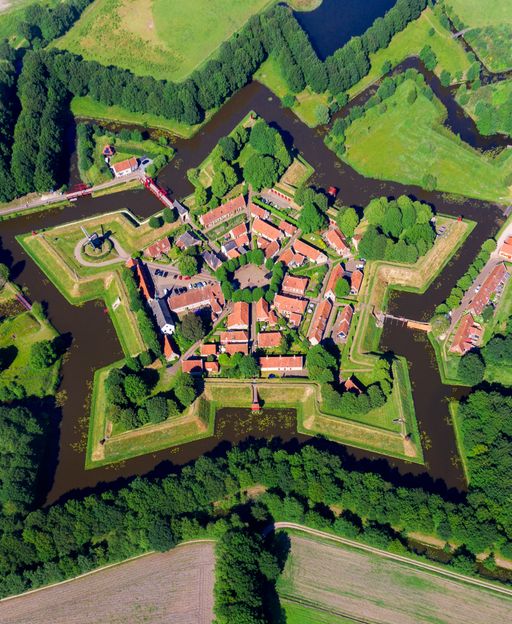
Stand at the edge of Groningen province, near the German border, and you find a village that makes no sense at first glance. The streets run at odd angles. The moat forms a perfect ring. From above, the whole thing looks like a star drawn in water and earth. Bourtange is not an accident. Every line was planned.
The Reason a Village Needed to Be a Star
In the 1580s, the Dutch were fighting for survival. Spain controlled much of the Low Countries, and the road from Germany into Groningen was a critical supply route. William of Orange ordered a fort built right across that road. The aim was simple: block the Spanish.
The star shape was not decorative. Each pointed bastion gave soldiers a clear line of fire along the walls beside it. Any attacker reaching one wall could be shot from the bastion next to it. There were no blind spots. No hidden angles where an enemy could shelter.
The geometry was ruthless. And it worked. Spanish forces tried to take Bourtange and failed. The supply route was held.
How the Fort Became a Village
Fort Bourtange was never meant to be a town. It was a garrison — a military post, a place for soldiers and supply wagons. But as the years passed, people came to work, to trade, to live. A market square appeared inside the walls. Then houses. Then a church.
By the 18th century, Bourtange had grown from a military strongpoint into a functioning community. The five bastions still stood and the moats still held water — but inside the walls were families, an inn, and a bakery.
The surrounding landscape was peatlands — flat, remote, and difficult to cross. That isolation kept the village almost unchanged for generations.
Abandoned and Then Rescued
Bourtange served as an active fort until 1851. When the army left, the moats began to drain. Buildings were sold off. The bastions crumbled at the edges. For more than a hundred years, the star shape was barely visible.
Then, in the 1960s, local authorities made a bold decision. They would restore the fort — not as a ruin, but as a careful reconstruction of how it looked in 1742. Engineers re-flooded the moats. Workers rebuilt the earth ramparts. Historic drawings guided every restored building.
Enjoying this? Get stories like this every week from Love Netherlands — Subscribe free →
What You’ll Find Inside the Walls Today
Walk across the drawbridge and you step into the 18th century. The market square sits flanked by reconstructed soldiers’ quarters, a small synagogue, and a Jewish monument — a reminder that Bourtange once had its own Jewish community.
The museum covers the military history with genuine artefacts. Cannons still point across the moats. In summer, costumed guides demonstrate period drills and craft on the ramparts.
But it is the silence that catches you. Bourtange is a living village — a few dozen people actually call it home. There are no gift shops crowding every corner. No queues. Just the sound of water in the moat and wind across the flat Groningen fields.
If you want to understand more about the wider region, Why Groningen Has More Cyclists Than Cars — and More Character Than You’d Expect is a good place to start. And if you’re new to the Netherlands, our Start Here guide covers how to explore beyond the obvious routes.
Getting to Bourtange and Making the Most of Your Visit
Bourtange sits near Vlagtwedde, about 45 kilometres south-east of Groningen city. There is no direct train. By car, the drive is straightforward. By bus, it takes patience — but the journey through the peatland landscape is part of the experience.
If fortress history interests you, pair Bourtange with The Dutch Town Almost Destroyed in 1572 — another corner of the Netherlands where the Eighty Years’ War left its mark on stone and street.
Plan Your Visit to Bourtange
The site opens year-round, but summer brings the full experience. More buildings open, guides appear in period dress, and the moat landscape shimmers in the long Dutch evening light. Autumn visits offer a quieter atmosphere and the mist rising off the surrounding peatlands.
Allow two to three hours to walk the bastions, visit the museum rooms, and take in the village atmosphere at a slow pace. Bring walking shoes — the ramparts involve uneven ground. And go hungry: the village café serves traditional Dutch food inside walls that have stood for over four centuries.
Bourtange — Frequently Asked Questions
What is the best time to visit Bourtange?
Summer (June to August) offers the fullest experience, with all buildings open and costumed guides on the ramparts. Autumn visits are quieter, with dramatic mist rising over the surrounding peat landscape.
How long does a visit to Bourtange take?
Two to three hours covers the museum, the bastions, and the village centre comfortably. Allow half a day if you want to explore the surrounding peatland paths as well.
Is Bourtange worth visiting from Amsterdam?
Yes — especially combined with a night in Groningen city. The drive from Amsterdam takes around two and a half hours. Bourtange offers something genuinely different: a living star fort with no crowds.
How do you get to Bourtange without a car?
Take a train to Groningen, then a bus towards Ter Apel and alight near Vlagtwedde. Bus connections are infrequent, so check schedules in advance. A hire car from Groningen gives much more flexibility.
Bourtange was built to keep people out. Now it quietly waits for you to find it. Once you do, it stays with you — a perfect star on the edge of the map, still holding its shape after 450 years.
Love Netherlands — Free Every Week
Canal towns, hidden villages, Dutch stories. A free letter about the Netherlands — written slowly, delivered weekly.
Love more? Join 64,000 Ireland lovers → · Join 43,000 Scotland lovers → · Join 30,000 Italy lovers →
Free forever · One email per week · Unsubscribe anytime
Tours & experiences you might love


Powered by Viator. Some links are affiliate links — we may earn a small commission at no extra cost to you.