

On the night of 31 January 1953, the sea broke through. A fierce storm drove the North Sea inland across Zeeland, South Holland, and North Brabant. When morning came, 1,836 people were dead. Entire villages sat under metres of freezing brown water.
The Dutch called it the Watersnoodramp — the water emergency disaster. It is the single worst peacetime catastrophe in modern Dutch history. And it changed everything about how the Netherlands relates to the sea.
A Country That Has Always Fought the Water
The Netherlands has reclaimed land from the sea for centuries. Roughly a third of the country sits below sea level. The Dutch built dykes, drained polders, and pushed the water back generation by generation.
But the system they relied on in 1953 was old. Wartime neglect had weakened many dykes. When the storm hit on a Saturday night — during a spring tide, with winds driving hard from the northwest — there was no warning system and no evacuation plan.
The sea came in, and the Dutch paid for it in lives.
The Answer the Delta Committee Gave
Within months of the disaster, the Dutch government formed the Delta Committee. Its task was simple to state and enormous to deliver: prevent this from happening again.
The committee proposed closing off the sea inlets of the Dutch Delta. They would build a series of massive dams, sluices, barriers, and locks across the river mouths and estuaries of Zeeland. This structure of defences would keep the sea from reaching low-lying land, even in the worst storms.
They called it the Deltawerken — the Delta Works.
Parliament approved the Delta Law in 1958. Construction began almost immediately. Engineers expected the project to take about twenty-five years. It took forty.
What Was Built — and How Large It Is
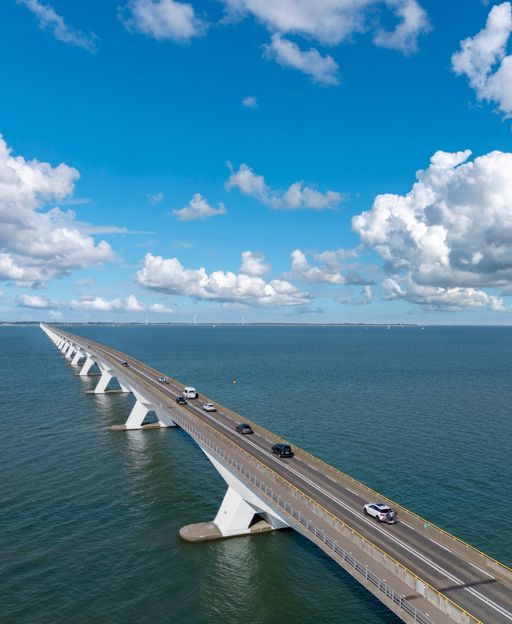
The Delta Works is thirteen separate structures — earth dykes, reinforced dams, massive sluice gates, and some of the most ambitious engineering ever attempted in peacetime.
The largest is the Oosterscheldekering — the Eastern Scheldt Storm Surge Barrier. It spans nine kilometres across the mouth of the Eastern Scheldt estuary in Zeeland.
Engineers spent years debating the design. A permanent closure would kill the tidal ecosystem — and the mussel and oyster industry that depended on it. Environmentalists pushed back hard.
The engineers found a compromise. They built 62 concrete pillars fitted with steel sliding gates. In calm weather, the gates stay open and tides flow freely. When a severe storm approaches, the gates close within about an hour. The whole structure weighs half a million tonnes.
The Oosterscheldekering opened in 1986. It remains the largest storm surge barrier in the world.
Enjoying this? Get stories like this every week from Love Netherlands — Subscribe free →
The Human Cost of the Works
The Delta Works reshaped the physical map of the Netherlands. Closing the estuaries also changed the lives of people who had lived around them for generations.
Fishing communities lost access to waters they had worked all their lives. The Grevelingen — once a tidal estuary — became a closed lake. Towns around it lost the sea rhythms that had shaped their identity for centuries.
To understand what Zeeland was before the Delta Works, you need to know that this province has always had an uneasy relationship with the water that surrounds it. The 1953 flood was not the first time the sea had taken lives here. It was simply the last time the Dutch allowed it to.
Some Dutch people grieved what was lost. Others felt immense pride. The Delta Works required not just engineering skill, but a collective decision to sacrifice something familiar in exchange for safety.
The Work That Never Ends
Engineers completed the last Delta Works structure — the Maeslantkering near Rotterdam — in 1997. Two enormous floating arms, each the size of the Eiffel Tower lying on its side, swing shut across the Nieuwe Waterweg when a severe storm threatens. The Maeslantkering protects Rotterdam, Europe’s largest port.
But the work continues. Sea levels are rising. Climate models suggest the Netherlands will face higher storm surges by 2100 than the Delta Works was originally designed to handle.
Dutch water engineers are already planning the next phase. Engineers and government planners from Bangladesh, the United States, Japan, and Vietnam have all visited Zeeland to study the Delta Works. After Hurricane Katrina flooded New Orleans in 2005, Louisiana’s flood protection authority brought in Dutch engineers to redesign the levee system.
The Netherlands became, by necessity, the world’s leading expert in keeping the sea out. New to the Netherlands? Start with our guide to the best of Love Netherlands to find more stories like this one.
Frequently Asked Questions
What is the Delta Works, and where can you visit it?
The Delta Works is a network of thirteen dams, barriers, and sluices in Zeeland in the southwest of the Netherlands. The main visitor site is Neeltje Jans island, where you can walk through the Oosterscheldekering storm surge barrier. The Watersnoodmuseum in Ouwerkerk tells the story of the 1953 flood through survivors’ own words.
When is the best time to visit the Delta Works?
Spring and early summer (April to June) offer the best conditions — mild weather, long days, and Zeeland’s islands at their greenest. The Watersnoodmuseum and Neeltje Jans visitor centre are both open year-round, though summer brings larger crowds.
Why did the Dutch build the Delta Works?
The 1953 North Sea flood killed 1,836 people in a single night and destroyed or damaged more than 4,500 homes. The Dutch government responded by passing the Delta Law in 1958, commissioning a network of barriers to close off the Delta’s sea inlets and prevent any repeat disaster.
Is the Oosterscheldekering the largest storm surge barrier in the world?
Yes. The Oosterscheldekering spans nine kilometres across the Eastern Scheldt estuary in Zeeland. Its 62 concrete pillars and steel gates, weighing half a million tonnes in total, make it the largest storm surge barrier ever built.
The 1953 flood lasted a few terrible days. The Delta Works will outlast everyone alive today. That is how the Dutch think about water — not as an enemy to defeat once, but as a force to manage, to respect, and to live beside, for ever.
Love Netherlands — Free Every Week
Canal towns, hidden villages, Dutch stories. A free letter about the Netherlands — written slowly, delivered weekly.
Love more? Join 64,000 Ireland lovers → · Join 43,000 Scotland lovers → · Join 30,000 Italy lovers →
Free forever · One email per week · Unsubscribe anytime
Tours & experiences you might love


Powered by Viator. Some links are affiliate links — we may earn a small commission at no extra cost to you.