
Nijmegen: Two Thousand Years on the Waal
The Netherlands’ oldest city rewards the curious traveller with Roman ruins, a bold new river island, and the world’s greatest walking festival.
An introduction to Nijmegen
Most visitors to the Netherlands head straight for Amsterdam, then Rotterdam, then perhaps Delft or Haarlem. Nijmegen, tucked into a great bend of the River Waal in the east of the country, tends to slip past on the itinerary β which is precisely why it remains such an extraordinary discovery. This is the oldest city in the Netherlands, a place where Romans built a legionary fortress on a bluff above the river some two thousand years ago, where Charlemagne held court and Frederick Barbarossa rebuilt a royal chapel, and where the river itself has recently been given back its freedom, carving a shining new channel and leaving a wild island park in its wake.
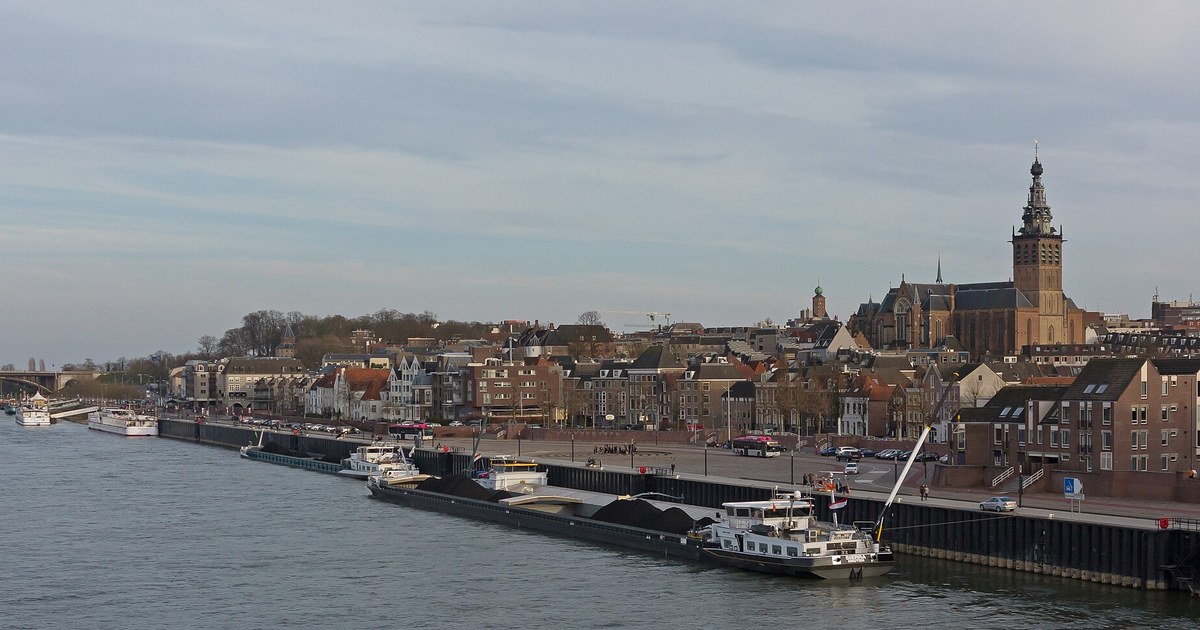
Nijmegen sits on the Waal β the largest and fastest of the Rhine’s three distributary arms β and the river defines the city in ways that go far beyond the practical. The Waal is wide here, a muscular, silver-green sweep of water that the city’s great steel arch bridge has straddled since 1936. From the Valkhof park on its high Roman hill, you look out over the river and the flat Betuwe orchards on the far bank, and on clear days the land dissolves into a haze that reaches all the way to Germany. That horizon has always mattered here. The Batavians, the Germanic tribe who gave their name to the entire Dutch lowland, called this bend of the river home. The Romans recognised the strategic value immediately.
The city that grew from those Roman foundations has lived through extraordinary moments: the Batavian Revolt of 69 AD, Charlemagne’s palace court, the medieval prosperity that raised the soaring Stevenskerk, and β with devastating suddenness β the American bombs of February 1944 that tore the old city centre apart. Nijmegen rebuilt with a dignity and quiet determination that still marks its character. It is a university city now, young and lively, but it carries its layered history with evident pride. Archaeology is visible at street level; the river is a living presence; and every July, tens of thousands of walkers from across the world arrive to take part in the Vierdaagse, the Four Days Marches, one of the great recurring rituals of European life.
What makes Nijmegen so compelling for the independent traveller is that it offers genuine depth in a compact setting. The Roman hill, the Gothic church, the medieval brewery, the wild wetlands of the Ooijpolder, the brand-new river island: all of it sits within cycling distance of a walkable centre. Come for a long weekend and you will leave with the feeling β rare and precious β of having understood somewhere properly.
In this email
- The Valkhof: where Rome, Charlemagne, and Barbarossa left their mark on the hill above the river
- The medieval heart: Stevenskerk, the Grote Markt, and the Benedenstad
- The Waal and Nijmegen Island: a great river reborn and a new urban park
- The Four Days Marches: the world’s greatest walking event and the Via Gladiola
- The Ooijpolder and Gelderse Poort: wild horses, beavers, and wide Gelderland skies
- Eating and drinking well: from medieval brewery to riverside cafΓ©
Best time to visit: The city is wonderful year-round, but July is extraordinary β the Four Days Marches and the Vierdaagsefeesten festival transform Nijmegen into a joyful, flower-strewn carnival. Spring brings blossom to the Betuwe orchards and cycling weather to the Ooijpolder; autumn turns the river landscapes copper and gold. Avoid the Vierdaagse week if you prefer quieter streets and easier accommodation.
Travel logistics: Nijmegen is easily reached by direct train from Amsterdam Centraal (just over an hour) and from Utrecht (around forty minutes). The city centre is highly walkable; the Ooijpolder and surrounding countryside are best explored by hired bicycle. Trains also connect to Arnhem (fifteen minutes), which pairs well with a visit if you are following the Rhine-Delta landscapes or the Operation Market Garden trail.
The Valkhof: two thousand years on a hill
Begin where Nijmegen itself began: on the Valkhof, the wooded park hill that rises above the Waal’s south bank and has served as a seat of power for longer than almost any other place in the Netherlands. The Romans were here first, establishing a military camp on the Kops Plateau to the east around 12 BC under the general Drusus, then shifting to the Valkhof hill itself as the settlement grew into the civilian town of Ulpia Noviomagus Batavorum β a name granted when Emperor Trajan conferred municipal rights around 100 AD. The Legio X Gemina was stationed here; coins, pottery, carved stones, and the foundations of substantial buildings have all emerged from the Nijmegen soil over the centuries.
What you see in the park today is not Roman but it is scarcely less impressive. In 777 AD, Charlemagne built a palace on the old Roman site; Nijmegen was one of his favoured court locations, and the palace was a significant statement of Carolingian power. The park still holds the ruins of two chapels from successive imperial eras. The rounder, octagonal St. Nicholas Chapel β its tufa-stone walls still standing to roof height β was built in 1030 under Emperor Conrad II, deliberately echoing the great Palatine Chapel at Aachen where Charlemagne himself was buried. When Frederick Barbarossa extended and rebuilt the Valkhof palace in 1155, he retained this octagonal chapel and added a second, whose graceful Romanesque apse β three semicircular niches of pale stone open to the sky β is one of the most quietly beautiful architectural fragments in the Netherlands. The French Revolution levelled everything else; only these two chapel ruins remain, preserved in a park that opens freely to all.
From the Valkhof’s terrace the view over the Waal is superb: the long silver curve of the river, the steel arch of the Waalbrug, the flat green of the Betuwe spreading beyond, and β on clear days β the church towers of distant villages dissolving into the horizon. Spend time here before descending into the city. This view explains everything that followed.
The Valkhof Museum, just below the park at Kelfkensbos, holds the city’s deep collection of Roman finds β gold coins, carved reliefs, ceramic vessels, weapons β alongside medieval objects and fine art. Having recently undergone renovation, it is the best single introduction to Nijmegen’s full two-thousand-year story, and worth at least a morning of your time.
The medieval heart: Stevenskerk, the Grote Markt, and the Benedenstad
From the Valkhof, the city’s medieval centre is only a few minutes’ walk. The Stevenskerk β St. Stephen’s Church β dominates the skyline with the authority of a Gothic building that took two centuries to build and lost much of its tower in a single catastrophic morning. Construction began in the mid-thirteenth century and the church was consecrated in 1273 by Albert Magnus, Bishop of Cologne; a vast choir, side chapels, and the great nave followed over the fifteenth century. Then came 22 February 1944.
That morning, American B-24 bombers of the 446th Bombardment Group set out for German targets. Through navigational error, they identified Nijmegen β still under German occupation β as a German city, and their bombs fell on the historic centre. The marshalling yards they had intended to hit were damaged; the city around them was devastated. Around 800 civilians died. The Stevenskerk lost a large section of its tower and its south-western end was wrecked. A generation of patient restoration work followed; the church was fully repaired by 1969, and today it stands again as a calm, luminous Gothic interior with soaring columns, magnificent stained glass, and a stillness that makes the horror of that February day feel very close. Step inside and take your time.
The Grote Markt surrounding the church is the city’s outdoor living room β market stalls on weekday mornings, cafΓ© terraces spreading across the cobbles in fine weather. From here, lanes lead down to the Benedenstad, the lower city along the old Rhine harbour, which has been reborn in recent years as Nijmegen’s most characterful neighbourhood. Independent shops, small galleries, and canal-side cafΓ©s occupy former warehouses and merchant houses; the streets are hilly by Dutch standards, descending in steep terraces to the river. On warm evenings the Waalkade, the riverside promenade, fills with locals enjoying the view across the Waal to the new island beyond.
The Waal and Nijmegen Island: a river given room to breathe
The Waalbrug, opened in June 1936 when Queen Wilhelmina drew a crowd of two hundred thousand for the ceremony, was the longest arch bridge in Europe at the time of its construction: 244 metres of steel arc carrying the road high above a river that floods, churns, and occasionally threatens to overwhelm its banks entirely. That threat became acute enough in the 1990s that the Dutch government began a national rethinking of its relationship with water β the landmark Room for the River programme, one of the most ambitious landscape interventions in modern European history.
Nijmegen’s contribution to that programme was audacious. Between 2013 and 2015, engineers dug an entirely new bypass channel β the Spiegelwaal, or Mirror Waal β through the polder on the Lent bank opposite the city, creating a three-kilometre parallel waterway. The spoil from the excavation, and the reconfiguration of the dike inland by 350 metres, produced a new island: Veur-Lent, a narrow strip of land between the original river and the new channel, now a freely accessible urban river park. Cross the Waalbrug on foot or by bicycle, turn east, and within minutes you are on an island that did not exist a decade ago β its banks planted with native grasses and willows, its beaches filling with swimmers in summer, its cycle paths empty enough on a weekday morning that you share them only with lapwings and passing barges. The Spiegelwaal glitters beside you; the old city skyline with its church tower and Valkhof treeline faces you across the water. It is an extraordinary thing that has been made here: pragmatic flood engineering transformed into landscape poetry.
The Four Days Marches: gladioli, blisters, and belonging
Every third week of July, Nijmegen becomes the centre of something that has no real equivalent anywhere else in the world. The International Four Days Marches β the Vierdaagse β began in 1909 as a modest military exercise with 306 participants walking 35 kilometres a day for four days. Today more than 45,000 walkers from over 70 nations sign up each year, choosing to walk 30, 40, or 50 kilometres a day, four days in succession, through the landscapes around Nijmegen: the Betuwe orchards, the Maas-Waal canal, the forests of the Reichswald, the quiet polder roads of the Ooijpolder.
The physical challenge is real β a 50-kilometre day in July heat, repeated four times, is not undertaken lightly β but the atmosphere is anything but grim. The roads are lined with people offering orange slices, cold water, and encouragement. Villages set up impromptu bands and barbecues. Military contingents from a dozen countries march in formation. Elderly walkers who have completed thirty or forty consecutive editions wear their accumulated medals like armour. Children run alongside strangers who have come from Japan, South Africa, Australia, and every corner of Europe to walk through this particular corner of the Netherlands.
The final day’s entry into Nijmegen is the ritual climax: walkers approach the city along the Sint Annastraat, which the crowds have transformed into the Via Gladiola. The name borrows from Latin β gladius, sword β but the tradition is Dutch warmth in its purest form: spectators line both sides of the street and shower the exhausted walkers with gladiolus flowers, hundreds of thousands of stems, until the road is carpeted in pink and red and white. The name echoes Roman triumph, and in the context of Nijmegen β the ancient Noviomagus β it feels exactly right.
Even if you cannot visit during the Vierdaagse week, the festival reverberates through the city’s identity year-round. The Vierdaagsefeesten β the accompanying outdoor music festival, the largest freely accessible event in the Netherlands β runs alongside the marches with over a thousand performances across forty stages. Outside July, the Waalkade and the city’s squares still carry that sense of a place that knows how to welcome strangers.
The Ooijpolder and Gelderse Poort: wild land at the river’s edge
East of Nijmegen, where the Waal curves towards the German border and the land flattens into a wide floodplain mosaic, lies one of the most rewarding cycling landscapes in the eastern Netherlands. The Ooijpolder is a low, damp, quietly extraordinary place: old river dunes grown over with oak and blackthorn, wet meadows loud with reed warblers and reed buntings, clay-banked channels where beavers build lodges and raise young in unhurried succession. This is part of the wider Gelderse Poort nature area β the Gelderland Gate, where the Rhine and its distributaries spread into the Netherlands across a braided patchwork of channels, islands, and seasonal floodplains.
The landscapes here feel genuinely wild in a way that the more densely managed Dutch countryside often does not. Konik horses and Galloway cattle roam freely across the reserve, grazing the riverbank grasslands that are too wet and too flood-prone for conventional farming. In spring, black terns nest on floating vegetation mats in the ditches; bitterns boom from the reedbed edges at dusk. In autumn, the skies fill with migrating geese streaming westward from Scandinavia and Russia, and the old willows along the dike roads turn a deep burnt amber.
The ideal way to explore is by bicycle. A circuit of around 47 kilometres loops east from Nijmegen through the polder, touches the Rhine bank near the German border, crosses the river by ferry from Millingen aan de Rijn, and returns along the Waal’s southern levee. The riding is almost entirely flat; the roads are quiet; and the views β wide, cloud-piled, green and silver β reward stopping often. Pack a picnic, choose a dike-top bench above the floodplain, and let the afternoon stretch.
Eating, drinking, and the medieval brewery
Nijmegen eats and drinks with a self-assurance that comes from being a university city of 180,000 that has never felt the need to perform sophistication. The food scene is honest, varied, and pleasingly unpretentious.
Begin any stay with a visit to De Hemel, the brewery and restaurant installed since 1999 in the medieval Commanderie van St. Jan β a thirteenth-century building of warm brick and vaulted ceilings that was once a monastic hospital. De Hemel brews its own range on site: the pale Luna, the amber Godelief with its caramel malt body, and the Serafijn, a white beer seasoned with orange zest and coriander. The brewery also produces whisky, gin, and liqueur from its own fermentation, and turns surplus production into beer vinegar and mustard. Lunch here β Dutch seasonal food, proper bread, a glass of something brewed twenty metres away β sets the tone for the city perfectly.
The Benedenstad neighbourhood rewards slow exploration for independent cafΓ©s and smaller restaurants. The Waalkade riverfront has a string of terraces that are at their best on warm summer evenings, when the Waal turns gold and the Waalbrug arch frames the sky. For coffee and the city’s daily rhythm, the Grote Markt terraces do exactly what market squares have always done: give you a seat, a view, and enough time to watch the world go past.
A three-day itinerary for Nijmegen
Day one: Roman foundations and the medieval city
Arrive and walk directly to the Valkhof. Spend an hour in the park, visiting the St. Nicholas Chapel and the Barbarossa apse, and taking in the river view from the terrace. Descend to the Valkhof Museum and allow two hours for the Roman collections. Lunch in the Benedenstad, then spend the afternoon in the old city centre: Stevenskerk, the Grote Markt, the lanes between. In the evening, dine at De Hemel in the Commanderie van St. Jan and work through the brewery’s range at leisure.
Day two: the river and the new island
Take the morning on foot along the Waalkade, then cross the Waalbrug on foot or by bicycle to explore Veur-Lent island. Walk or cycle the full length of the Spiegelwaal channel and back, stopping to swim if the season allows. Return to the city for a late lunch. Spend the afternoon at the Valkhof Museum if you did not finish the previous day, or hire a bicycle and ride the riverbank west. Evening on the Waalkade terraces watching the barges pass.
Day three: the Ooijpolder cycle loop
An early start and a full day on a bicycle. Head east from Nijmegen through the Ooijpolder, following the cycle route through the Gelderse Poort nature reserve. Look for Konik horses on the river dunes, beavers along the waterway edges, and birds in the reed fringes. Cross to the south bank at Millingen aan de Rijn by ferry and return along the Waal levee. Allow five to six hours total. A final evening in the Benedenstad before departure.
Where to stay
The Mercure Hotel Nijmegen Centre offers a reliable four-star base two minutes’ walk from the central station, with a pool and spa that earn particular gratitude after a long day cycling the Ooijpolder. For more character, Boutique Hotel Manna β close to the station and the centre β provides well-appointed suites with an excellent breakfast that starts the day well. The Van der Valk Hotel Nijmegen-Lent, across the river in the Lent village, gives easy access to the new island park and earns consistently high guest ratings for its spa facilities; the short bridge or ferry crossing into the city centre is no hardship when the river view from the hotel terrace compensates. During the Four Days Marches in July, book well in advance β Nijmegen fills completely during Vierdaagse week and accommodation within cycling distance is equally stretched.
In closing
Nijmegen does not announce itself. It sits on its hill above the Waal and waits for the traveller who is willing to look past the obvious Dutch itinerary, to follow the river east and discover what two thousand years of continuous habitation look like when they have been lived honestly β through conquest and revolt, through Carolingian grandeur and medieval piety and wartime devastation and pragmatic, optimistic rebuilding. The Romans named this place Noviomagus: the new market, or the new field. The name has worn well. Nijmegen keeps finding ways to be new: a river island where none existed ten years ago, a festival that has grown from three hundred soldiers to forty-five thousand walkers from every corner of the world, a university that fills the old streets with young people who treat this Roman hill as simply the place they happen to live. Come and walk their streets. The gladioli are waiting.


