
Most Dutch cities look like they have been sleeping for four centuries. Cobbled streets, canal houses, brick towers rising above the water. Rotterdam woke up differently — and never stopped surprising people.
What the Bombs Left Behind
On 14 May 1940, German aircraft destroyed Rotterdam’s entire medieval centre in a single afternoon. Around 24,000 homes vanished. Churches, guild houses, ancient bridges — gone in hours.
The Dutch faced a choice: rebuild what was lost, or build something entirely new.
They chose new. Architects arrived from across the world. The city became an open-air experiment. That single decision still shapes every street you walk today.
A City Built for Tomorrow
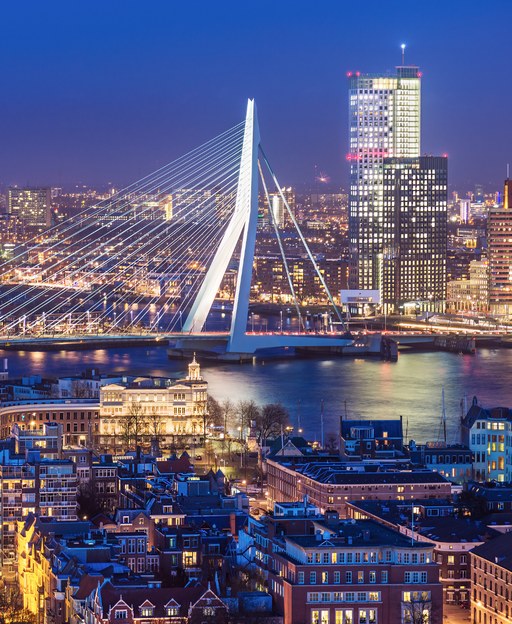
Walk through Rotterdam and you feel it immediately. The skyline is bold, strange, and modern. Glass towers lean at unexpected angles. A covered market the size of a cathedral curves overhead in a horseshoe arch.
Architect Piet Blom built the Cube Houses — the Kubuswoningen — in the 1980s to form a “forest” of tilted cubes above a pedestrian bridge. You can visit one as a show home and discover that a tilted cube means a great deal of slanted shelving.
The Markthal opened in 2014. Builders completed the arched shell above 228 apartments and a busy food market. A painted mural stretches across the full interior ceiling. People eat stroopwafels under it while staring upwards. The building looks like nothing else in the Netherlands — and that is entirely the point.
The Port That Powers a Continent
Rotterdam’s port is the largest in Europe. Every year, more than 460 million tonnes of cargo pass through — oil, containers, grain, cars. The port stretches 40 kilometres along the River Maas.
Cranes mark the horizon. Container ships move slowly upriver. An industrial skyline sits just beyond the glass towers of the city centre. Rotterdam has always been a place of movement and trade. That restless energy is still alive today.
The city has a different character from Amsterdam — faster, more international, less focused on tourists. Visitors who arrive expecting quiet canals and old courtyards find something rawer and more alive.
Enjoying this? Get stories like this every week from Love Netherlands — Subscribe free →
The Neighbourhood That Survived
Not everything in Rotterdam is glass and steel. The Delfshaven neighbourhood survived the 1940 bombing almost untouched. Its canal, old windmill, and 17th-century brewery look exactly as a Dutch town should look.
The Pilgrim Fathers set sail from this quayside in 1620, heading for a new life in America. A small plaque marks the spot. The street beside it is entirely unremarkable — and somehow that makes it more moving.
Further east, the Kralingse Plas lake draws families on summer evenings. Sailboats cross the water. People sit on grassy banks with food from nearby stalls, while a windmill stands at the edge of the park. Rotterdam keeps its softer side out of the spotlight. That restraint is part of what makes it worth finding.
If you are planning your first trip to the Netherlands, the Start Here guide is the right place to begin.
How Rotterdam Fits a Netherlands Trip
Rotterdam sits just 25 minutes from Amsterdam by direct train. Most visitors treat it as a day trip — but an overnight stay gives you access to the restaurant and bar scene on the Witte de Withstraat, which runs well into the evening.
The Markthal alone has enough food stalls to fill an afternoon. Dutch cheese, Indonesian rice dishes, fresh stroopwafels, Vietnamese street food — the variety reflects the city’s port character. More than 170 nationalities call Rotterdam home.
For a contrast, the Dutch canal city that hid its cafés below the waterline offers a quieter, older side of Dutch urban life. And if history draws you further, the Dutch city where the Pilgrim Fathers lived before crossing the Atlantic is a short train ride south of Rotterdam.
What is Rotterdam famous for in the Netherlands?
Rotterdam is the Netherlands’ second-largest city and home to Europe’s busiest port. The city is known for its bold modern architecture — including the Cube Houses, the Markthal, and the Erasmus Bridge — built after wartime bombing destroyed the old city centre in 1940.
Is Rotterdam worth visiting as a day trip from Amsterdam?
Yes. The train takes around 25 minutes and runs frequently throughout the day. Most visitors spend a full day exploring the Markthal, Cube Houses, and Delfshaven. Staying overnight gives access to Rotterdam’s lively evening restaurant scene, which extends much later than in smaller Dutch cities.
When is the best time to visit Rotterdam?
May to September offers the best weather for walking the waterfront and exploring outdoor markets. Rotterdam’s museums and the Markthal are open all year. The architecture looks striking in every season — even grey winter light suits the city’s industrial-modern character well.
What is the Markthal in Rotterdam and is it worth visiting?
The Markthal is an arched indoor market hall that opened in 2014. It contains apartments, a food market, and a vast painted mural across the interior ceiling. Entrance is free. It is one of the most visited buildings in the Netherlands and a centrepiece of Rotterdam’s post-war architectural story.
Walk across the Erasmus Bridge at dusk and look back at that skyline. Whatever you expected Rotterdam to be, this was not it. That surprise is the city’s gift to every visitor who arrives.
Love Netherlands — Free Every Week
Canal towns, hidden villages, Dutch stories. A free letter about the Netherlands — written slowly, delivered weekly.
Love more? Join 64,000 Ireland lovers → · Join 43,000 Scotland lovers → · Join 30,000 Italy lovers →
Free forever · One email per week · Unsubscribe anytime
Tours & experiences you might love


Powered by Viator. Some links are affiliate links — we may earn a small commission at no extra cost to you.