
On 27 April every year, something extraordinary happens across the Netherlands. Millions of people flood into the streets dressed head to toe in orange. It is not a football match. It is not a protest. It is the most joyful day on the Dutch calendar — and once you understand it, you will want to be there.
A Birthday Turned National Festival
Koningsdag — King’s Day — began as a celebration of the Dutch monarch’s birthday. The date was not always in April. For decades the holiday fell on 30 April, the birthday of Queen Juliana. Her daughter Queen Beatrix kept that date even though her own birthday fell in January. When King Willem-Alexander took the throne in 2013, the date shifted to his birthday: 27 April.
So a nation moved its biggest party by three days. Nobody complained.
Why Does Everyone Wear Orange?
The colour has nothing to do with carrots or autumn leaves. Orange is the colour of the House of Orange-Nassau — the royal family whose roots stretch back to the 16th century. William of Orange led the Dutch revolt against Spanish rule. He became the founding father of the modern Netherlands. Ever since, orange has stood for national pride. On King’s Day, the Dutch wear it with cheerful defiance.
It is also worth knowing that almost no Dutch person calls it “Koningsdag” in everyday speech. They just say “Kingsday” — half Dutch, half English — and everyone knows exactly what they mean.
What Actually Happens on the Day
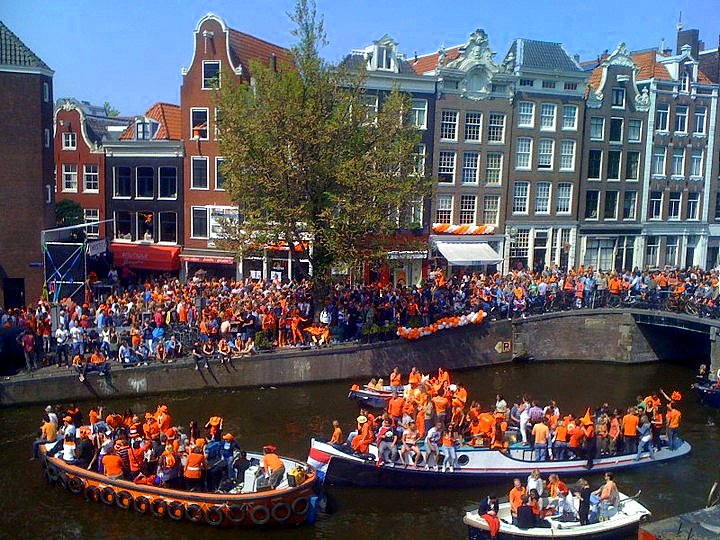
In Amsterdam, the canals fill with boats. Hundreds of vessels — from rented pedal boats to old barges — crowd the waterways. Every boat carries people in orange wigs, orange suits, and face paint. The noise is extraordinary.
Every neighbourhood sets up a vrijmarkt — a free market. Children lay out old toys and clothes on the pavement. Adults do the same. No permits are needed. On this one day each year, anyone can sell anything, anywhere in the country. The city becomes one enormous open-air jumble sale.
Music plays on every corner. Street performances, DJs, and brass bands compete for space. The air smells of oliebollen — fried dough balls dusted with icing sugar — and stroopwafels fresh off the iron.
Enjoying this? Get stories like this every week from Love Netherlands — Subscribe free →
Amsterdam vs the Rest of the Netherlands
Most visitors head straight to Amsterdam, and for good reason. The canal boat parade is spectacular. Smaller cities offer their own character, though. In The Hague, the celebrations feel more formal — this is the seat of government, after all. Cities like Groningen and Eindhoven attract younger crowds who party well into the night.
Want to see Koningsdag without the tourist crush? Head to Haarlem or Leiden. Same orange chaos, far fewer selfie sticks.
If you are new to the Netherlands, our guide to getting started will help you plan your trip around festivals, seasons, and hidden highlights that most visitors never find.
The Night Before — Koningsnacht
Few visitors know about Koningsnacht — King’s Night. The evening of 26 April is when celebrations begin a full day early. Clubs and outdoor stages run all-night events across the country. Amsterdam’s Museumplein becomes one giant open-air concert. If you want to experience Koningsdag at its most electric, arrive the night before.
The two-day combination makes this the biggest street party in Europe. Some estimates place the Amsterdam crowds above 800,000 people on the 27th alone.
How to Experience King’s Day Like a Local
Wear orange — nothing expensive. A scarf, a hat, or a painted cheek is enough. The Dutch welcome every level of enthusiasm. Join the vrijmarkt and buy something small from a child selling old toys. Eat the oliebollen. Get on a boat if you can find a spot.
Avoid one common mistake: booking accommodation only for the 27th. Come the evening before. Stay through the quieter afternoon hours, when the vrijmarkt winds down and the canals begin to clear. That final hour — when the orange-clad crowds thin and the boats drift home — is one of the most beautiful things you will see in the Netherlands.
The Dutch have a word for the warm, connected feeling of being in a good place with good people. It is called gezellig — and Koningsdag is the most gezellig day of the Dutch year.
What is King’s Day in the Netherlands?
King’s Day (Koningsdag) is a national holiday celebrated every year on 27 April — the birthday of King Willem-Alexander. The Dutch mark it with free street markets, canal boat parades, and a nationwide tradition of wearing orange.
Where is the best place to celebrate King’s Day in the Netherlands?
Amsterdam is the most famous destination, with canal parades and enormous street markets. For a less crowded experience, Haarlem, Leiden, or Utrecht offer the same orange energy with a more local feel.
When does King’s Day start in the Netherlands?
Officially on 27 April — but celebrations begin the evening before on Koningsnacht (King’s Night), 26 April. Arriving on the 26th gives you the full festival experience, including outdoor concerts and all-night events.
What should I wear to King’s Day?
Anything orange. A simple orange shirt, hat, or scarf is enough. The Dutch welcome every level of orange enthusiasm — from a subtle accessory to a full outfit with matching face paint and an orange wig.
There is a moment on King’s Day — usually mid-afternoon, when the boats are still on the canals and the music has not yet stopped — where you look around and understand something essential about the Dutch. They do not celebrate quietly. They turn an entire nation orange and call it a birthday party. And somehow, it works.
Love Netherlands — Free Every Week
Canal towns, hidden villages, Dutch stories. A free letter about the Netherlands — written slowly, delivered weekly.
Love more? Join 65,000 Ireland lovers → · Join 43,000 Scotland lovers → · Join 30,000 Italy lovers →
Free forever · One email per week · Unsubscribe anytime
Tours & experiences you might love


Powered by Viator. Some links are affiliate links — we may earn a small commission at no extra cost to you.