

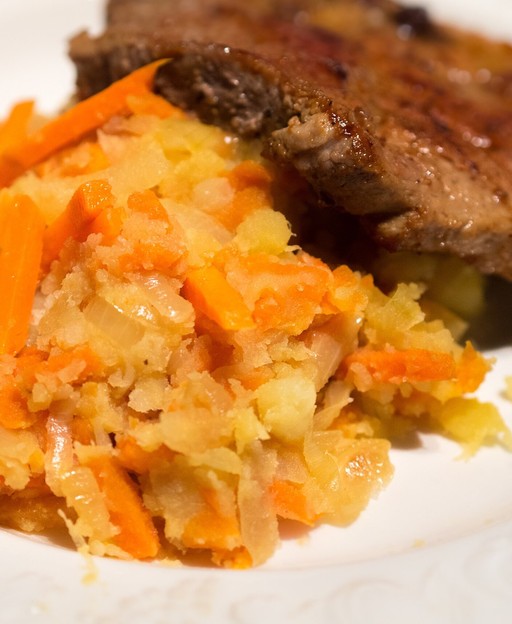
Orange-flecked mash, a slice of slow-cooked beef and a puddle of gravy. In Leiden it is more than supper: every 3 October the whole city eats it to remember the morning a siege ended in 1574.
Free Netherlands Travel Guide
The Ultimate Netherlands Travel Guide (PDF), 2026 edition. All 12 provinces in one place. Free when you join our newsletter.
A city that nearly starved
In 1573 and 1574, during the Eighty Years’ War, Spanish troops of King Philip II surrounded Leiden and tried to starve it into surrender. Museum De Lakenhal, Leiden’s own city museum, estimates that more than 6,000 people died, almost half the town, from hunger, plague and dysentery.
Rescue came by water. William of Orange’s army and the Sea Beggars broke the dykes, and in the night of 2 to 3 October 1574 the polders around the city flooded and the Spanish fled. In the early morning the Beggars sailed in over the flooded land and handed out herring and white bread to the starving people.
The pot the Spanish left behind
Here the story of hutspot begins. In the abandoned Spanish camp at the Lammenschans, a Spanish fort outside the city, someone found a cooking pot with stew still in it. According to tradition, says the Lakenhal, the first man brave enough to walk into the empty fort was a Leiden freebooter, Gijsbert Cornelisz. Schaeck. He checked the Spanish had gone, sent word to the Beggar leader Boisot that the fleet could sail on safely, and carried the pot of hutspot home.
That pot still exists. It is a bronze cooking pot, made before 1574, and it is on show in the Lakenhal’s Van Breezaal. After Schaeck died, a poem about his deed was engraved on its belly. Two Leiden regent families, Van Assendelft and De Wildt, kept it for centuries until it joined the city’s 3 October collection in 1838. The pot became the symbol of a city that survived the famine, and hutspot became the food of 3 October.
The orphan who never was
Ask in Leiden today who found the pot and many people will tell you it was an orphan boy, Cornelis Joppensz. The Lakenhal is clear that this is not correct: over time Schaeck was forgotten and the orphan took his place in the town’s memory, and the boy’s version quickly became the favourite.
What was in the pot is a story too. The Dutch food site The Dutch Table passes on the tale that the first hutspot was parsnips and white beans with mutton, not today’s potatoes, carrots and beef. Almost a century after the siege the word still meant a meat-and-vegetable stew: the Amsterdam cookbook De verstandige kock (1669 edition) has a hutspot of mutton, as Marleen Willebrands notes on DBNL. The dish even gave English a word: the Dutch food historian Janny de Moor points out that “hotchpotch”, a mishmash, comes from hutspot.
Where to taste it
Go to Leiden on 3 October, when the city still celebrates the Relief with herring, white bread and hutspot (Museum De Lakenhal). Any other day, you can stand in front of the pot itself in the Van Breezaal at Museum De Lakenhal, then make this at home.
Hutspot met Klapstuk (Dutch Carrot and Onion Mash with Braised Beef)
Ingredients
Method
- Put the beef in a heavy pan with the water, stock cube, bay leaf and peppercorns. Bring to the boil, then cover and simmer very gently for 1 1/2-2 hours, until a fork slides into the meat with no resistance.
- Lift out the beef. Strain the broth into a jug and keep it.
- Layer the potatoes in a large pan, then the carrots, then the onions. Pour in just enough water to cover the potatoes and add a pinch of salt. Lay the beef on top to keep warm, cover and bring to the boil.
- Simmer for 20-25 minutes, until the potatoes are tender when pierced with a fork.
- Meanwhile, make the gravy: bring the beef broth to the boil in a small pan, stir in the flour-and-water mix and simmer, stirring, for a few minutes until it thickens. Season to taste.
- Lift out the beef and cut it into slices. Drain the vegetables, saving a cup of the cooking water.
- Mash the potatoes, carrots and onions coarse, with the warm milk, the butter and a splash of the cooking water if it is stiff. Season with salt and pepper.
- Pile the hutspot onto hot plates, lay the beef on top and pour over the gravy.
Notes
Frequently Asked Questions
Why do the Dutch eat hutspot on 3 October?
Because Leiden was freed from the Spanish siege on 3 October 1574, and a pot of hutspot found in the abandoned Spanish camp became the symbol of surviving the famine (Museum De Lakenhal).
What is klapstuk?
A marbled cut from the beef rib that needs long, slow cooking. In the States, The Dutch Table uses beef chuck rib roast; boneless short rib works too (The Dutch Table).
Can I see the original hutspot pot?
Yes. The bronze kettle, made before 1574, is on display in the Van Breezaal of Museum De Lakenhal in Leiden.
Sources: Museum De Lakenhal, Hutspot (object 3346) and Siege and Relief of Leiden; Janny de Moor, Dutch Hotchpotch (Hutspot); The Dutch Table, Hutspot met klapstuk; Marleen Willebrands, ‘Malse aspargies, dick en soet’ (DBNL). Checked November 2026.
Free Netherlands Travel Guide
The Ultimate Netherlands Travel Guide (PDF), 2026 edition. All 12 provinces in one place. Free when you join our newsletter.
Tours & experiences you might love


Powered by Viator. Some links are affiliate links — we may earn a small commission at no extra cost to you.