

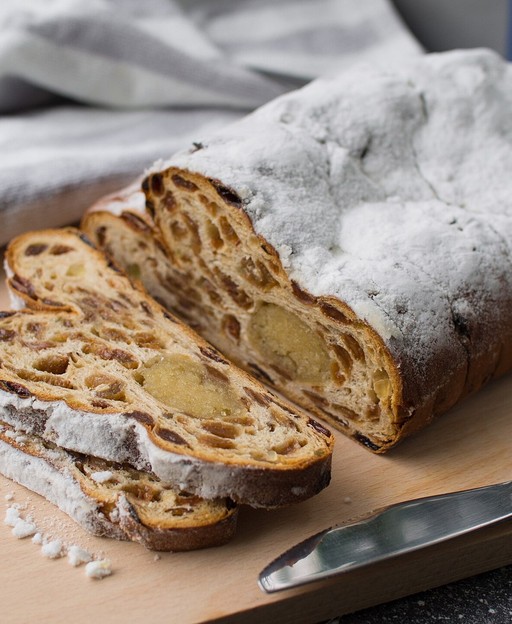
Cut a Dutch kerststol and the first thing you look for is the yellow ribbon of almond paste running through the middle. That ribbon is the whole point, and the Dutch can be fussy about what it is made of.
Free Guide: Dutch Christmas Baking (PDF)
8 Dutch holiday bakes, from kruidnoten to kerststol and oliebollen, in metric and US cups. Free when you join our newsletter.
A Bread With Two Names
In a Dutch bakery in December you will see two loaves that look almost the same: kerstbrood and kerststol. Dutch-born food writer Nicole Holten of The Dutch Table puts the difference simply: if the Christmas bread has a ribbon of creamy almond paste inside, it is a stol. Without it, it is “just” Christmas bread.
Both are rich, sweet yeast breads full of raisins and candied peel, with a coat of icing sugar on top. The Amsterdam bakers behind Weekend Bakery say the Dutch eat so much of it over the holidays that most of them cannot face another slice until Easter, when the very same bread comes back in the shops as Easter bread. A stol sold at Easter is called a paasstol.
A Cousin From Dresden
The stol belongs to the same family as the German Stollen, and that loaf has a paper trail. According to the European Union’s protected-name record for Dresdner Christstollen, the first written mention of stollen is from 1474, on a bill at the hospital of St Bartholomew in Dresden. Advent was then a time of fasting, and in 1450 baking with butter during Advent had been banned. In 1490 Pope Innocent VIII issued his “Butterbrief”, the butter letter that freed Dresden’s stollen bakers from that ban. The rich, buttery loaf we know today grew from there.
Almonds or Beans?
Here is the part every Dutch baker has an opinion on. Barry van der Steen runs a family bakery in Made, North Brabant, with his brother Jeroen; the family has baked there for three generations and the shop has been named Beste Echte Bakker van Nederland (Best Real Baker in the Netherlands) three times. He told the consumer programme Kassa that his almond paste is one part almonds to one part sugar, and that it goes into his kerststollen.
The cheaper filling, banketspijs, is made from cooked beans, often white beans and sometimes soy, plus ground apricot kernels, which cost less than almonds. Dutch packs must say which filling is inside, so the first thing a stol lover does in the supermarket is read the label. When you bake your own, you choose.
When the Dutch Eat It
The Dutch celebrate two Christmas Days, 25 and 26 December. The Dutch Table describes a late-night koffietafel after Christmas Eve Mass, with luxury rolls, cheese and hot chocolate, and calls kerststol the traditional bread of the season. Over the holidays buttered slices turn up at breakfast and brunch, and a slice is offered to guests with their coffee instead of a biscuit.
Where to taste it: Van der Steen, De Echte Bakker in Made, North Brabant, told Kassa it fills its kerststollen with real almond paste; its Christmas range is on the bakery’s website. Elsewhere, ask your bakker for a stol “met amandelspijs”.
Kerststol (Dutch Christmas Bread with Almond Paste)
Ingredients
Method
- Soak the raisins, currants and peel in the warm orange juice for 15 minutes. Drain, then spread them out on a clean tea towel to dry while you make the dough.
- Mix the flour, yeast, sugar and salt in a large bowl. Add the lukewarm milk and the beaten egg (minus the tablespoon you kept back) and bring it together, then add the soft butter and lemon zest.
- Knead for about 10 minutes with dough hooks (12-14 minutes by hand) until smooth, supple and only slightly sticky. Work in the dried fruit gently at the end, pushing back any raisins that escape.
- Shape into a ball, put it in a greased bowl, cover and leave in a warm place for about 1 hour, until doubled.
- Knead the kept-back tablespoon of egg into the almond paste until smooth, then roll it into a sausage a little shorter than the loaf will be (about 25 cm / 10 in).
- Pat the dough into an oval about 25 x 20 cm (10 x 8 in), with the edges a little thicker than the middle. Press a groove along the length, lay the almond paste in it and fold the dough over, so the top half stops just short of the bottom edge: that step is the stol’s typical ‘lip’. Press down firmly beside the almond paste.
- Lift it onto a baking sheet lined with baking paper, cover and leave to rise for 40-45 minutes, until a gentle fingertip dent springs back only slowly. Heat the oven to 180°C / 160°C fan / 350°F / Gas 4.
- Bake for 35-40 minutes until deep golden. Cover loosely with foil if it browns too fast. It is done when an instant-read thermometer in the bread (not the almond paste) shows about 88°C / 190°F.
- Brush the hot loaf with the melted butter and leave to cool on a rack. Dust thickly with icing sugar when cold. Slice and serve with butter.
Notes
Frequently Asked Questions
What is the difference between kerstbrood and kerststol?
The almond paste. A Dutch Christmas bread with a ribbon of almond paste through the middle is a stol; without it, it is kerstbrood (The Dutch Table).
What is banketspijs?
A cheaper filling made from cooked beans with ground apricot kernels, sugar and flavourings. Real amandelspijs is made from almonds and sugar. The pack must say which one is used (Kassa).
Can I bake kerststol ahead?
Yes. Well wrapped at room temperature it keeps 2 to 5 days. For longer, freeze it and thaw for at least an hour. Avoid the fridge, where bread goes stale fastest (Weekend Bakery).
Sources: The Dutch Table, “Kerststol”; Weekend Bakery, “Our Perfect Christmas Stollen”; European Commission, Dresdner Christstollen PGI; BNNVARA Kassa, “Goedkope banketspijs of dure amandelspijs”; Van der Steen, De Echte Bakker. Checked November 2026.
Free Guide: Dutch Christmas Baking (PDF)
8 Dutch holiday bakes, from kruidnoten to kerststol and oliebollen, in metric and US cups. Free when you join our newsletter.
Tours & experiences you might love


Powered by Viator. Some links are affiliate links — we may earn a small commission at no extra cost to you.