
Most visitors to the Netherlands look south. They plan Amsterdam, then loop down through Delft, Leiden, and The Hague. Few look north.
But the Dutch will tell you something those visitors miss. Two hours from Amsterdam, past flat fields and enormous skies, sits Groningen — a city of students, markets, and canal water that most tourists never discover. It is one of the country’s most liveable, most creative cities. And it gets on with things quietly, without asking for attention.
A City Built Around Its Students
Around 60,000 students live in Groningen. In a city of 200,000 people, that ratio changes everything. The cafés stay busy late. The cycle paths fill up by 8am. The bookshops are serious, and the conversation in them even more so.
The University of Groningen opened in 1614. It counts Aletta Jacobs among its alumni — she enrolled in 1871 and became the first woman admitted to a Dutch university. She later became the country’s first female doctor. Her statue stands near the Academy Building in the city centre.
That spirit of doing things differently has never left Groningen. The city consistently ranks among the happiest in the Netherlands. It also has one of the highest densities of cyclists of any Dutch city — which is saying something.
The Market the Dutch Actually Use
On a Tuesday, Friday, or Saturday morning, the Vismarkt comes to life. Traders from across the Groningen region set up stalls selling aged cheese, smoked fish, fresh bread, vegetables, and flowers. The buyers are local. The prices reflect that.
On the western edge of the square, the Korenbeurs rises behind a neo-classical stone facade. A huge cast-iron and glass hall sits behind the stone front — the glass included so buyers could judge grain quality in natural light. Today the hall houses a supermarket, which is very Dutch. It is also one of the Netherlands’ top 100 UNESCO monuments, which is very Groningen.
You can feed yourself well from a single lap of the Vismarkt. A wedge of aged Gouda, a herring roll, a paper bag of warm stroopwafels. No reservation required.
The Museum That Looks Like No Other in the Netherlands
Enjoying this? Get stories like this every week from Love Netherlands — Subscribe free →
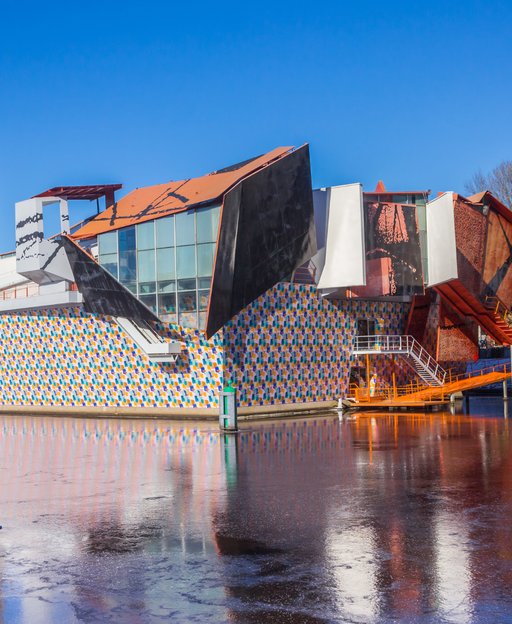
The Groninger Museum sits on a small island between the central station and the old town. From the outside, it looks like nothing you would expect in the north of the Netherlands.
Architect Alessandro Mendini oversaw its redesign in 1994. He assembled a team that included Philippe Starck and Coop Himmelb(l)au. Together they wrapped the building in clashing geometric forms and bold colours — part space station, part celebration. It is one of the most photographed buildings in the Netherlands, and most international visitors have never heard of it.
Inside, the collections move between archaeology and modern art. The permanent archaeology section includes finds from Roman-era settlements across the region — evidence of how long people have worked this land before anyone called it the Netherlands.
The Canal Ring Nobody Writes About
Amsterdam’s canals attract millions of visitors each year. Groningen has its own canal ring — the Diepenring — and it circles the entire medieval centre. In recent decades, planners removed most traffic from the canal banks and turned them into cycling and walking routes.
On a summer evening, terraces along the Kattenbrug and the Gedempte Zuiderdiep fill with people. The water reflects old gabled buildings above. It feels less staged than Amsterdam. More genuinely lived-in.
If you have visited the wharf cafés built into Utrecht’s canal bridges, Groningen’s waterfront offers something quieter — but equally real.
What Groningen Opens Up
Groningen is not only a destination. It is a starting point for the Dutch north.
Forty minutes south-east, the perfectly preserved star fortress of Bourtange rises from flat Groningen farmland. Read why Bourtange was built in the shape of a star — and why it still survives. To the west, the Frisian Lakes stretch across a network of waterways that Dutch families have sailed for generations. To the north, the Wadden Sea coast leads towards the islands.
Our Start Here guide covers how to plan a trip that reaches beyond the Amsterdam tourist trail and into the parts of the Netherlands most visitors never find.
What is Groningen known for in the Netherlands?
Groningen is the largest city in the Dutch north. It is famous as a student city with one of the youngest populations in the country, a high density of cyclists, and the Groninger Museum — a striking postmodernist building on a canal island in the city centre.
How do I get from Amsterdam to Groningen?
Direct trains run every 30 minutes from Amsterdam Centraal to Groningen station. The journey takes around two hours and 15 minutes, with no changes required.
What is the best time to visit Groningen?
May to September offers the warmest weather and the most outdoor life along the canals and at the market. The Saturday Vismarkt runs year-round and is worth a visit in any season.
Is Groningen worth visiting for a day trip from Amsterdam?
Yes — but two days works better. The city rewards a slow walk through the canal ring, a morning at the Vismarkt, and time at the Groninger Museum. An overnight stay lets you experience the evening atmosphere on the canal terraces as well.
Love Netherlands — Free Every Week
Canal towns, hidden villages, Dutch stories. A free letter about the Netherlands — written slowly, delivered weekly.
Love more? Join 64,000 Ireland lovers → · Join 43,000 Scotland lovers → · Join 30,000 Italy lovers →
Free forever · One email per week · Unsubscribe anytime
Groningen does not chase visitors. It simply gets on with being itself. That, in the end, is exactly why it is worth finding.
Frequently Asked Questions
How far is Groningen from Amsterdam?
Groningen is about two hours north by train. While it requires more travel than the typical tourist route through southern Dutch cities, locals say it's well worth the journey.
When are the markets open in Groningen?
The Vismarkt operates Tuesday, Friday, and Saturday mornings with local traders selling aged cheese, smoked fish, fresh bread, and vegetables at prices for residents rather than tourists.
What's the atmosphere like in Groningen?
With 60,000 students in a population of 200,000, the city feels youthful and energetic with busy cafés, high cycling rates, and active bookshops. It consistently ranks among the Netherlands' happiest cities.
What's historically significant about Groningen?
The University of Groningen, founded in 1614, admitted the Netherlands' first female university student—Aletta Jacobs—in 1871, who became the country's first female doctor. That pioneering spirit still defines the city today.
Tours & experiences you might love


Powered by Viator. Some links are affiliate links — we may earn a small commission at no extra cost to you.