

Power, Paintings, and a Grand North Sea Shore: The Complete Guide to The Hague and Scheveningen
The seat of Dutch government, a treasury of Golden Age masterpieces, and a sweeping Edwardian resort — all in one extraordinary city.
An introduction to The Hague and Scheveningen
There is a gentle corrective the Dutch will offer any visitor who arrives in The Hague and calls it the capital: the capital is Amsterdam. The Hague — Den Haag in Dutch — is something altogether different, and in many ways altogether more fascinating. This is the seat of government, the home of the royal family’s working palaces, the city where the world comes to settle its most serious disputes, and, a short tram ride to the west, the place where generations of Dutch families have spent their summers beside the great grey-green North Sea. It is one of the most worthwhile cities in the Netherlands, and one of the most underestimated.
The Hague wears its history with remarkable ease. Ministries and embassies occupy the same handsome canal-side streets as neighbourhood bakeries and Saturday markets. The Binnenhof, a Gothic castle complex at the city’s medieval heart, has housed the Dutch parliament since the thirteenth century. A few steps away, the Mauritshuis sits on the Hofvijver — the glittering Court Pond — holding within its seventeenth-century walls one of the most concentrated collections of Dutch masterpieces anywhere on earth. This is a city that accumulates significance without quite trying, and then presents it all with the understated confidence of somewhere that has nothing left to prove.
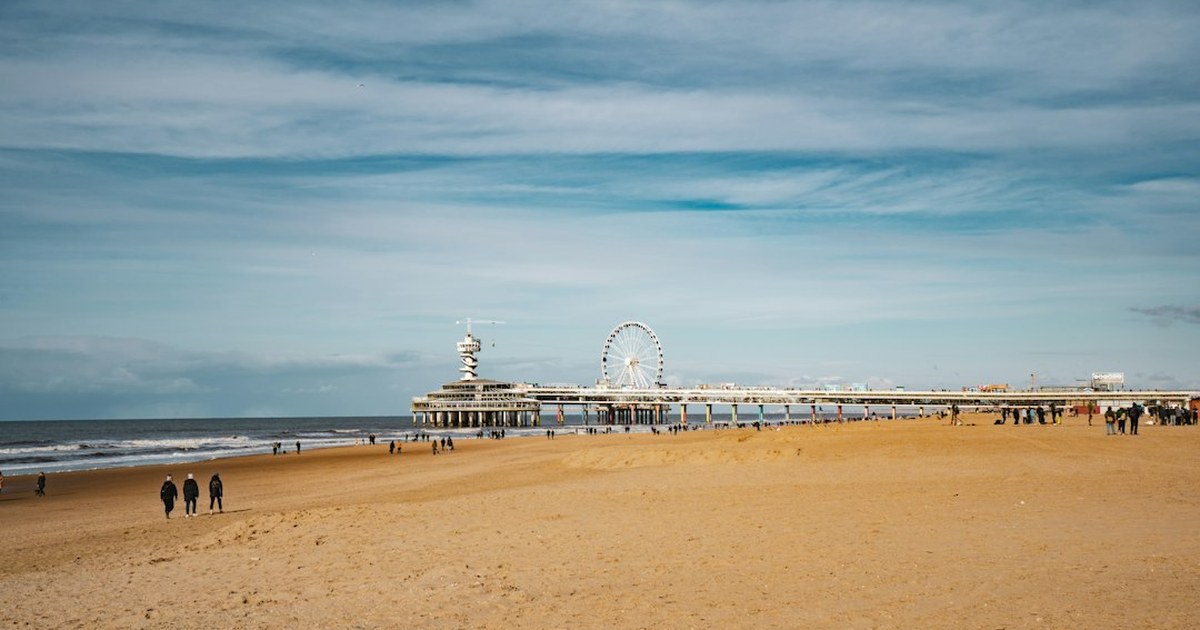
And then there is Scheveningen. Technically one of The Hague’s eight districts, this former fishing village turned grand Edwardian resort feels at times like a separate world: a long, wide beach, an elegant pier stretching out over the North Sea surf, and the Kurhaus Hotel rising improbably above the dunes like a Baroque mirage. When the North Sea cooperates — or even when it categorically does not — there are few finer places to walk in the Netherlands. The salt air and the roar of the waves are a wonderful counterpoint to all those gilded chambers inland, and the boulevard at Scheveningen has an exuberant, slightly old-fashioned charm that is entirely its own.
Whether you come for a long weekend or a full week, The Hague and Scheveningen offer a genuinely rich itinerary: world-class art, living history, architectural splendour, miniature marvels, some of the best independent shopping in the country, and the kind of wide windswept shore that makes you feel, after all the museums and palaces, properly, irreducibly alive. This guide covers everything you need to make the most of both.
In this email
- The Mauritshuis and Vermeer’s Girl with a Pearl Earring
- The Binnenhof: parliament, the Hall of Knights, and the spectacle of Prinsjesdag
- The Peace Palace: where the world comes to seek justice
- Escher in Het Paleis: impossible worlds inside a royal winter palace
- Scheveningen: the pier, the beach, the Kurhaus, and the North Sea
- Madurodam and the Statenkwartier: miniature Holland and elegant neighbourhood life
Best time to visit: May through September for the beach and outdoor café life; the third Tuesday of September for the spectacular Prinsjesdag royal procession; April and early May for tulips and empty museums.
Travel logistics: Intercity trains run from Amsterdam Centraal to Den Haag Centraal in around fifty minutes, and from Amsterdam Schiphol in roughly thirty; Den Haag Hollands Spoor (HS) is the city’s second main station, equally well connected. The Hague’s tram network is excellent — trams 1 and 9 connect the city centre to Scheveningen in under twenty minutes.
Continue reading with a Premium subscription
This is a Love Netherlands Sunday Premium guide. Premium subscribers receive the full article in their inbox every Sunday and unlock the full archive of past editions.
Become a Premium subscriber →Tours & experiences you might love


Powered by Viator. Some links are affiliate links — we may earn a small commission at no extra cost to you.