
Where the Netherlands Finally Gets Some Hills: The Complete Guide to South Limburg
Marl caves, a ruined medieval castle, vineyard-draped slopes and a hilltop where three countries shake hands — South Limburg is the Netherlands as you never expected it.
An introduction to South Limburg
Pull up a map of the Netherlands and your eye is drawn north and west: the great delta cities, the tulip fields, the flat horizon stretching all the way to the sea. But trace your finger to the very bottom of the country, where it tapers to a narrow finger of land squeezed between Belgium and Germany, and you find something the rest of the Netherlands simply cannot offer. The land rises. Hedgerows line sunken lanes. Orchards cling to hillsides. A ruined castle sits on a wooded ridge above a valley carved by a proper, tumbling river. This is South Limburg — the Heuvelland, the hill country — and it occupies a world entirely its own.
The hills are not dramatic by Alpine standards. The highest point in the Netherlands proper, the Vaalserberg at 322.5 metres, would barely register as a hill in Scotland. But in a country where the land fights daily to stay above sea level, these gentle rises feel quietly extraordinary. The Geul river has spent millennia cutting through soft marl limestone, creating a valley of real beauty: wide-bottomed, orchard-fringed, dotted with half-timbered farmhouses and villages that could have stepped sideways out of rural Belgium or the German Eifel. Which, in a sense, they have — the borders here have always been porous, the culture a wonderful blending of Flemish, German and something stubbornly, warmly Limburgian all at once.
South Limburg rewards the curious traveller generously. The caves beneath Valkenburg have been carved from marl for centuries and now host some of Europe’s more unusual attractions, including a Christmas market held entirely underground. Vineyards produce wines that would surprise those who think the Netherlands means only beer and jenever. And at Rolduc, a Romanesque abbey founded in 1104 stands in such untroubled serenity that a morning in its cloister feels like a small act of time travel. The region asks you to slow down, to walk its waymarked paths, to sit with a Limburgse vlaai and a glass of something local, and to notice just how different the Netherlands can be when it puts its mind to it.
There is a particular pleasure in discovering a corner of a well-travelled country that most visitors never reach. While day-trippers stream through Amsterdam, South Limburg gets on quietly with being one of the most rewarding short-break destinations in north-west Europe. Come in summer for the walking and the wine; come in advent for the cave markets; come in spring when the fruit trees froth white along the valley floors. Whenever you come, come prepared to be surprised.
In this email
- Valkenburg: caves, a ruined castle and all that character
- Walking the Geuldal valley
- On the vine: South Limburg’s wine country
- Rolduc Abbey: a thousand years in stone
- Drielandenpunt: standing in three countries at once
- Your South Limburg itinerary, where to stay, and how to get there
Best time to visit: South Limburg earns a visit in any season, but late spring (May–June) and early autumn (September–October) offer the finest combination of mild walking weather, orchard colour and open valley views. The winter cave markets at Valkenburg, running late November through December, are an experience in a category of their own.
Travel logistics: Maastricht is the natural gateway, reached in roughly two and a half hours by direct train from Amsterdam Centraal. Valkenburg has its own station on the Maastricht–Heerlen line, making it easy to base yourself there without a car. That said, a car unlocks the valley villages, vineyard lanes and the walk up to Drielandenpunt — and South Limburg’s country roads are genuinely pleasurable to drive.
Valkenburg: caves, a ruined castle and all that character
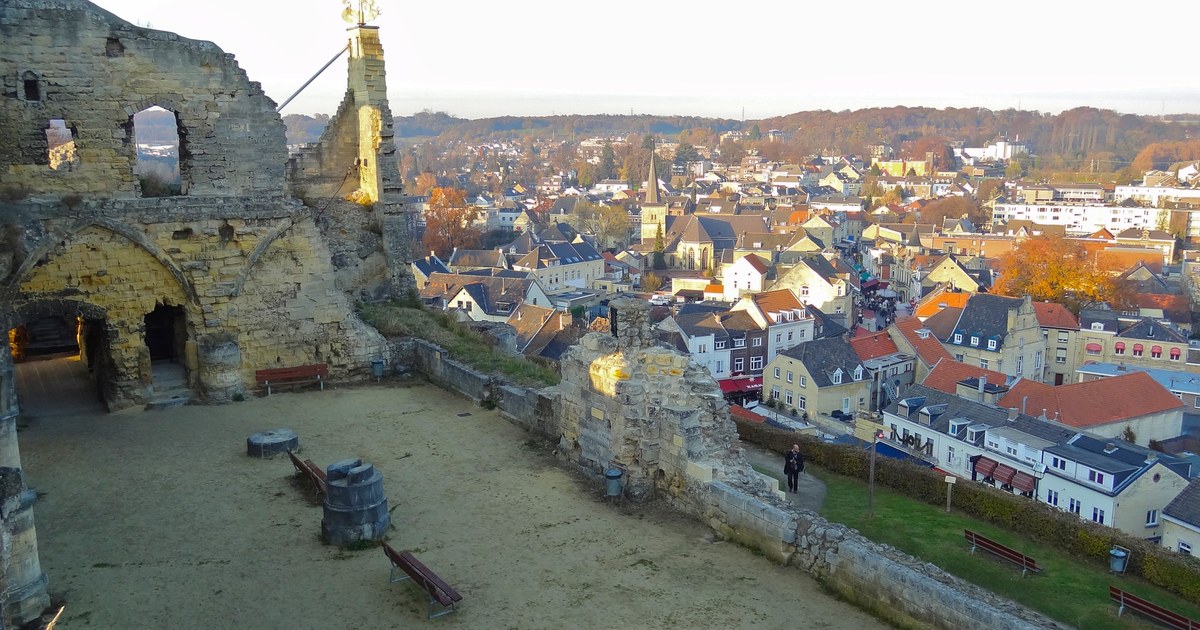
Valkenburg aan de Geul is the undisputed capital of South Limburg tourism, and it earns the title honestly. Perched above the Geul river and backed by a wooded ridge, this small town packs more genuine character into its medieval streets than places ten times its size. The castle ruin on the hill is visible from almost every approach — roofless walls of pale marl limestone rising from the trees — and it sets the tone immediately: this is a place with layers.
Kasteel Valkenburg dates to the eleventh century and was once one of the most strategically significant strongholds in the region, changing hands repeatedly across the centuries of Low Countries conflict. Its story ended dramatically during the Rampjaar of 1672 — the Year of Disaster — when French forces swept through the Dutch Republic. After the French withdrawal, the States-General ordered the castle demolished, determined it would never again serve as an enemy stronghold. The ruin they left behind is, paradoxically, one of the finest in the Netherlands: roofless but largely intact, laced with underground passages, and accessible via a short but rewarding climb from the town centre. The views from the walls across the Geuldal are worth every step of the ascent.
Beneath the castle and much of the town runs an extraordinary network of passages quarried from the soft marl. The Fluweelengrot — the Velvet Cave — is one of the oldest tourist attractions in the Netherlands, a natural marl cave whose walls are covered in carvings accumulated across centuries: coats of arms, devotional images and historical scenes left by quarrymen, soldiers and sightseers across the generations. The larger Gemeentegrot, an artificial cave complex hacked from the rock over many centuries of marl quarrying, was used as an air-raid shelter during the Second World War and still holds the atmosphere of those years in its cool, whispering chambers. Both caves are accessible only on guided tours, which adds considerably to the drama.
Come winter and Valkenburg undergoes a remarkable transformation. The cave complex hosts one of the most atmospheric Christmas markets in Europe: stalls selling glühwein, crafts and hot food set up inside the marl passages, lit by thousands of lights against the ancient pale walls. The Kerstmarkt in de Grotten draws enormous crowds and sells out months in advance — if this is your reason for visiting, plan accordingly.
Walking the Geuldal
The Geul is a small river by any objective measure — it rises near Walhorn in Belgium and joins the Maas north of Maastricht — but the valley it has carved through the South Limburg marl is disproportionately beautiful. The Geuldal is the heartland of Heuvelland walking country, and the network of waymarked paths criss-crossing its slopes and connecting its villages is reason enough to spend several days in the region.
The valley’s settlements reward slow exploration on foot. Epen, at the southern end near the Belgian border, is frequently described as one of the most attractive villages in the Netherlands — a cluster of Limburgian vakwerkhuizen, the distinctive half-timbered farmhouses of the region, with flower-filled gardens and a village square seemingly untouched by the twentieth century. Walking routes from Epen into the surrounding hills and across into Belgium are among the finest in the country, passing through orchards, along sunken lanes and across the open plateau land above, where views stretch far enough to feel genuinely expansive.
Mechelen, Slenaken and Gulpen each have their own pleasures. Gulpen is home to the Gulpener Brewery, founded in 1825 and one of the oldest independent breweries in the Netherlands. Gulpener has long championed local and sustainable ingredients, and its tap room makes a welcome destination after a morning on the paths. Between the villages, the valley route follows the Geul itself for long stretches — through stands of alder and willow, across small footbridges, past mill sites that speak to the valley’s long working history.
The plateau land above the valley has a character entirely its own: wide, open farmland under enormous skies, broken by copses and punctuated by the spires of small churches. From the high paths, you can see into Belgium and Germany simultaneously — a reminder of how compressed, and how genuinely European, this corner of the continent really is.
On the vine: South Limburg’s wine country
The idea of Dutch wine tends to prompt a smile. It should not. The south-facing slopes of the Geuldal and the surrounding hills have been cultivated with vines since Roman times — the legions knew good agricultural land when they saw it — and the modern South Limburg wine scene, modest in scale but serious in intent, produces bottles of genuine quality.
The Apostelhoeve winery on the Sint Pietersberg slopes just outside Maastricht is among the most established in the country. Set on terraced south-facing hillsides that catch the maximum of the region’s sunshine, it produces cool-climate whites — Auxerrois, Pinot Gris and Müller-Thurgau among them — that reflect the limestone soils and the honest restraint of northern viticulture. Visits and tastings can be arranged, and walking through the vineyard terraces with the Maas valley spread below is a genuinely lovely way to spend an hour.
Smaller producers dot the valley slopes throughout the region. Wijnhoeve De Colonjes near Eys and Wijngaard ‘t Hout at Slenaken both welcome visitors and offer the particular pleasure of tasting wine in the exact landscape that produced it. The South Limburg wine route — the Limburgse Wijnroute — connects the producers in a circuit that works equally well by bicycle or car, winding through orchards and past kitchen gardens with the unhurried rhythm that defines this region at its best.
If wine isn’t the priority, South Limburg offers other local consolations. The Limburgse vlaai — the region’s signature fruit flan, a yeasted pastry base filled with cherries, plums, apricot or sweetened rice custard — is available in every bakery and taken with the same seriousness that the French bring to their tarte tatin. Pair one with a Gulpener at a village café terrace and you will understand immediately why people keep coming back here.
Rolduc Abbey: a thousand years in stone
In the town of Kerkrade, near the German border in the eastern part of South Limburg, stands one of the most complete and affecting monastic complexes in the Low Countries. Abdij Rolduc — Rolduc Abbey — was founded in 1104 by Ailbert of Antoing, a cleric from Tournai who had sought a life of solitary prayer in this wooded corner of the region. What began as a hermit’s cell became a community, then a priory, then one of the most influential Norbertine (Premonstratensian) religious houses in the Low Countries.
What makes Rolduc exceptional is its architectural coherence. The Romanesque basilica at its heart is among the finest examples of the style in the Netherlands: heavy, measured, serene, built from the same pale marl that underlies everything in this region. The crypt is particularly extraordinary — a low, vaulted space of great spiritual weight, its columns worn smooth by nine centuries of passing hands. Above ground, the cloister garden offers the particular kind of peace that only very old buildings seem capable of generating, a stillness that feels architectural rather than merely circumstantial.
Rolduc ceased to function as a monastic house in the late eighteenth century and was later used as a seminary before becoming the conference and retreat centre it operates as today. The church remains active and open to visitors. Guided tours of the complex run regularly and are strongly recommended — arriving without a guide means missing the best of the crypt and the chapter house, where nine centuries of institutional life sit most palpably in the stones.
Drielandenpunt: standing in three countries at once
At the summit of the Vaalserberg, near the town of Vaals in the far south-eastern corner of the Netherlands, three countries share a single point. The Netherlands, Belgium and Germany meet here at the Drielandenpunt — the Three Countries Point — at an altitude of 322.5 metres. This is the highest point in the Netherlands proper, a fact that the Dutch receive with affectionate self-deprecation given that a fit cyclist could reach the top without leaving the saddle.
The hilltop itself has been developed — a viewing tower, a café, the usual paraphernalia of a popular landmark — but step a hundred metres into the surrounding forest paths and you are in beech woodland of real loveliness. The trees are enormous and cathedral-like, the paths leading down into the valleys of all three countries simultaneously, the forest managed cooperatively across the national boundaries in a way that feels quietly moving at a place where the map has always been negotiated and renegotiated. On clear days the views from the tower sweep across the rolling German Eifel to the east and into the Belgian Ardennes to the south — a prospect that stretches far beyond what the Netherlands normally allows.
Standing at the exact junction marker, you can place one foot in each country. Children and adults alike make a game of it, stepping between the Netherlands, Belgium and Germany in quick succession. It is one of those uncomplicated travel pleasures — slightly absurd, entirely human — that stays with you considerably longer than it has any right to.
The walk from Vaals town up to the summit through the forest takes around forty minutes and is the best way to arrive. It earns the view in a way that driving does not, and the forest on the ascent is worth the journey in its own right.
Your South Limburg itinerary
Three or four nights gives South Limburg the time it deserves — long enough to walk, taste, explore the caves and get genuinely lost on a plateau path without rushing any of it.
Day one: Arrive via Maastricht, settle into Valkenburg. Maastricht is worth an evening in its own right — one of the most handsome and lively cities in the Netherlands, with a distinguished restaurant scene centred on the Vrijthof square. Take the short train to Valkenburg in the afternoon, check in, and walk up to the castle ruin before dinner. The town is small enough to understand in an hour and comfortable enough to settle into immediately.
Day two: The Geuldal on foot. Leave Valkenburg on one of the valley walking routes heading south — the path following the Geul to Mechelen and on to Epen is a classic half-day. Lunch in Epen, then continue up onto the plateau above the valley for the afternoon’s walking. Return by bus or taxi to Valkenburg. A terrace dinner in the town centre rounds off the day well.
Day three: Vineyard morning, Rolduc afternoon. Head to Apostelhoeve or one of the valley wineries for a late-morning tasting and a walk through the terraces. After lunch, drive or take the bus east to Kerkrade for the guided tour of Rolduc. Time the visit so you reach the crypt in the quieter part of the afternoon — the light and the stillness are at their best then.
Day four: Drielandenpunt and home. An early start for the forest walk up to the Drielandenpunt from Vaals. Morning light through the beech canopy is worth the early alarm. Lunch back in Vaals or Maastricht, then the train north. If time allows, an hour in Maastricht’s extraordinary Dominicanen bookshop — housed in a converted Gothic church — extends the stay without rushing it.
Where to stay
Valkenburg is the obvious base for exploring the caves, the castle and the valley walks, with a range of accommodation from family-run hotels to comfortable guesthouses clustered near the centre. The train station makes day trips to Maastricht and Kerkrade straightforward without needing a car.
For something quieter and closer to the walking, the village of Epen in the southern Geuldal has several walking-focused guesthouses and small hotels that have long been beloved of Dutch walkers — the kind of places where boots are expected in the hallway and the dinner menu features local produce. Booking ahead is advisable at weekends and through the summer months.
Maastricht is the most cosmopolitan option, with a wider range of hotels including some genuinely distinguished addresses in historic buildings. It adds a short train or bus journey to the hill-country excursions but compensates with a city worth exploring at length: the Vrijthof, the Bonnefantenmuseum, the riverside promenades. For travellers who want caves, vineyards and a real European city in a single stay, Maastricht holds the whole trip together elegantly.
Rolduc Abbey itself accepts paying guests in its guesthouse, offering stays that range from a single night to longer retreats. Sleeping within the abbey walls is a quietly extraordinary experience — simple rooms, extraordinary surroundings, and a silence that settles over the complex after dark unlike anything you will find in a conventional hotel.
In closing
South Limburg will not compete with the Netherlands you already know. It has no canals, no tulip fields, no Golden Age townhouses reflected in broad water. What it has instead is hills — modest, warm, entirely its own — and a culture shaped by centuries of sitting at the junction of three countries and quietly taking the best from each. The vlaai is extraordinary. The caves are unlike anything else on a northern European weekend. The valley walks are among the loveliest in the Low Countries. And the particular satisfaction of standing on the Vaalserberg and looking out across three countries at once is the kind of small, uncomplicated travel pleasure that stays with you long after the train has carried you back to the flatlands.
Come for the hills. Stay for everything else.


