

Gouda sits just 25 minutes by train from Rotterdam, and most visitors have never set foot there. They know the cheese — in its orange wax coat, stacked in supermarkets worldwide — but the actual city of Gouda is a revelation: a beautifully preserved medieval market town with Gothic architecture, a surprisingly rich museum scene, and one of the most atmospheric town squares in the Netherlands. A day trip from Amsterdam or Rotterdam takes you somewhere the tourist coaches rarely stop.
Love the Netherlands? Join our free newsletter for hidden Dutch gems → inlovewithnetherlands.com/subscribe
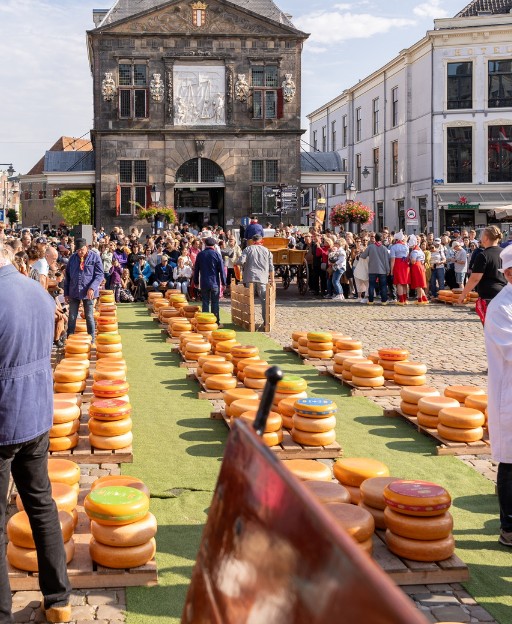
The famous cheese market still operates on Thursday mornings in summer, with porters in traditional white costumes carrying vast wooden boards of Gouda wheels across the cobbled Markt square. It is one of the great Dutch spectacles, but it is far from the only reason to visit. Gouda’s town hall, its stained glass, its stroopwafel bakeries, and its canal-lined streets offer a complete picture of the Dutch Golden Age at a fraction of the crowd pressure of Amsterdam or Delft.
Getting to Gouda
Gouda has direct train connections from both Rotterdam (25 minutes) and Amsterdam (45 minutes via Alphen aan den Rijn, or 55 minutes direct on the intercity). The train station sits a 10-minute walk from the Markt, Gouda’s central square. No bus or taxi is necessary — the entire old centre is easily walkable from the station.
Gouda also makes a natural stop on a day combining Delft and Rotterdam, or as part of a wider Netherlands itinerary. The town takes around four to five hours to explore properly, making it ideal for a half-day extension rather than a standalone full day from Amsterdam.
The Gouda Cheese Market
The traditional cheese market runs on Thursday mornings from 10:00 to 12:30, every week from April through August. It takes place on the Markt, in front of the 15th-century Stadhuis (town hall), and follows a ritual that has changed little in centuries. Producers bring their cheeses by cart; buyers sample and negotiate; porters carry the purchased wheels on specially shaped wooden boards, moving in a distinctive bouncing trot to transfer the load to the weighing house.
The Waag (weighing house), a 1668 building on the Markt, houses a small cheese museum on the upper floor explaining the weighing and trading process. Entry costs a few euros and gives context to what you see playing out on the square below. The Waag building itself, with its distinctive Dutch gable and painted exterior carvings, is worth examining up close.
If you visit outside market day, do not assume the cheese experience is over. The surrounding streets hold numerous cheese shops selling all varieties of Gouda — from young (jong) wheels that are mild and springy to aged (oud) cheese that is hard, crystalline, and intensely flavoured. The craft cheese shops around Gouda let you taste before you buy.
Gouda’s Town Hall
The Stadhuis on the Markt is one of the finest Gothic town halls in the Netherlands. Builders completed it in 1450, and its red and white painted façade with elaborate shutters and a central carillon tower makes it the focal point of the square in every season. The carillon plays on the hour, and the automatic knights that emerge from the clock mechanism draw small crowds each time.
The interior of the Stadhuis opens for tours on certain days and includes the original council chambers. Even without a tour, the exterior rewards an extended look — the stone carving details around the windows and the stepped gable roofline represent the very best of late-Gothic municipal architecture in the Low Countries.
Sint Janskerk and the Famous Stained Glass
Gouda’s Church of Saint John (Sint Janskerk) holds the largest collection of 16th-century stained glass windows in the Netherlands. The church stretches 123 metres in length, making it the longest church building in the country, and the 72 stained glass windows along its nave and transepts transform the interior into a gallery of light and biblical narrative.
The windows depict scenes ranging from the life of John the Baptist to allegorical figures representing justice and charity. Several windows carry donor portraits of powerful figures from the Reformation period, including William of Orange. The windows escaped the destruction of the Reformation in the 1570s because Gouda’s city council purchased them before the iconoclasts arrived — one of the more fortunate decisions in Dutch art history. Entry costs a small fee; the church is open daily except Sunday mornings.
Museum Gouda
Museum Gouda occupies the former Catharine Gasthuis, a medieval hospice complex near the Markt. The collection covers Dutch paintings from the 15th to the 20th century, including works by artists who trained or worked in Gouda, alongside decorative art, medieval objects, and a section on the history of the city’s industries.
The museum’s De Moriaan building — a separate 17th-century merchant’s house — focuses on the history of clay pipes, which Gouda produced in enormous quantities for three centuries and exported across Europe. The pipe museum is an unexpectedly absorbing detour, particularly the displays showing the different techniques for pressing, drying, and firing the long white pipes that Dutch traders carried worldwide.
Stroopwafels in Gouda
The stroopwafel — two thin waffle layers sandwiching a caramel syrup — originates in Gouda. Gerard Kamphuisen invented it in 1810 in his Gouda bakery, and the treat has since become one of the most recognisable Dutch food exports. In Gouda itself, several bakeries still make stroopwafels fresh on rotating waffle irons, selling them warm by the piece. The difference between a fresh warm stroopwafel eaten at the source and the vacuum-sealed version in a foreign supermarket is considerable.
The Kamphuisen name lives on in at least one Gouda bakery, and the tradition of eating a stroopwafel perched on top of a hot coffee cup — warming the syrup from below — remains a genuinely observed ritual rather than a tourist performance.
Walking the Canals and Side Streets
Gouda’s historic centre rewards aimless walking more than many Dutch cities its size. The canals radiate outward from the Markt, and the streets between them contain merchant’s houses, 17th-century warehouses, and gabled facades that receive little attention outside the town itself. The Pottersstraat and Westhaven areas preserve stretches of waterfront that look essentially unchanged from the Golden Age.
The Gouda by foot experience shares something with Haarlem — a compact, beautifully intact Dutch city where the absence of large tourist infrastructure has kept the architecture and atmosphere genuine. Gouda simply lacks Haarlem’s proximity to Amsterdam, which in practice means fewer visitors and more space.
Practical Tips for Your Gouda Day Trip
- Cheese market timing: Arrive by 09:30 if you want to photograph the setup before the Markt fills. The market peaks between 10:30 and 11:30 and winds down by 12:15.
- Best day to visit: Thursday (for the cheese market) from April to August. Outside this period, Gouda is quieter but still fully open.
- Train tip: From Amsterdam, take the intercity via Utrecht or the direct via Alphen aan den Rijn. Check the NS app for the current fastest route; times vary by departure.
- Cheese buying: Most cheese shops will vacuum-pack purchases for travel. Aged Gouda (18 months or more) travels better than young Gouda without refrigeration.
- Stroopwafels fresh: Look for bakeries with the words “vers gebakken stroopwafels” (freshly baked stroopwafels) in the window. These are markedly superior to pre-packaged versions.
- Parking: If driving, use the P+R facility at Goudaplein on the edge of town and walk in. Parking in the centre is limited and expensive on market days.
Frequently Asked Questions
When does the Gouda cheese market take place?
The traditional Gouda cheese market runs every Thursday morning from 10:00 to 12:30, from April through the end of August. It takes place on the Markt, directly in front of the historic Stadhuis (town hall). Outside these months, Gouda runs a smaller winter market on the Markt on some Thursdays, but the full traditional cheese-weighing ceremony only operates during summer season.
How far is Gouda from Amsterdam?
Gouda is approximately 45 to 55 minutes from Amsterdam by direct intercity train, depending on the route. Trains run several times per hour from Amsterdam Centraal. From Rotterdam, the journey takes around 25 minutes. Gouda station is a 10-minute walk from the town centre and Markt.
Is there more to see in Gouda than the cheese market?
Yes. The church of Sint Janskerk holds the largest collection of 16th-century stained glass in the Netherlands. Museum Gouda covers Dutch Golden Age painting, medieval objects, and the city’s pipe-making history. The town hall (Stadhuis) dates to 1450 and is one of the finest Gothic civic buildings in the country. Gouda also claims the origin of the stroopwafel, and several bakeries sell them fresh. A full visit rewards four to five hours of exploration beyond the market itself.
What is the difference between young and aged Gouda cheese?
Young Gouda (jong, aged 4–8 weeks) is mild, smooth, and slightly springy — the variety most commonly exported internationally. Aged Gouda (oud, 18 months or more) is hard, deeply golden, and develops caramel and butterscotch flavours with crunchy crystals of tyrosine. Most shops in Gouda offer tastings so you can compare before buying. For travel, aged Gouda keeps better without refrigeration.
You Might Also Enjoy
- Rotterdam, Netherlands: Your Complete City Guide for 2026
- Haarlem Day Trip from Amsterdam: The Complete 2026 Guide
- Alkmaar Day Trip from Amsterdam: The Complete Guide
Plan Your Netherlands Trip
Planning your Dutch adventure? Visit our Start Here guide for itinerary ideas, travel tips, and everything you need to make the most of the Netherlands.
Join Netherlands Lovers
Every week, discover the Netherlands beyond the tourist trail — hidden villages, local recipes, cycling routes, and travel insights you won’t find in any guidebook.
Subscribe free — enter your email:
Love more? Join 64,000 Ireland lovers → · Join 43,000 Scotland lovers → · Join 30,000 Italy lovers →
Free forever · One email per week · Unsubscribe anytime
Tours & experiences you might love


Powered by Viator. Some links are affiliate links — we may earn a small commission at no extra cost to you.