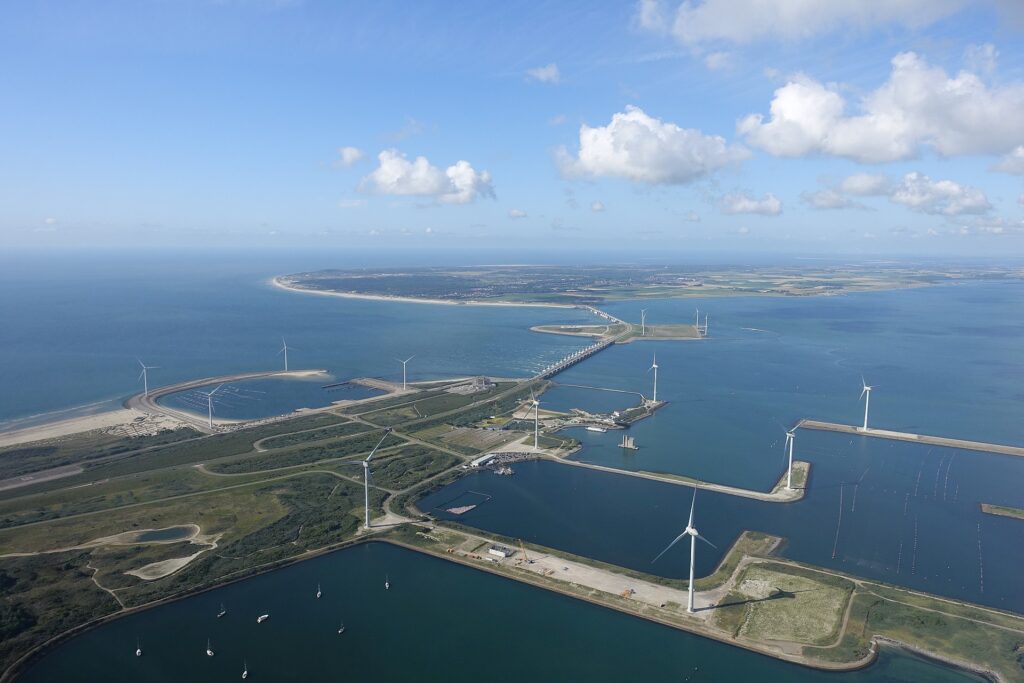
Zeeland’s islands and storm barriers reveal the Dutch mastery of water—and the warmth of coastal towns that survived catastrophe.
Love Netherlands
Dear Netherlands,
There’s an old saying in the Netherlands: God made the world, but the Dutch made Holland. Drive across Zeeland, past the Delta Works, and you start to understand. Or stand at Kinderdijk at sunrise, when the windmills catch the first light and the canals are mirror-flat, and you can feel 800 years of stubbornness built into the landscape.
If the daily newsletter brings you closer to the Netherlands, our Sunday Premium Edition takes you deeper into it. Every Sunday you’ll receive travel deep dives, curated itineraries, regional stories, and lesser-known places you won’t find anywhere else.
The dyke near Ouwerkerk runs straight as a Roman road, its grass crown worn smooth by centuries of footsteps. On one side, the fields of North Brabant stretch inland. On the other, the Oosterschelde glints grey-green, and you can feel the weight of water pressing against the ancient earthwork. This is Zeeland’s ordinary miracle: a province where geography and human stubbornness have written the landscape together. Zeeland—meaning “sea-land”—sits in the Netherlands’ southwestern corner, a fragmented archipelago of islands and peninsulas that jut into the North Sea and the Rhine delta. It’s connected by the Delta Works , the engineering complex built after the catastrophic flood of 1953. To visit Zeeland is to understand, viscerally, why the Dutch have always been a people who build walls against the sea—and why they’ve learned to live, with characteristic pragmatism and even joy, on the…
Café Hoppe on the Spui has been pouring beer since 1670 — long enough that the wooden floor has sunk slightly at the door from three and a half centuries of footfall. It’s the kind of place where the bartender knows the regulars’ orders, the tourists get treated exactly the same as the locals, and the bitterballen come out exactly hot enough to burn the roof of your mouth if you don’t wait. It sits right in the middle of the city, a few minutes’ walk from the Dam, and it’s one of the last genuinely authentic brown cafés you can still find without trying. Come in the late afternoon, sit outside on the pavement, and order a beer.
On a Thursday evening, the Vismarkt fills with students balancing paper cones of fried eierbal—rounded croquettes of ragout that burst with cream and spiced meat—while cyclists…
The Maas river curves lazily around Maastricht , and on a Saturday morning, the city’s oldest square fills with the smell of fresh bread, grilled cheese, and the particular…
Water meets cobblestone in Utrecht , and the difference is immediate. Sit at a café along the Oudegracht with a coffee cooling in front of you, and you’ll notice what makes…
The Mauritshuis sits so close to the water of the Hofvijver that on still mornings, the seventeenth-century townhouse and its gabled reflection seem to occupy the same space. It’s…
The Erasmus Bridge appears first as you approach Rotterdam by train—a white swan of steel and cable suspended over the Maas, its single pylon rising like a bent neck against the…
The bullet holes are still there. Two of them, embedded in the wooden doorframe of the Prinsenhof Museum , where Balthasar Gérard’s musket fire killed William of Orange on 10 July 1584. They sit at chest height, dark punctures in pale oak, as real and immediate as anything in this small town between The Hague and Rotterdam . Stand close enough and you can feel the weight of a moment that changed everything—not just for the Dutch Revolt, but for…
A bitterbal is a small, crumb-coated sphere of slow-cooked beef ragout, deep-fried until crisp and served burning hot with a dish of sharp Dutch mustard. Walk into any brown café on a weekday evening and you’ll see them on half the tables. The rules are: wait two minutes so you don’t burn your mouth, bite off the top to let the steam escape, dip in mustard, eat in two bites, and order another round. Their name has nothing to do with being bitter — it’s from the old Dutch word bittertje, an aperitif served at pre-dinner hour. The name stuck long after jenever stopped being the drink of choice.
If you’re enjoying this letter, the best thing you could do is forward it to one friend who’d love the Netherlands too. This newsletter grows by word of mouth alone — every single subscriber came from someone sending it to someone else. Thank you for being one of the first.
Our daily newsletter is free and always will be. But for less than the price of a pint, you can upgrade to our Sunday Premium Edition, which gives you access to our travel deep dives, curated itineraries, and regional stories. Consider buying us a stroopwafel — it’s the Dutch way to say thank you.
Also From Our Family
Love Ireland too? Over 64,000 readers wake up each morning to the Love Ireland newsletter — loveireland.substack.com
The best Scottish rugby updates, straight to your inbox — Six Nations, the Nations Championship, Glasgow and Edinburgh. Only when there's something worth reading.
A newsletter for Londoners who want to rediscover their own city. Travellers planning their first or fifth visit. Anglophiles who fell in love with London through literature, film, or a rainy afternoon on the South Bank.