

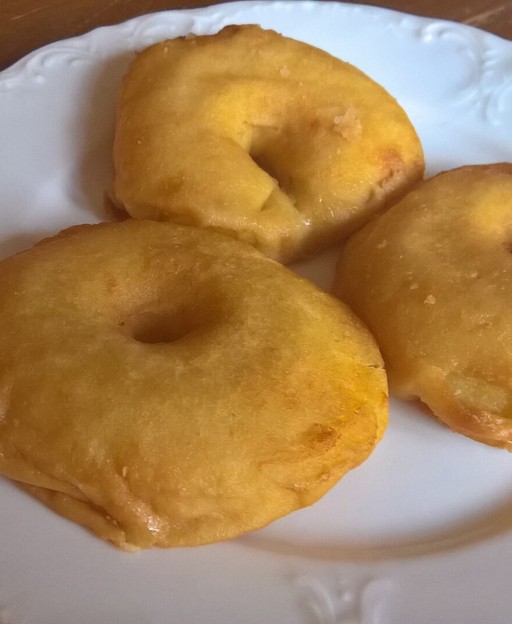
A ring of apple, a coat of batter, a minute or two in hot oil and a roll in cinnamon sugar. Appelbeignets are the other half of the Dutch New Year’s Eve plate, and they are easier to make at home than oliebollen: no yeast, no waiting.
Free Netherlands Travel Guide
The Ultimate Netherlands Travel Guide (PDF), 2026 edition. All 12 provinces in one place. Free when you join our newsletter.
Second Place on New Year’s Eve
The oliebol is king on 31 December, but the apple ring is the runner-up. In December 2025 the Dutch bakers’ association NVB told NL Times that it expected the plain oliebol, with or without raisins, to make up about 80 percent of sales. Most of the rest, it said, would be apple fritters and other fried treats.
A French Word for a Bump
The name came from France. According to the Etymological Dictionary of Dutch, “appelbeignets” is in print in Dutch by 1863, in a household dictionary called the Woordenboek voor het Praktische Leven. The French beignet comes from beigne, a bump or swelling, and by 1605 it meant a filled, fried piece of dough: a fried “bump”. In regional French, beigne also came to mean a clout, the blow that causes the bump.
They have long been a home-kitchen treat, too. A 1933 family photo by the photographer Willem van de Poll, now free to view on Wikimedia Commons, shows his wife Nell Langlais at the stove, frying appelbeignets in a pan of oil.
Beignet or Flap?
Here is where the Dutch start arguing. Dutch-born writer Nicole Holten of The Dutch Table calls the battered rings appelbeignets, and points out they are not doughnuts at all, even if the cored apple slice gives them a doughnut look. Food blogger Stefan Gourmet makes exactly the same battered rings for a New Year’s party and calls them appelflappen.
In Alkmaar, Talitha Klaassen of the old-Dutch sweet shop Inde Soete Suyckerbol told NH Nieuws on New Year’s Eve 2018 that her battered apple treats, made to her mother’s and grandmother’s recipe, are “real appelflappen, not beignets”. One customer loved them “with the hole in it”. Whatever you call them, the apple is the secret: hers had to be a Goudreinet from a good greengrocer.
Where to taste it: Inde Soete Suyckerbol on the Voordam in Alkmaar, facing the cheese market square, sells its oliebollen until 18:00 on 31 December. In 2018 it also fried its old-Dutch apple rings; ask in the shop what is on this year. Otherwise, any oliebollen stall in December will have appelbeignets next to the bollen.
Appelbeignets (Dutch Apple Rings in Batter)
Ingredients
Method
- Whisk the flour, baking powder, salt and sugar in a bowl. Add the egg and milk and whisk to a smooth batter, a little thicker than pancake batter. Add a splash more milk if it is too thick.
- Heat the oil to 180°C / 350°F in a deep-fat fryer, or in a heavy pan with at least 5 cm (2 in) of oil. Use a thermometer and never leave the oil alone.
- Peel the apples, remove the cores with an apple corer and cut each apple across into 5 rings, about 1 cm (3/8 in) thick. Pat them dry with kitchen paper.
- Mix the sugar and cinnamon on a plate. Press each ring into the cinnamon sugar on both sides; keep what is left over.
- Dip a ring into the batter, coating it all over, and lower it straight into the hot oil. Fry 3-4 at a time for 2-3 minutes, turning once, until golden on both sides.
- Lift out with a slotted spoon, drain on kitchen paper and toss in the leftover cinnamon sugar, or dust with icing sugar. Eat warm.
Notes
Frequently Asked Questions
What is the difference between an appelbeignet and an appelflap?
In most recipes an appelbeignet is a ring of apple fried in batter, and an appelflap is apple folded in puff pastry. But the names are used loosely: some cooks call the battered rings appelflappen too (Stefan Gourmet, NH Nieuws).
Which apples work best?
Firm apples that hold their shape: the Dutch use Elstar, Jonagold or Cox (Andrea Janssen). The Dutch Table suggests Honeycrisp, Pink Lady or Golden Delicious in the US, and not Granny Smith.
Can I make them ahead?
Not really: the batter goes soft as they sit, so eat them the same day. If you need them to keep, the puff-pastry version stays crisp overnight (The Dutch Table).
Sources: NL Times, 30 December 2025; Etymologiebank (Etymologisch Woordenboek van het Nederlands); Fotocollectie Van de Poll, 1933 (Wikimedia Commons); The Dutch Table; Stefan Gourmet; NH Nieuws, 31 December 2018; Andrea Janssen; Inde Soete Suyckerbol. Checked November 2026.
Free Netherlands Travel Guide
The Ultimate Netherlands Travel Guide (PDF), 2026 edition. All 12 provinces in one place. Free when you join our newsletter.
Tours & experiences you might love


Powered by Viator. Some links are affiliate links — we may earn a small commission at no extra cost to you.